

Quick answer: Seven automotive logistics trends 2027 budgets must absorb are already visible: diesel above $6 a gallon, tighter truck capacity from driver rules, wider broker liability, bigger cargo theft losses, annual USMCA reviews, the November 9, 2026 end of the vessel fee suspension, and an EV market resetting at a lower base.
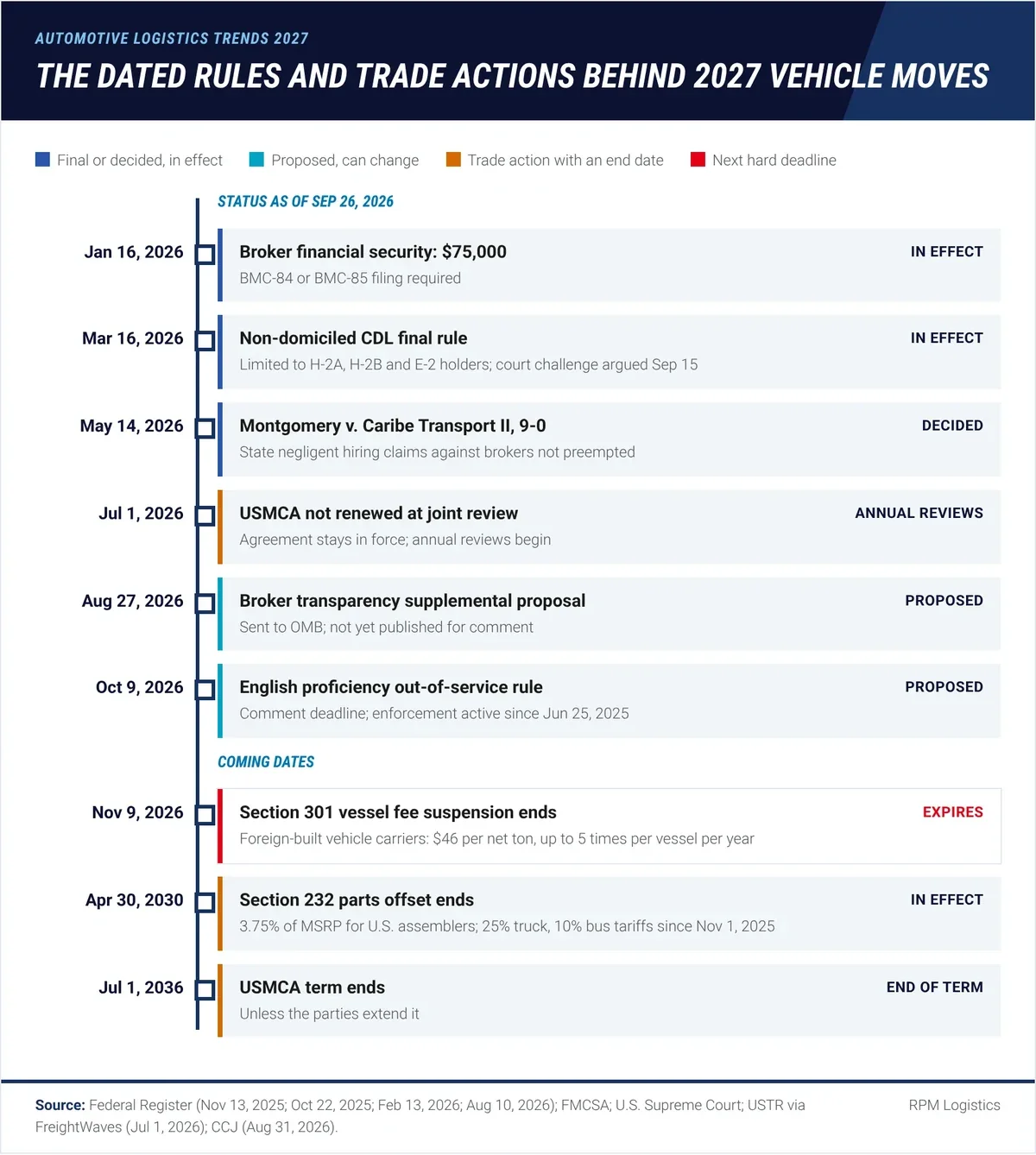
Status is as of September 26, 2026. Two items on this line can still move before 2027: the vessel fee suspension and the broker transparency proposal.
Automotive logistics is the planning and movement of vehicles and parts from plant or port to dealers, fleets and remarketing lanes. Finished vehicle logistics is the slice that moves completed vehicles by truck, rail and ship. This article looks at that slice and asks one question: what changes the cost, risk or timing of a vehicle move in 2027?
Our mid-2026 analysis of the automotive logistics market is the baseline. It covers market size, production volumes and the five forces of early 2026. This piece does not repeat those numbers. It tracks what moved between May and late September 2026 and turns each shift into a planning step. No source here is dated after September 26, 2026.
The seven trends at a glance
The seven trends fall into three groups: cost of the move, risk on the move, and rules behind the move. The table below names each trend, the dated signal behind it, and who feels it first.
Trend | Dated signal | Who feels it first |
|---|---|---|
1. Diesel above $6 | $6.529 a gallon, week of Sep 21, 2026 (EIA) | Every truck lane, through fuel surcharges |
2. Driver rules tighten capacity | Tender rejections at 14.32% after Labor Day 2026 (FreightWaves) | Spot and surge volume |
3. Broker liability widens | Montgomery v. Caribe Transport II, May 14, 2026 | Shippers whose brokers cut corners on carrier selection |
4. Fewer thefts, bigger losses | $304.6 million in Q2 2026 losses (Verisk CargoNet) | High-value and high-volume vehicle loads |
5. USMCA goes annual | U.S. declined renewal, Jul 1, 2026 | Mexico and Canada sourced vehicles |
6. Vessel fees can return | Suspension ends Nov 9, 2026 | Imported vehicles on foreign-built car carriers |
7. EV base resets lower | 5.8% EV share in Q2 2026 (Cox Automotive) | OEM and fleet EV programs |
Trend 1: Diesel above $6 rewrites transport budgets
The biggest cost trend going into 2027 is fuel. The U.S. on-highway diesel average reached $6.529 a gallon in the week of September 21, 2026, according to the Energy Information Administration (EIA). The same series stood at $3.749 a year earlier and $3.477 in the first week of January 2026.
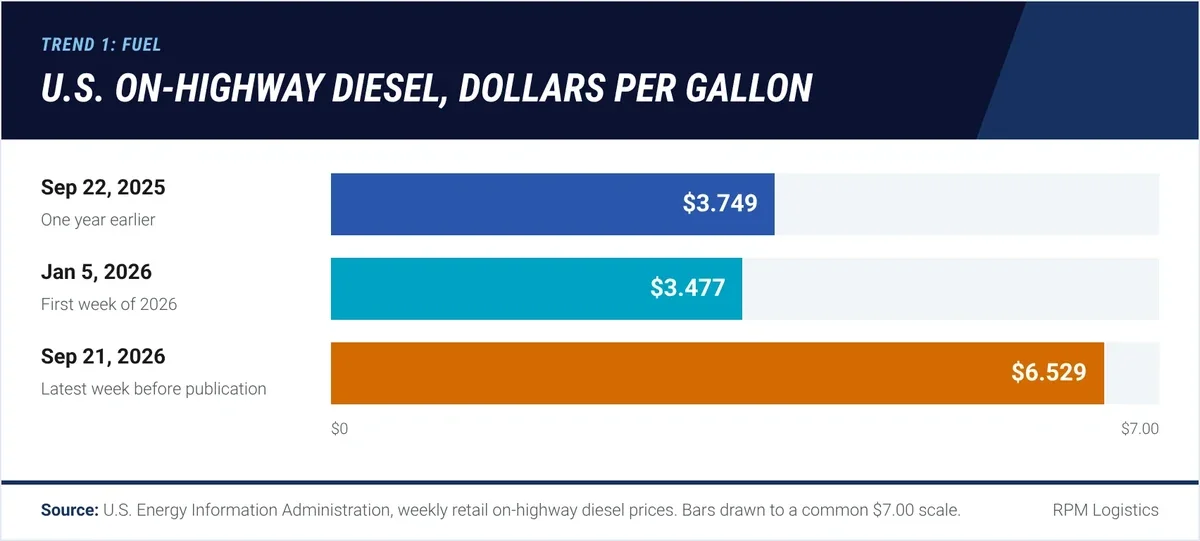
Weekly prices move fast. A surcharge table indexed to the weekly EIA number keeps the rate honest in both directions.
What changed
Diesel jumped in March 2026 and never fell back to its January level. The EIA series went from $3.897 on March 2 to $5.375 by March 23. After a summer dip to $4.578 in early July, it climbed again through September. A haulaway truck burns diesel on every loaded and empty mile, so the price lands in every quote.
What to do
- Separate line haul from fuel surcharge in every 2027 rate agreement.
- Index the surcharge to the weekly EIA national or regional average, with a stated base price.
- Re-run mode comparisons, because fuel moves the truck side faster than rail. Our rail versus truck break-even worksheet shows which inputs to update.
Trend 2: Driver eligibility rules are tightening truck capacity
Truck capacity is tightening, and FreightWaves analysis names driver enforcement among the main causes. FreightWaves reported the Outbound Tender Rejection Index at 14.32% in the days after Labor Day 2026. That post-holiday spike ran well above the same point in 2025. On September 10, its van spot index sat at $3.43 a mile, including fuel.
What changed
Two federal actions removed drivers from the pool. FMCSA began enforcing English language proficiency as an out-of-service violation on June 25, 2025. Its August 10, 2026 proposed rule counts 60,399 violations through March 19, 2026, with 19,045 resulting in out-of-service orders.
The non-domiciled CDL final rule took effect March 16, 2026. It limits those licenses to H-2A, H-2B and E-2 visa holders. Overdrive reported it affects some 194,000 of about 200,000 non-domiciled CDL holders. The D.C. Circuit heard the challenge on September 15, 2026, and the rule stays in force for now.
Carriers expect the squeeze to reach 2027 contracts. In FreightWaves coverage dated September 17, 2026, Werner projected a 10% to 13% rise in one-way rate per total mile for Q3 2026. It also expects "strong" contract increases in the 2027 bid season.
What to do
- Lock 2027 lane commitments early, before the bid season resets rates.
- Build surge capacity into contracts instead of relying on the spot market.
- Give longer pickup windows on non-urgent moves so carriers can build full loads.
Trend 3: Broker liability now extends to carrier selection
Broker liability means a freight broker can now be sued under state law for negligently choosing an unsafe carrier. The Supreme Court decided Montgomery v. Caribe Transport II 9-0 on May 14, 2026. It held that the FAAAA safety exception preserves negligent hiring claims against brokers.
What changed
The ruling does not make brokers liable for every crash. Justice Kavanaugh addressed this in a concurrence. Brokers who select reputable carriers and act reasonably "should be able to successfully defend against state tort suits," he wrote. The practical test is documentation: what the broker checked, and when.
The ruling arrived on top of two other broker rules. Since January 16, 2026, brokers must keep $75,000 in financial security under the BMC-84 or BMC-85 filing. A supplemental broker transparency proposal went to the White House budget office on August 27, 2026, CCJ reported. That proposal is not yet a rule.
Some brokers are narrowing who they use. FreightWaves reported on September 17, 2026 that Schneider cut its approved carrier list to 14,000 from a peak of 60,000. After Montgomery, other brokers have the same reason to tighten.
What to do
- Ask each broker for its written carrier selection criteria and how it documents them.
- Confirm the broker's financial security filing is active before tender.
- Ban undisclosed re-brokering in the contract. Our guide on how to prevent double brokering lists the checks.
Trend 4: Cargo crime means fewer thefts but bigger losses
Cargo crime in 2026 shows fewer incidents and larger losses per incident. Verisk CargoNet counted 677 supply chain theft incidents in Q2 2026, down 26% year over year. Estimated losses still reached $304.6 million, against $135.7 million in Q2 2025.
What changed
The average Q2 2026 theft was valued at $564,009 (Verisk CargoNet, Aug 6, 2026). CargoNet logged 158 fictitious pickups in the quarter, against 165 a year earlier. Each theft that does succeed now costs far more. The pattern held across 2025, when CargoNet estimated $725 million in U.S. and Canadian losses, up 60%, on 2,646 confirmed thefts. Q1 2026 brought 767 events, down 5.3% year over year, with $131.58 million in estimated losses. Our cargo theft statistics reference sets out each data source and its scope.
What to do
- Assign a value tier to each load before tender, and match controls to it.
- Require that the carrier name on the rate confirmation matches the truck at the gate.
- Record a VIN-level condition report at origin and delivery.
Trend 5: USMCA now faces an annual review
The USMCA annual review is the yearly renegotiation cycle the agreement entered when the United States declined to renew it. On July 1, 2026, U.S. Trade Representative Jamieson Greer said the U.S. "did not agree to renew the USMCA in its current form," FreightWaves reported. The agreement stays in force, with yearly joint reviews until its term ends on July 1, 2036.
What changed
Talks did not stop at the review. Automotive rules of origin were on the agenda in two negotiating rounds, White & Case reported. Those rounds ran May 28 to 30 and June 16 to 17, 2026. FreightWaves reported U.S.-Mexico bilateral talks resuming the week of July 20, 2026. No change to the auto rules of origin had been announced as of September 26, 2026.
The stakes for vehicle flows are large. U.S.-Mexico trade hit a record $872.83 billion in 2025, and U.S.-Canada trade reached $712.76 billion, per the same report. Section 232 tariffs also look settled for years. Proclamation 10984 extended the 3.75% of MSRP parts offset for U.S. assemblers through April 30, 2030. Since November 1, 2025, it has applied a 25% tariff to medium and heavy-duty trucks and a 10% tariff to buses.
What to do
- Price cross-border lanes for one year at a time, with a review clause tied to each USMCA review.
- Keep a second border crossing qualified for high-volume Mexico lanes.
- For commercial truck and bus imports, budget the 232 duty into landed cost before transport.
Our guide to Mexico cross-border finished vehicle logistics covers documentation and crossing options.
Trend 6: Vessel fees on car carriers can return after November 9
The Section 301 vessel fee is a U.S. charge on Chinese-linked and foreign-built ships calling at U.S. ports. For foreign-built vehicle carriers, USTR set it at $46 per net ton from October 14, 2025, charged up to five times per vessel per year. USTR then suspended all of the fees, per a November 13, 2025 Federal Register notice.
What changed
The fee basis itself changed in 2025. The original April 2025 action priced vehicle carriers per car equivalent unit (CEU) of capacity. USTR's October 16, 2025 notice switched the basis to net tons at $46. Any budget still built on a per-CEU figure is out of date.
The suspension runs through 11:59 p.m. Eastern on November 9, 2026. On September 23, 2026, a coalition of trade associations asked USTR to extend it, in a letter published by the National Foreign Trade Council. As of September 26, 2026, no extension had been announced. Who pays a returning fee depends on the terms of each ocean contract.
What to do
- Check whether your ocean contracts allow a pass-through of government fees.
- Ask your ocean carrier now how it will bill the fee if the suspension lapses.
- Prepare compound and inland capacity for uneven arrivals. Our piece on port congestion and finished vehicle throughput explains where vehicle backlogs form.
Trend 7: The EV market resets at a lower base
The EV reset is the drop in electric vehicle sales after the federal EV tax credit ended on September 30, 2025. Cox Automotive counted 247,226 EVs sold in Q2 2026, a 5.8% share of new-vehicle sales. That compares with a record 10.6% share in Q3 2025, just before the credit expired.
What changed
The decline is slowing. EV sales fell 20.5% year over year in Q2 2026, after a 27.3% drop in Q1, per Cox Automotive's Q2 2026 EV report. Q4 2025 had fallen 36%. Tesla held roughly half of EV sales in Q2 2026, and Toyota and Subaru doubled their EV volumes year over year. Hybrids are growing. Cox projected first-half hybrid sales up about 9%, while the total new-vehicle market fell 2.2%.
What to do
- Plan EV transport volume from current sales, not from 2025 targets.
- Keep EV handling rules in place for the units that do move, including state of charge and weight.
- Expect more hybrid volume on the same lanes, with no special handling class.
Fleets phasing in EVs can follow our ICE-to-EV fleet transition sequencing guide.
Which trends hit which vehicle shippers
The same trend lands differently on an OEM, a dealer group, a remarketer and a fleet. The table below maps each shipper type to the trends that change its 2027 plan most.
Shipper type | Trends with the most exposure | First planning step |
|---|---|---|
OEM and importer | 5 (USMCA), 6 (vessel fees), 7 (EV base) | Model landed cost under fee and no-fee cases for Q4 2026 arrivals |
Dealer group | 1 (diesel), 2 (capacity), 4 (theft) | Separate fuel from line haul and set value tiers for high-line units |
Remarketer and auction | 2 (capacity), 3 (broker liability), 4 (theft) | Ask brokers for carrier selection criteria before peak lanes |
Corporate and rental fleet | 1 (diesel), 2 (capacity), 7 (EV base) | Commit core lanes early and rebase EV delivery volume |
Commercial truck and bus buyers sit across these rows. Their imports carry the Section 232 duty, so trend 5 belongs in their landed-cost budget.
Signals we are watching but not counting yet
A watch-list signal is a development that could shape 2027 but lacks a confirmed date or final text. Three items sit here as of September 26, 2026.
- FMCSA Motus registration, Phase II: the Federal Register placed it in Q2 2026. We found no confirmation that it launched.
- Freight fraud legislation: no federal freight fraud bill had passed as of September 2026.
- Broker transparency final rule: the supplemental proposal must still publish, take comments and clear a final rule.
Regulatory and trade status board, September 2026
A regulatory status board lists each rule or trade action by its legal stage on a fixed date. The table below is current as of September 26, 2026. Proposed items can change. Final items apply now.
Item | Stage | Key date | Vehicle shipper exposure |
|---|---|---|---|
Broker and freight forwarder financial responsibility | Final, in effect | Jan 16, 2026 | Confirm $75,000 security is on file |
Non-domiciled CDL rule | Final, in effect; court challenge argued | Effective Mar 16, 2026 | Fewer eligible drivers |
Montgomery v. Caribe Transport II | Decided, 9-0 | May 14, 2026 | Broker carrier selection under scrutiny |
USMCA joint review | Not renewed; annual reviews | Jul 1, 2026; term to Jul 1, 2036 | Cross-border cost uncertainty each year |
English proficiency out-of-service rule | Proposed; enforcement already active | Comments due Oct 9, 2026 | Fewer eligible drivers |
Broker transparency | Supplemental proposal at OMB | Sent Aug 27, 2026 | Possible access to broker rate records |
Section 301 vessel fees | Suspended | Ends Nov 9, 2026 | Fee on foreign-built car carriers can return |
Section 232 parts offset; truck and bus tariffs | In effect | Offset to Apr 30, 2030; tariffs since Nov 1, 2025 | Landed cost of trucks and buses |
How to turn the trends into a 2027 transport plan
A 2027 transport plan should treat cost, capacity and rules as three separate budget lines. Fuel and capacity drive cost. Theft and broker liability drive risk. Trade actions drive timing and landed cost.
- By October 2026: separate fuel from line haul in every rate agreement and set the index.
- By November 9, 2026: confirm how a returning vessel fee would flow through your ocean contracts.
- Before the 2027 bid season: lock core lanes and surge terms, and ask brokers for carrier selection criteria.
- Each quarter: re-check EV volume, theft data and the status board above.
Frequently Asked Questions
What are the top three trends in automotive logistics for 2027?
The top three are fuel, capacity and liability. Diesel averaged $6.529 a gallon in the week of September 21, 2026, per EIA. Tender rejections topped 14% after Labor Day, while driver rules shrink the pool. The Supreme Court's May 2026 Montgomery ruling allows state negligent hiring claims against brokers. Together they raise the cost and scrutiny of every truck move in 2027.
Will vehicle transport costs go up in 2027?
Most signals point up. Diesel is far above its January 2026 level, and truckload capacity is tightening as fewer drivers qualify. Werner, a large truckload carrier, expects strong contract rate increases in the 2027 bid season. Shippers can limit the impact by indexing fuel separately, committing core lanes early and giving carriers wider pickup windows on flexible moves.
Is the US auto industry struggling in 2026?
Demand is softer but not collapsing. Cox Automotive projected the U.S. new-vehicle market down 2.2% in the first half of 2026. EV sales fell 20.5% year over year in Q2 2026 after the federal tax credit ended. Cox projected hybrid sales up about 9% in the first half. For logistics, that means slightly lower overall volume and a shift in powertrain mix.
What happens to USMCA after the 2026 joint review?
USMCA stays in force. The United States declined to renew it on July 1, 2026, which moves the three countries into yearly joint reviews. The agreement runs until July 1, 2036, unless the parties extend it or a country withdraws. Vehicle shippers should expect cross-border rules and costs to come up for discussion every year.
When do the Section 301 vessel fees resume?
The suspension ends at 11:59 p.m. Eastern on November 9, 2026. Unless USTR extends it, fees can apply again after that date. For foreign-built vehicle carriers, the fee was set at $46 per net ton, up to five times per vessel per year. Trade groups asked USTR on September 23, 2026 to extend the suspension.
Plan your 2027 vehicle moves with RPM
RPM arranges vehicle transport across all 50 states and Canada and manages booking, documentation, condition reporting and coordination with a national network of contracted, independently operated carriers. To plan 2027 lanes around these trends, or to subscribe to updates, contact the RPM team.