

Quick Answer
To store a classic car for winter, move it before road salt season, ideally in an enclosed trailer, to a dry and secure space. Wash it, address the fuel and connect a battery maintainer. Keep the tires fully inflated and use a breathable cover. Document its condition going in and coming out.
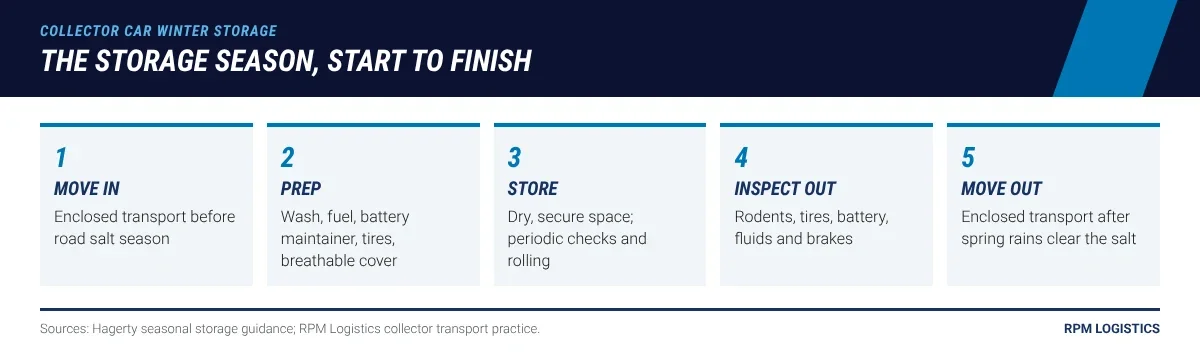
The transport legs bookend the season: move in before the first salted road, move out after the spring rains rinse it away.
What is collector car winter storage?
Collector car winter storage is the seasonal practice of taking a classic, vintage or high-value car off the road for the cold months. The car is prepared, moved to a protected space and kept there until spring. Done right, it comes out in the same condition it went in.
The value at stake keeps rising. Monterey Car Week auctions set a record of $756 million in sales in 2026 (Hagerty, 2026). Owners protecting cars at that level treat storage as part of ownership, not an afterthought.
Winter storage has three parts:
- The move in, from the owner's garage or last event to the storage site.
- The storage itself, with preparation and periodic checks.
- The move out, back to the owner or straight to the first spring event.
Most storage guides cover only the middle part. The transport legs are where many collector cars pick up their winter damage.
When should you move a classic car into winter storage?
You should move a classic car into winter storage before road crews start salting, not after the first snow. Road salt and brine cling to undercarriages and wheel wells, and they keep working on metal all winter if the car is stored dirty.
Plan the inbound move around:
- Your local salting schedule, which often starts with the first freezing forecast.
- Your last drive or event of the season.
- Transport capacity, since fall is busy for enclosed carriers moving cars to storage and auctions.
- Facility intake dates, as many storage sites fill up early.
Shipping the car in an enclosed trailer avoids the problem entirely. The car never touches a wet or salted road, and it arrives clean enough to go straight into storage. Our guide to soft-tie vs. hard-tie enclosed transport explains how classic cars are secured in transit.
How do you prepare a classic car for winter storage?
You prepare a classic car for winter storage by protecting its fuel system, battery, tires, paint and interior from months of sitting. Cars do not like to sit, so the goal is to limit the damage that sitting causes.
Fuel
Ethanol-blended gasoline is the main concern. Hagerty notes that E10 is widely quoted as having a shelf life of only about 30 days, and ethanol absorbs water over time. The traditional approach is to fill the tank, add stabilizer as directed and run the engine briefly to circulate it. Some owners prefer ethanol-free fuel for storage where it is available.
Battery
For a stay longer than a week, Hagerty recommends disconnecting the negative terminal. For a full winter, especially in an unheated space, use a battery maintainer or a three-stage charger. If a battery has dropped below about 11.5 volts, remove it before charging it.
Tires
Tires can develop flat spots after about six months of sitting, according to Hagerty. Keep them fully inflated. Roll the car a few feet every few months, or use jack stands for storage longer than a season.
Engine and fluids
Before storage, run the engine long enough to drive out condensation. Hagerty suggests about 15 minutes, until water stops dripping from the tailpipe. Many owners also change the oil before storage so used oil does not sit in the engine all winter.
Body and interior
- Wash and dry the car, including the undercarriage, before it goes in.
- Clean the interior and remove any food or wrappers that attract rodents.
- Use a breathable cover, which Hagerty calls a must unless the space has active air filtration.
- Block rodent entry points, such as the exhaust tip and air intake, and leave a note on the steering wheel.
Hagerty's seasonal storage mythbusting guide covers these steps in more depth. It also debunks the old belief that concrete floors drain batteries.

Chrome bumpers, original paint and a soft top are exactly what a damp winter attacks; dry storage and a breathable cover do most of the protecting.
What should you look for in a winter storage facility?
You should look for a winter storage facility that is dry, secure, insured and easy to reach. Dryness matters more than almost anything else, because humidity drives rust, mold and electrical problems.
Factor | What to look for | Why it matters |
|---|---|---|
Climate | Dry space, ideally climate controlled, on a sealed floor | Humidity causes rust and mold; dirt or gravel floors trap moisture |
Security | Cameras, alarms, controlled access and staff on site | Collector cars are theft targets even in storage |
Power | Outlets at each space for battery maintainers | Batteries discharge over a full winter |
Insurance | The facility's coverage and your own policy terms in storage | Gaps between the two can leave a loss uncovered |
Access | Clear rules on visits, checks and release | You may need to start, roll or inspect the car |
Loading | Room for an enclosed trailer to load and unload | Tight driveways raise the risk of damage at handoff |
Ask how the facility handles release. A car should leave only with the owner or a carrier the owner has named in writing. That rule matters as much in storage as at a dealer or auction.
Indoor, covered or outdoor: which storage is right for a classic?
Indoor storage is the right choice for nearly every classic car that will sit all winter. Covered and outdoor options cost less, but they leave the car exposed to the humidity, temperature swings and pests that storage is meant to prevent.
- Climate-controlled indoor storage keeps humidity and temperature steady. It is the best fit for original paint, leather, wood trim and older wiring.
- Unheated indoor storage, such as a dry garage or warehouse, works well with a breathable cover and a battery maintainer.
- Covered outdoor storage, such as a carport, keeps snow off but not moisture or rodents.
- Outdoor storage is a last resort for a collector car, even under a cover.
A home garage can be a good option if it is dry and secure. Long-term storage away from home, beyond one season, raises other questions covered in our guide to long-term car storage.
Do you need insurance changes for winter storage?
You may need to review your insurance for winter storage, but you should not drop it. A stored car can still be damaged by fire, flood, theft or a falling roof, and those risks need comprehensive coverage.
Before the move, confirm:
- Your policy covers the car at the storage address, not just your home garage.
- The car's agreed value is current, using a resource such as Hagerty's valuation tools.
- Transport is covered during both moves, through the carrier's cargo insurance and your own policy.
- Any storage-only option your insurer offers, and what it excludes.
Our guide to agreed value vs. actual cash value explains how collector coverage works during transport.
How should a classic car be transported to and from storage?
A classic car should be transported to and from storage in an enclosed trailer with soft-tie securement whenever possible. It keeps the car out of salt, rain and road debris, and it protects the work you did to prepare it.
For each leg:
- Book early, since fall and spring are busy for enclosed carriers.
- Share the car's details: whether it runs, ride height, fragile trim and any leaks.
- Confirm both addresses, gate rules and contacts at the storage site.
- Record condition at pickup with a photo report covering every panel, the wheels and the interior.
- Inspect at delivery and note anything new before signing.
A car that does not run after storage can still be moved. Tell the carrier in advance so it brings a winch. Our guide to moving non-running classics without damage covers the equipment involved.
Why should you document condition going in and coming out?
You should document condition going in and coming out because it is the only way to prove when damage happened. Without dated records, a scratch found in spring could be blamed on the storage site, the carrier or the owner.
A strong storage record includes:
- Photos at pickup for the inbound move, from every angle.
- A storage-in report from the facility, with mileage and any notes.
- Logs of checks during the season, if the facility offers them.
- A storage-out report before the car leaves.
- Photos at delivery for the outbound move.
The same standard applies to any high-value move. Our guide to insurance-grade condition reporting shows what each report should capture.
What should you do when the car comes out of storage?
When the car comes out of storage, inspect it before you drive it far. Months of sitting can leave tires soft, brakes sticky and rodents in places you would not expect.
- Look for rodent signs under the hood, in the air box and in the cabin.
- Check tire pressure and look for flat spots or cracking.
- Reconnect or check the battery and confirm it holds a charge.
- Check fluids for level and leaks under the car.
- Test the brakes at low speed before any road drive.
- Remove intake and exhaust blockers and the reminder note.
Flat spots usually round out once the car is driven, according to Hagerty. Some cars go straight from storage to a spring show. Shipping that leg keeps a freshly woken car off the highway. Our guide to event and rally transport for classic cars covers that leg.
How RPM supports seasonal collector car moves
RPM Logistics moves classic, collector and luxury cars between homes, storage facilities, shops and events across all 50 states and Canada. Enclosed transport with soft-tie securement is the standard for collector moves, and every move includes photo condition reports at pickup and delivery.
Collectors moving several cars can schedule them together on one enclosed trailer, which simplifies timing at both the home and the storage site. For larger collections, see our guide to relocating a luxury vehicle collection. To book, start with our enclosed car transport service.
Frequently asked questions
How do you store a classic car for winter?
Move it before road salt season to a dry, secure space. Wash it, address the fuel and battery, keep the tires inflated and use a breathable cover. Document its condition going in and coming out.
Should you fill the gas tank before winter storage?
The traditional advice is to fill the tank, add stabilizer as directed and run the engine briefly. Hagerty notes that E10 fuel is widely quoted as having a shelf life of about 30 days.
Should you start a classic car during winter storage?
Briefly starting a car without driving it can leave condensation in the engine and exhaust. If you run it, run it long enough to reach full temperature, or keep it on a battery maintainer instead.
How do you prevent flat spots on stored tires?
Keep the tires fully inflated and roll the car every few months. For storage longer than a season, use jack stands. Hagerty notes flat spots can develop after about six months.
Is it better to ship a classic car to winter storage?
Shipping in an enclosed trailer keeps the car off salted and wet roads. It arrives clean and ready for storage, with a condition report from pickup.
What should a winter storage facility provide?
Look for a dry space on a sealed floor, strong security and power for battery maintainers. Clear access and release rules matter too, along with room for a trailer to load and unload.
Plan both legs of your storage season
Winter storage protects a collector car only if the moves in and out protect it too. RPM Logistics schedules enclosed pickup before salt season and delivery when you are ready to drive. Request a quote for your storage moves.