

Quick answer: Cross border lithium battery shipping by truck is legal in both directions. A load from the US can enter Canada under 49 CFR if it meets section 9.1 of Canada's TDG Regulations. Loads from Canada enter the US under 49 CFR 171.12. Mexico requires its own NOM standards, a Mexican-permitted carrier and a Carta Porte invoice.
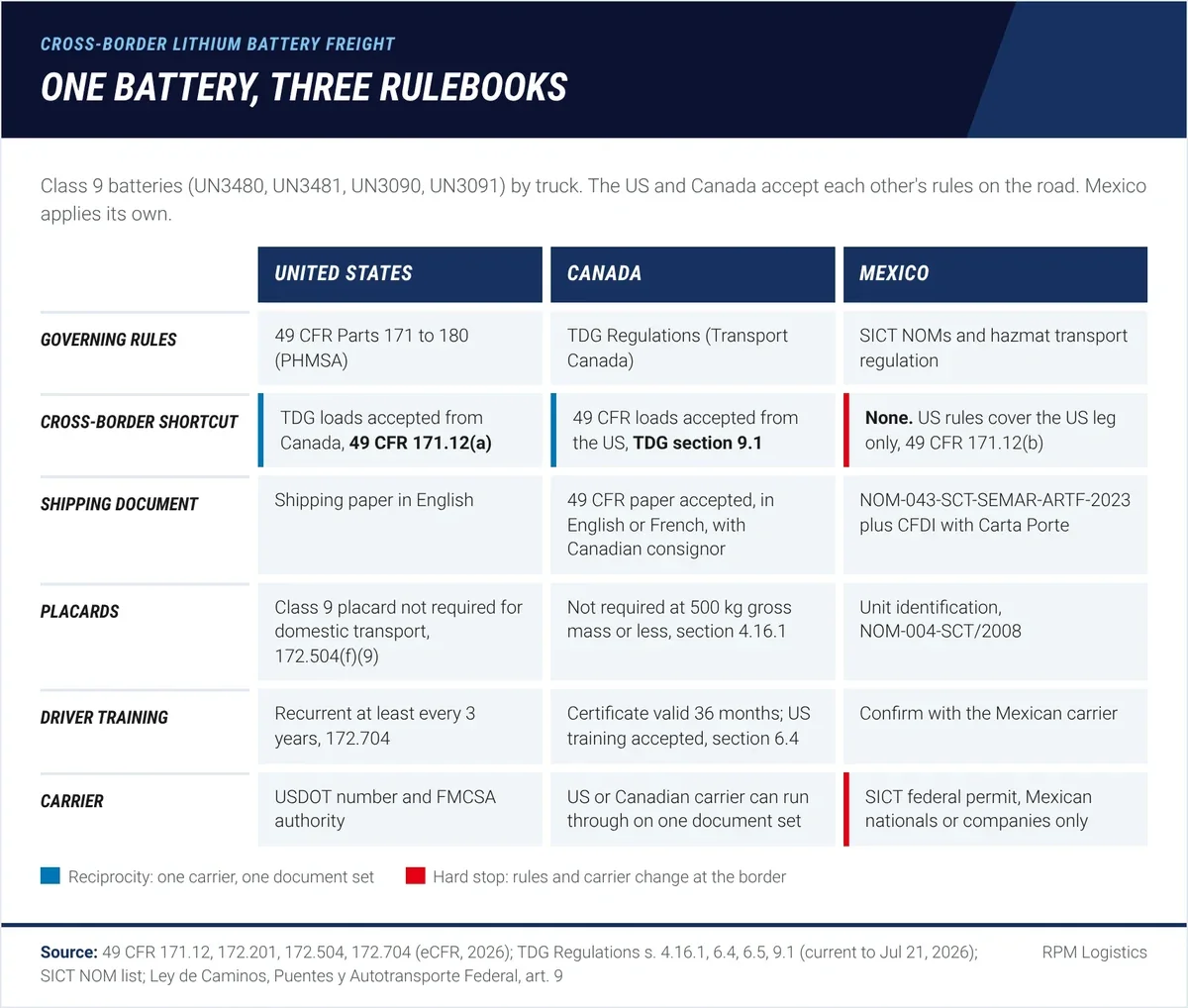
The US and Canada accept each other's rules on the road. Mexico does not, so a southbound load changes paperwork and carrier at the border.
Cross-border lithium battery freight is lithium cells and batteries moving by truck between the US and Canada or Mexico. The batteries ship as Class 9 dangerous goods under four UN numbers: UN3480, UN3481, UN3090 and UN3091. Each country regulates the leg on its own soil. The skill is knowing which rule set governs the whole trip and where it stops.
This guide covers ground and truck moves only. Air and ocean exports are covered in our guide to shipping lithium batteries internationally under IATA and IMDG. For the full US rule set, start with the lithium battery transport compliance guide.
Why the truck lanes carry North American battery trade
Trucks are the default mode for North American freight. The Bureau of Transportation Statistics 2025 transborder report counted $1.6 trillion of freight across both borders. That was down 1.0% from 2024 (BTS, 2026). Trucks moved $1.0 trillion of it, up 0.7% (BTS, 2026).
The split by border shows where truck dependence is highest. The table below uses the BTS annual figures for 2025.
Border | All-mode freight value, 2025 | Change vs 2024 | Truck freight value | Truck share |
|---|---|---|---|---|
US-Canada | $712.8 billion | Down 6.4% | $396.8 billion | 55.7% |
US-Mexico | $872.8 billion | Up 3.9% | $642.2 billion | 73.6% |
Batteries sit inside a large category. Electrical machinery, equipment and parts made up 21.3% of US-Mexico truck freight, or $136.9 billion (BTS, 2026). BTS does not break out lithium batteries on their own. Still, the category tells you how many electrical loads share the same border lanes and inspection lines.
The rules that travel with the battery in all three countries
The constants are the UN classification, the testing and the packaging logic. All three countries build on the UN Model Regulations. A battery that is UN3480 in Laredo is UN3480 in Monterrey and Windsor. If you need the basics first, read whether lithium batteries count as hazmat.
- UN 38.3 testing. Under 49 CFR 173.185(a)(3), makers and distributors of cells made after January 1, 2008 must make a test summary available. Our guide to UN 38.3 test summary documentation covers what it must contain.
- Size thresholds. The 49 CFR 173.185(c) exceptions apply to lithium ion cells up to 20 Wh and batteries up to 100 Wh. For lithium metal, the limits are 1 g per cell and 2 g per battery.
- Packaging. Fully regulated batteries need UN specification packaging in all three countries. Each country cites its own standard for it.
One rule does not travel: the 30% state-of-charge limit. That cap comes from air rules for lithium ion batteries shipped alone. The highway rules in 49 CFR 173.185 set no state-of-charge cap for trucks. Some top-ranking guides and AI answers still apply 30% to every mode. Our breakdown of lithium battery state-of-charge rules explains where the limit applies.
US, Canada and Mexico compliance crosswalk
A compliance crosswalk is a side-by-side view of how each country handles the same requirement. The table below maps the requirements a carrier or shipper will be asked about at the border. US entries cite 49 CFR, Canadian entries cite the TDG Regulations, and Mexican entries cite SICT standards.
Requirement | United States | Canada | Mexico |
|---|---|---|---|
Governing rules | 49 CFR Parts 171 to 180 (PHMSA) | TDG Regulations (Transport Canada) | Reglamento para el Transporte Terrestre de Materiales y Residuos Peligrosos plus SICT NOMs |
Cross-border shortcut | TDG-compliant loads accepted from Canada, 49 CFR 171.12(a) | 49 CFR-compliant loads accepted from the US, TDG section 9.1 | None. US rules apply to the US leg only, 49 CFR 171.12(b) |
Hazmat list | Hazardous Materials Table, 49 CFR 172.101 | Schedule 1 | NOM-002-SCT-SEMAR-ARTF/2023 |
Shipping document | Shipping paper, 49 CFR Part 172 Subpart C | Shipping document, TDG Part 3 | NOM-043-SCT-SEMAR-ARTF-2023 plus CFDI with Carta Porte |
Document language | English, 49 CFR 172.201(a)(2) | English or French | Confirm with the Mexican carrier |
Vehicle placards | Class 9 placard not required for domestic transport, 49 CFR 172.504(f)(9) | Not required at 500 kg gross mass or less, TDG section 4.16.1 | Unit identification under NOM-004-SCT/2008 |
Training | Recurrent every 3 years, 49 CFR 172.704 | Certificate valid 36 months for road; US training accepted, TDG section 6.4 | Confirm with the Mexican carrier |
Carrier authority | USDOT number and FMCSA operating authority | Carrier duties under TDG section 3.2; confirm provincial carrier rules | SICT federal permit, Mexican nationals or companies only |
Emergency response | Emergency response information and phone number, 49 CFR Part 172 Subpart G | ERAP only where Schedule 1 assigns an ERAP index | Emergency information under NOM-005-SCT/2008 |
Read the table as a map, not a substitute for the text of each rule. The sections below explain the entries that cause the most rejected loads.
US to Canada: how TDG section 9.1 lets a 49 CFR load cross
TDG section 9.1 is the Canadian rule that lets a road shipment cross from the US under 49 CFR. It covers the classification, marking, labelling, placarding and documentation requirements. It applies to loads from the US into Canada and from Canada into the US. It also covers loads moving from the US through Canada to a place outside Canada, such as Alaska.
The consolidated TDG text used here is current to July 21, 2026. Canada amended the TDG Regulations in June 2026 through an international harmonization update registered June 4, 2026. Confirm transition dates with Transport Canada before relying on a section number.
What the shipping document must show
The 49 CFR shipping paper is accepted with additions. Section 9.1(1)(a) requires the information to be legible, in indelible print, and in English or French. It must also include:
- The name and address of the consignor's place of business in Canada, for loads to or from Canada.
- The name and address of each consignor, for loads crossing Canada to another country.
- ERAP information, if an ERAP applies.
The carrier also follows three Canadian documentation sections. These are 3.2 on carrier responsibilities, 3.7 on where the document sits in a road vehicle, and 3.10 on storage in transit.
When the 49 CFR shortcut does not apply
Section 9.1(2) removes the shortcut for goods forbidden under TDG and goods regulated in Canada but not under 49 CFR. It also excludes 49 CFR mark or packaging exceptions that Canada does not permit. That last point matters for small-battery exceptions. Before a carton moves under a 49 CFR exception, check that Canada allows the same one.
Importers have one more task. Transport Canada's lithium battery guidance says importers must obtain a proof of classification under TDG section 2.2.1. The same page warns importers to screen for counterfeit batteries.
Placards when the load is reshipped inside Canada
A load that enters Canada and is then reshipped domestically falls under section 9.4. The 49 CFR marks on packages may stay. The large means of containment, such as the trailer, must carry placards under TDG Part 4. Under section 4.16.1, no placard is required when the dangerous goods weigh 500 kg gross mass or less. Goods that need an ERAP lose that exemption.
Driver training across the line
Canada accepts US hazmat training for US-licensed drivers. Under TDG section 6.4, a document showing training under 49 CFR 172.700 to 172.704 counts as a valid training certificate. It stays valid while it is valid in the US. A Canadian-issued certificate for road transport expires 36 months after issue, under section 6.5.
Does a battery load need an ERAP?
An Emergency Response Assistance Plan (ERAP) is a Transport Canada-approved plan for responding to a release. Section 7.2 ties the requirement to the ERAP index in column 7 of Schedule 1. If your UN number has no index there, no ERAP is triggered. Check the Schedule 1 entry for the exact UN number before you book.
Canada to US: what 49 CFR 171.12 accepts
49 CFR 171.12 is the US rule for North American shipments. Under paragraph (a)(1), a hazardous material may move by motor carrier or rail under the TDG Regulations. That covers loads from Canada into the US, from the US into Canada, and across the US. The conditions in 171.22 and 171.23 still apply.
Four US obligations stay on the load even under TDG. Section 171.22(g) keeps them in force:
- Emergency response information under 49 CFR Part 172 Subpart G.
- Hazmat employee training under Part 172 Subpart H, including function-specific training.
- Security requirements under Part 172 Subpart I.
- Incident reporting under 171.15 and 171.16 for incidents inside the US.
Lithium batteries get a specific line. Section 171.12(a)(6) requires excepted packages shipped under TDG to carry the 173.185(c) marks or labels. A Canadian carton marked only to Canadian rules can be stopped on that point. Our guide to lithium battery marking failures shows the common errors. Under 171.22(f)(2), a carrier may not accept the load without a shipper's certification.
US training also has its own clock. New hazmat employees must finish training within 90 days, and recurrent training runs at least once every 3 years (49 CFR 172.704, 2026).
US to Mexico: NOM standards, SICT permits and Mexican carriers
Mexico has no reciprocity shortcut for US hazmat rules. Under 49 CFR 171.12(b), shipments to or from Mexico must meet all applicable US requirements while in the US. At the border, Mexican rules take over. The Secretaría de Infraestructura, Comunicaciones y Transportes (SICT) issues the standards and the carrier permits.
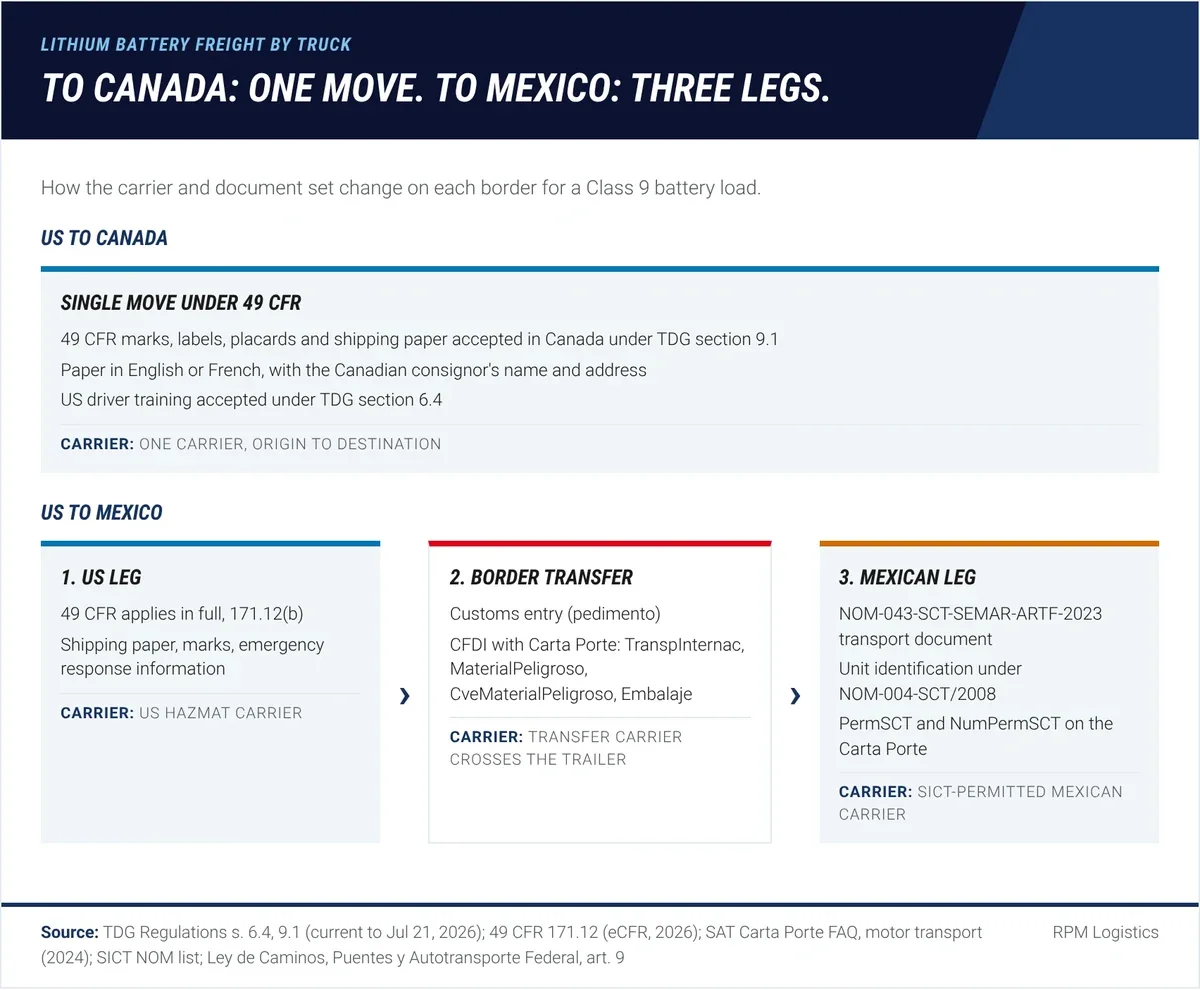
A load into Canada can keep one carrier and one document set. A load into Mexico changes carrier and adds Mexican documents at the border.
The carrier changes, not only the paperwork. Mexico's federal motor transport law is the Ley de Caminos, Puentes y Autotransporte Federal. Its Article 9 reserves carrier permits for Mexican nationals and Mexican companies. In practice, a US-origin battery load moves in legs: a US carrier, a border transfer, then a Mexican carrier. The customs side of that handoff is covered in our guide to Mexico cross-border finished vehicle logistics.
SICT publishes the hazmat standards in force on its list of hazardous materials NOMs. The table below covers the ones a battery shipper is most likely to be asked about. Dates come from the Mexican government's standards catalog.
Standard | What it covers | Published in the DOF | In force |
|---|---|---|---|
NOM-002-SCT-SEMAR-ARTF/2023 | List of dangerous goods, including UN3480, UN3481, UN3090 and UN3091 as Class 9 | December 18, 2023 | February 16, 2024 |
NOM-002-1-SCT-SEMAR-ARTF/2023 | Packing instructions and use of packagings | July 29, 2024 | January 25, 2025 |
NOM-007-SCT-2-2022 | Construction, UN marking and testing of packagings | December 1, 2022 | May 30, 2023 |
NOM-003-SCT/2008 | Labels on packages | August 15, 2008 | In force |
NOM-004-SCT/2008 | Identification of transport units (placards) | August 18, 2008 | In force |
NOM-005-SCT/2008 | Emergency information for transport | August 14, 2008 | In force |
NOM-043-SCT-SEMAR-ARTF-2023 | Dangerous goods transport document | May 27, 2024 | November 23, 2024 |
Two of these replaced older standards that many guides still cite. NOM-002-SCT-SEMAR-ARTF/2023 cancelled NOM-002-SCT2/2011. NOM-043-SCT-SEMAR-ARTF-2023 replaced NOM-043-SCT/2003 as the shipping document standard. If a Mexican partner's checklist names the 2011 or 2003 versions, it is out of date.
The Mexican carrier also needs a SICT federal permit that covers hazardous materials. Ask for the permit type and number before tender. Both appear on the Carta Porte.
Carta Porte: the Mexican tax document that carries hazmat data
The Carta Porte is a complement to Mexico's electronic invoice (CFDI) that documents goods in transit. The SAT, Mexico's tax authority, requires it for international moves as well as domestic ones. For hazmat, it carries dedicated fields that identify the dangerous goods.
The SAT Carta Porte FAQ for motor transport lists the fields a battery load touches:
- MaterialPeligroso set to "Sí", with CveMaterialPeligroso (the hazmat code) and Embalaje (packaging) both completed.
- TranspInternac set to "Sí" for a border crossing, with customs documentation, country of origin or destination, and entry or exit route.
- The pedimento (Mexican customs entry) number, unless another customs document applies.
- PermSCT and NumPermSCT, the carrier's permit type and number.
- AseguraMedAmbiente and PolizaMedAmbiente, the environmental insurance fields.
The FAQ also places the issuing duty at the border. The carrier that presents the goods at customs issues the CFDI with Carta Porte. It then provides the fiscal folio for the customs dispatch document. SAT updates the complement's version over time, so confirm the current one with your billing provider.
Border-crossing checklist for lithium battery freight
A border-crossing checklist is the sequence of checks that keeps a battery load from being held at the line. Run it before tender, not at the dock.
- Confirm the UN number and regulated status. Match each SKU to UN3480, UN3481, UN3090 or UN3091 and confirm fully regulated or excepted status.
- Pull the UN 38.3 test summary. Match the summary to the exact cell and battery model shipped.
- Check the exception in the destination country. A 49 CFR exception works in Canada only if TDG permits the same exception.
- Build the shipping document for the whole route. Northbound, add the Canadian consignor and use English or French. Southbound, prepare the NOM-043-SCT-SEMAR-ARTF-2023 document.
- Confirm placards for each leg. Check 49 CFR 172.504 in the US, the 500 kg TDG test in Canada and NOM-004-SCT/2008 in Mexico.
- Verify driver training and carrier authority. Check US training records, TDG certificates and the Mexican carrier's SICT permit.
- Complete customs and Carta Porte data. Line up the pedimento, the hazmat fields and the environmental insurance fields before the truck reaches the border.
The US leg has its own detail. Our guide to transporting lithium batteries by road under 49 CFR 173.185 covers segregation, packaging and carrier rules.
Frequently Asked Questions
Can you ship lithium batteries from the US to Canada by truck?
Yes. TDG section 9.1 lets a road shipment from the US enter Canada using 49 CFR classification, marks, labels, placards and documents. The shipping document must be in English or French and show the Canadian consignor's name and address. Goods forbidden under TDG, and 49 CFR exceptions Canada does not permit, fall outside that allowance. Canadian importers must also hold proof of classification.
Can you ship lithium batteries to Mexico by truck?
Yes, but the load changes rule sets at the border. The US leg follows 49 CFR. In Mexico, the goods follow SICT standards such as NOM-002-SCT-SEMAR-ARTF/2023 and NOM-043-SCT-SEMAR-ARTF-2023. A Mexican carrier with a SICT federal permit hauls the Mexican leg. The move also needs a CFDI with the Carta Porte complement, including the hazmat and international transport fields.
Does the 30% state-of-charge limit apply to trucks crossing the border?
No. The 30% state-of-charge cap comes from air transport rules for lithium ion batteries shipped on their own. The highway provisions in 49 CFR 173.185 set no state-of-charge limit for trucks. A cross-border truck load does not need batteries discharged to 30%. Check the charge level again if the batteries will later move by air.
Do US drivers need TDG training to haul batteries into Canada?
Not separate TDG training in most cases. Under TDG section 6.4, Canada accepts a document showing a US-licensed driver was trained under 49 CFR 172.700 to 172.704. It stays valid while it is valid in the United States. US rules require that hazmat training be repeated at least once every three years.
Does a lithium battery load into Canada need an ERAP?
Only if the TDG Regulations assign an ERAP index to the battery's UN number. Section 7.2 ties the ERAP requirement to column 7 of Schedule 1 and the quantity carried. Check the Schedule 1 entry for UN3480, UN3481, UN3090 or UN3091 before booking. If an ERAP applies, its reference must appear on the shipping document under section 9.1.
What documents does a lithium battery truckload need to enter Mexico?
Plan for four sets. You need the US shipping paper for the US leg and the UN 38.3 test summary. You also need the Mexican dangerous goods transport document under NOM-043-SCT-SEMAR-ARTF-2023. Finally, you need the customs entry (pedimento) and a CFDI with Carta Porte. The Carta Porte must mark the load as hazardous and carry the carrier's SICT permit.
Plan Your Next Cross-Border Battery Load
RPM arranges transport across all 50 states and Canada, managing booking, documentation and coordination with contracted, independently operated carriers. To check a battery lane before you tender, Request a Compliance Review.