

Quick Answer
Shipping lithium UPS batteries for a data center is a Class 9 hazmat move under 49 CFR 173.185. A UPS cabinet with batteries installed ships as batteries contained in equipment. Loose battery modules ship as batteries alone. Units of 12 kg or more with strong casings can ship on pallets or in crates. Every design needs UN 38.3 test records.
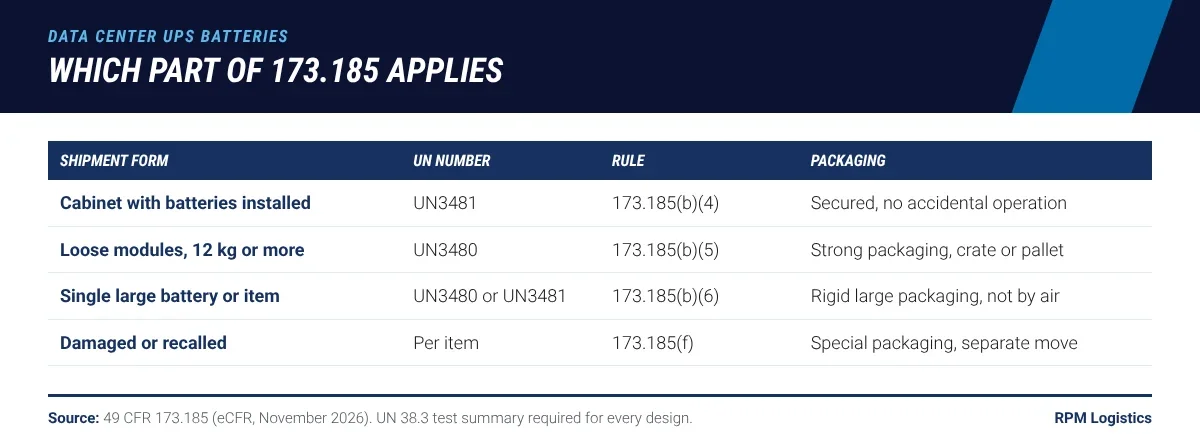
The first question is whether the batteries are installed, loose or damaged. Each answer points to a different paragraph of 173.185.
Why UPS Battery Moves Are Growing
A UPS (uninterruptible power supply) keeps servers running in the seconds between a grid failure and generator start. In a data center, that means rows of battery cabinets or racks sized to the facility's load.
Data centers are adding load fast. They used about 4.4% of U.S. electricity in 2023, or 176 TWh (Lawrence Berkeley National Laboratory, 2024). The same report projects 6.7% to 12% by 2028 (Lawrence Berkeley National Laboratory, 2024). More load means more UPS capacity, and more battery shipments to build it.
Lithium-ion has become a common choice for new UPS systems because of its smaller footprint and longer service life. That shift turns a routine electrical delivery into a hazmat shipment.
UPS Batteries Versus Grid Storage
Data center UPS batteries and grid-scale battery energy storage systems both use lithium-ion. They are not shipped the same way. A BESS container is a large, self-contained unit with its own UN number in some cases. RPM covers those moves in its guide to UN3536 battery energy storage system transport.
UPS batteries arrive as cabinets, racks or individual modules. They fall under the standard lithium battery rules in 49 CFR 173.185. The form the shipment takes decides which part of that rule applies.
How 173.185 Applies to UPS Shipments
Cabinets with batteries installed
A UPS cabinet that ships with its batteries already inside is batteries contained in equipment, UN3481. Under 173.185(b)(4), the equipment must be secured against movement inside its packaging and protected from accidental operation. Any outer packaging must be strong enough for the weight and the trip. The rule allows an exception when the equipment itself gives the batteries equivalent protection. Spare batteries packed with the cabinet follow the packaging rules for batteries alone.
Loose battery modules
Modules shipped separately for installation on site are batteries alone, UN3480. Under 173.185(b)(5), batteries of 12 kg (26.5 lb) or more with a strong, impact-resistant casing may ship in strong outer packagings, in protective enclosures such as crates, or on pallets. They must be secured against shifting and short circuits. Most UPS modules clear the 12 kg mark.
Single large batteries
Under 173.185(b)(6), a single battery or a single item of equipment can ship in a rigid large packaging. This option is for ground and vessel moves, not aircraft.
Damaged or recalled batteries
Batteries removed after a failure, a thermal event or a recall fall under separate, stricter rules in 173.185(f). Do not ship them on a standard install order. RPM's guide to shipping damaged and defective lithium batteries covers that path.
Paperwork and Testing
Every lithium cell and battery design must pass UN 38.3 testing before it ships. The manufacturer must make a test summary available, and shippers should have it on file before the first load. RPM explains what that document must show in its guide to UN 38.3 test summary documentation.
A fully regulated Class 9 shipment also needs shipping papers, emergency response information, marks and labels. The shipping paper requirements in 49 CFR Part 172, Subpart C set what the papers must include. The shipper is responsible for getting these right, even when the carrier provides the truck.
One common question is state of charge. The 30% limit people hear about is an air rule. It covers batteries shipped alone and, since January 1, 2026, batteries packed with equipment. It does not apply to ground moves. See RPM's explainer on lithium battery state of charge rules for the detail.
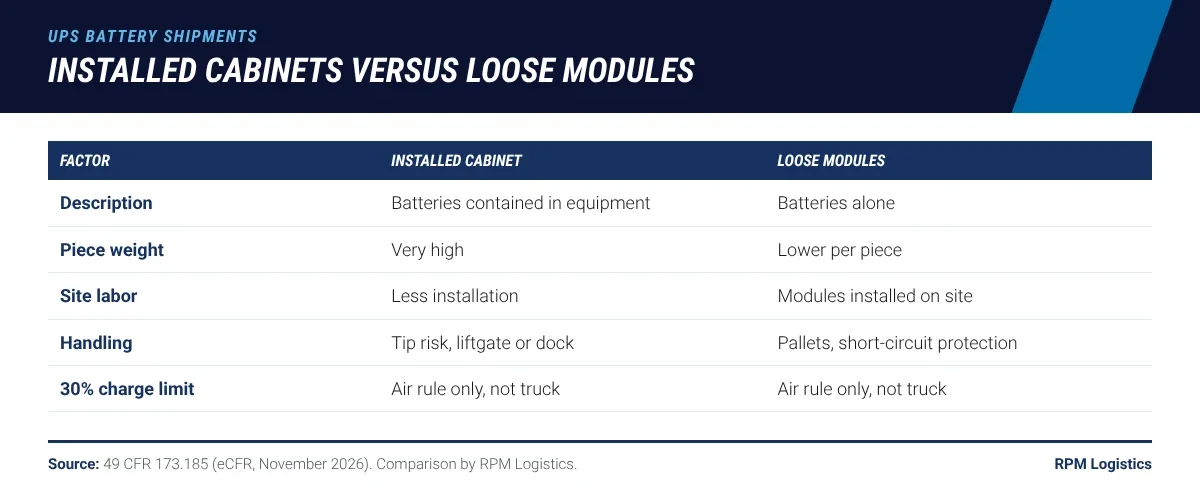
Shipping modules separately lightens each piece but adds hazmat line items. Shipping installed cabinets cuts site labor but raises piece weight.
Handling and Delivery at the Data Center
Most UPS battery problems on a data center job are not regulatory. They are physical. A cabinet can weigh well over a thousand pounds, and data centers have strict receiving rules.
Plan for these before booking:
- Dock or liftgate. Confirm whether the site has a dock at trailer height. If not, the load needs a liftgate rated for the piece weight, or a forklift on site.
- Receiving windows. Many data centers accept deliveries only at set times, with advance notice and named drivers.
- Tip and shock protection. Tall cabinets can tip during loading. Tilt and shock indicators on the crate show whether a unit was mishandled.
- Load securement. Pieces must be blocked and braced so they cannot shift. Shifting is a damage risk and a short-circuit risk.
- Staging space. Battery cabinets often arrive before the room is ready. Confirm where they will wait and under what fire code limits.
Storage on site is its own question. RPM's guide to lithium battery warehousing and NFPA 855 covers storage limits for staged batteries.
LTL or Truckload for UPS Batteries
Small replacement orders can move LTL with a carrier that accepts Class 9 freight. Full builds usually need truckload. A dedicated truck avoids extra handling at terminals, keeps the delivery window tight and lets the driver meet site check-in rules. RPM compares the two in its guide to lithium battery LTL versus truckload.
Lead-acid UPS systems still exist in many facilities. Valve-regulated lead-acid batteries follow different rules for non-spillable batteries in 49 CFR 173.159a. Do not assume a lithium plan works for a lead-acid swap, or the reverse.
Common Mistakes on UPS Battery Jobs
Most failed UPS battery deliveries share a few causes. None of them are hard to prevent.
- Booking a general freight carrier. Not every carrier accepts Class 9 loads. Confirm hazmat acceptance before you tender, not at pickup.
- Missing test summaries. A shipper that cannot produce the UN 38.3 test summary on request has a compliance gap. Collect it from the OEM before the first truck.
- Underestimating piece weight. A cabinet quoted at its empty weight can exceed a liftgate's rating once batteries are installed. Use the shipping weight with batteries.
- Arriving outside the window. A truck that misses a data center's receiving slot may wait hours or be turned away. Build buffer into the transit plan.
- Mixing damaged returns with new stock. Batteries pulled after a failure cannot ride back on a standard return. Separate them and ship them under the damaged battery rules.
Pre-Shipment Checklist for a UPS Battery Move
- Confirm the chemistry and whether batteries ship installed, loose or damaged.
- Collect the UN 38.3 test summary for every battery design.
- Assign the UN number and prepare shipping papers, marks and labels.
- Choose packaging under the correct paragraph of 173.185.
- Confirm piece weights, dimensions and whether a liftgate or dock is needed.
- Book the site's receiving window and send driver details in advance.
- Plan blocking, bracing and tip protection for tall cabinets.
- Confirm where units will be staged on arrival.
Working With a Transport Partner
A UPS battery job touches the OEM, the electrical contractor, the general contractor and the data center operator. The transport plan has to fit all four. Share the bill of materials, piece weights and site rules early.
RPM Logistics moves lithium battery freight in all 50 states and Canada. Its lithium battery transport service covers battery-only and equipment shipments. For the broader rule set, see RPM's lithium battery transport compliance guide and its walkthrough of transporting lithium batteries by road under 173.185.
Frequently Asked Questions
Is a UPS with lithium batteries considered hazmat?
Yes. Lithium-ion batteries are Class 9 hazardous materials. A UPS cabinet shipped with batteries installed moves as UN3481, batteries contained in equipment. Loose modules move as UN3480, batteries alone.
Can large UPS battery modules ship on pallets?
Yes, in many cases. Under 49 CFR 173.185(b)(5), batteries of 12 kg (26.5 lb) or more with a strong, impact-resistant casing can ship on pallets, in crates or in strong outer packagings. They must be secured against shifting and short circuits.
Does the 30% state of charge rule apply to trucked UPS batteries?
No. The 30% state of charge limit is an air transport rule. It covers lithium-ion batteries shipped alone and, since January 1, 2026, batteries packed with equipment. Ground shipments do not carry that limit.
What documents are needed to ship data center UPS batteries?
You need a UN 38.3 test summary for each battery design, plus shipping papers, emergency response information, marks and labels for a fully regulated Class 9 shipment. Requirements are in 49 CFR 173.185 and Part 172.
How are damaged UPS batteries shipped?
Damaged, defective or recalled lithium batteries follow stricter rules in 49 CFR 173.185(f). They need special packaging and handling and should never ship on a standard install order.