

Quick Answer
UN3536 is the hazardous materials entry for lithium batteries installed in a cargo transport unit, such as a containerized battery energy storage system (BESS). By U.S. truck, it ships as Class 9 under Special Provision 389, with Class 9 placards and the number 3536 on two opposite sides. Many units also exceed federal weight limits and need permits.
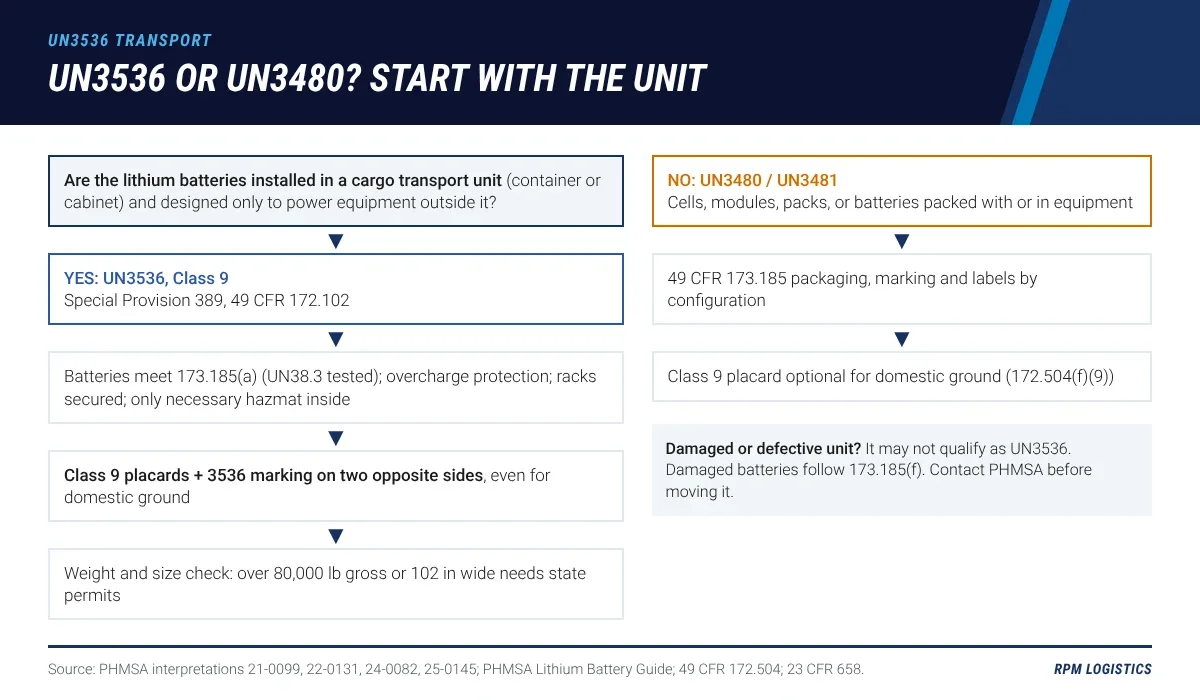
The classification question is about the unit, not the cells: batteries built into an enclosure that powers something outside it point to UN3536.
What is UN3536?
UN3536 is the UN number for lithium ion or lithium metal batteries installed in a cargo transport unit and designed only to provide power external to that unit. In practice, it covers containerized and cabinet-style battery energy storage systems that ship fully assembled. The cargo transport unit itself, such as a container or enclosure, acts as the packaging.
The entry sits in the Hazardous Materials Table at 49 CFR 172.101 as a Class 9 material, governed by Special Provision 389 in 49 CFR 172.102. PHMSA has confirmed that a BESS cabinet or freight container counts as a cargo transport unit for this purpose (PHMSA interpretation 24-0082, 2025).
Volume is rising fast. U.S. battery storage capacity reached 43.6 GW at the end of 2025, and about 8.3 GW more came online in the first half of 2026 (EIA, 2026). Developers planned another 14 GW for the second half of 2026 and 26 GW for 2027. Almost all of it reaches site by truck at some point.
UN3536 vs. UN3480: which entry applies?
UN3536 applies when the batteries are installed in a unit that powers something outside itself. UN3480 and UN3481 apply to cells, modules and packs shipped on their own or packed with or in equipment. The difference changes almost every requirement that follows.
Question | UN3536 | UN3480 / UN3481 |
|---|---|---|
What ships | Assembled BESS container or cabinet | Cells, modules, packs, or batteries with equipment |
Main rule | Special Provision 389 | 49 CFR 173.185 |
Packaging | The cargo transport unit itself | Specified outer packaging |
Battery labels inside | Not required | Required by configuration |
Placards on the vehicle | Class 9 plus 3536 on two opposite sides | Class 9 placard optional for domestic ground |
If you ship modules or packs to a site for assembly there, you are shipping UN3480 or UN3481, not UN3536. Our guide to commercial lithium battery shipping by ground covers those rules. The broader framework is in our lithium battery transport compliance guide.
What Special Provision 389 requires
Special Provision 389 sets the conditions a BESS must meet to ship as UN3536. PHMSA has quoted its terms in several interpretation letters and in its Lithium Battery Guide. Those sources describe the following requirements.
- Tested battery types. The batteries must meet 49 CFR 173.185(a), which means each type has passed UN38.3 testing. Keep the UN38.3 test summary available.
- Charge protection. The system must have controls that prevent overcharge and over-discharge.
- Secure attachment. Batteries must be securely attached to the interior structure, such as racks or cabinets. They must be protected against short circuits and movement under normal transport loads.
- Necessary equipment only. Hazardous materials needed for the unit to operate safely, such as fire suppression or HVAC, must be secured and are otherwise exempt. Hazardous materials not needed for that purpose must not be inside the unit.
- No battery labels inside. The batteries in the unit do not need individual marks or labels.
- Exterior marking and placards. The unit must display the identification number 3536 under 49 CFR 172.332 and carry Class 9 placards on two opposite sides.
- No air transport without approval from PHMSA's Associate Administrator.
PHMSA has applied these terms to real equipment. In one letter, it confirmed that a 750 kWh, roughly 20,000 lb unit moving on a truck trailer correctly ships as UN3536 (PHMSA interpretation 22-0131). PHMSA has also said it will not confirm a specific design. Classification stays the shipper's responsibility.
Placards, marking and the domestic Class 9 exception
A UN3536 unit needs Class 9 placards on two opposite sides even for a domestic truck move. That surprises many shippers, because placards are usually optional for Class 9 on domestic ground shipments.
Under 49 CFR 172.504(f)(9), a Class 9 placard is not required for domestic transportation. Special Provision 389 overrides that for UN3536 and makes the placards mandatory. The number 3536 must also appear, either on an orange panel, on a white square-on-point display, or on the Class 9 placard itself.
Placarding is one of the most common reasons lithium loads get rejected. Our guides to DOT hazmat classes and placarding and why lithium loads get rejected at the dock cover the common mistakes.
Does a driver need a hazmat endorsement for UN3536?
This question is not settled, so confirm it before dispatch. PHMSA's 2021 letter said the placards for UN3536 are not required under the general placarding rules in Subpart F of Part 172. On that reading, no hazmat endorsement would be needed (PHMSA interpretation 21-0099).
A newer letter changed the picture. In January 2026, PHMSA confirmed the placarding requirement again but referred the endorsement question to FMCSA rather than answering it (PHMSA interpretation 25-0145). The same "placarding under Subpart F" question affects hazmat registration, security plans and insurance minimums.
Until FMCSA answers, the conservative choice is a driver with a hazmat endorsement and a carrier that holds hazmat registration. Ask your carrier how it handles UN3536 moves and get the answer in writing.
Is there a state-of-charge limit for shipping a BESS by truck?
No general state-of-charge limit applies to UN3536 by highway under the Special Provision 389 text quoted by PHMSA. The familiar 30% limit applies to air transport, not ground.
That does not mean charge level is irrelevant. Manufacturers often set their own shipping charge level. Some ocean carriers apply their own rules for the export leg. Read our guide to state-of-charge rules by mode for the full picture. Also note that PHMSA proposed changes to Special Provision 389 in its HM-215R rulemaking in February 2026, including new emergency response information. Check whether that rule has been finalized before you ship.
How much does a BESS container weigh, and does it need a permit?
Many BESS containers are heavy enough to need oversize or overweight permits on their own. Federal rules cap gross vehicle weight at 80,000 lb on the Interstate System, with 20,000 lb per single axle and 34,000 lb per tandem axle (23 CFR 658.17).
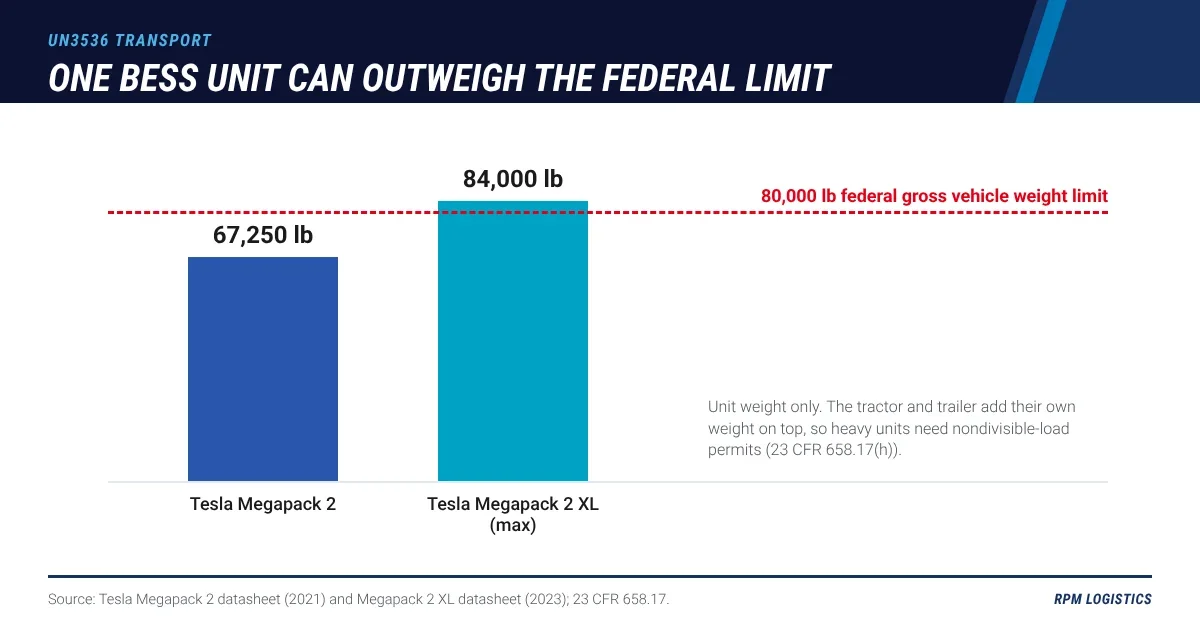
These are unit weights alone; once the tractor and trailer are added, even the lighter unit leaves little room under the federal limit.
Published specifications show how quickly a single unit uses up that limit:
- Tesla Megapack 2 weighs about 67,250 lb (Tesla datasheet, 2021).
- Tesla Megapack 2 XL weighs up to 84,000 lb (Tesla datasheet, 2023), more than the federal gross limit before the truck is counted.
- CATL's Tener Stack was designed in units under 36 tonnes each specifically to meet road transport limits (Energy-Storage.news, 2025).
Because a BESS unit cannot be broken down for transport, states can issue permits for these nondivisible loads under 23 CFR 658.17(h). Permit rules, escort requirements and travel windows vary by state. Width matters too, since 102 inches is the federal standard on the National Network. Our guide to oversize permits and escorts explains the process. Heavy units also call for heavy-haul trailers and route surveys. For permitted heavy and oversize loads, see RPM Logistics' over-dimensional freight transport service.
Shipping papers, emergency response and training
Special Provision 389 does not exempt UN3536 shipments from the core hazmat rules. Every UN3536 move needs the standard paperwork and trained people.
- Shipping papers must meet 49 CFR 172.200 through 172.205, with the proper shipping name and UN3536.
- Emergency response information must travel with the shipment under 49 CFR 172.600 through 172.604. The Emergency Response Guidebook assigns Guide 147 to lithium ion and Guide 138 to lithium metal batteries.
- Hazmat employee training under 49 CFR 172.704 applies to anyone who prepares or offers the shipment.
- Cargo securement must meet 49 CFR Part 393, Subpart I, which matters for top-heavy containers.
Plan for what happens if something goes wrong in transit. Our guide to what happens when a Class 9 load goes wrong covers notification and response steps.
Can a damaged BESS ship as UN3536?
A damaged BESS may not qualify for UN3536, and that is an open question to resolve with PHMSA before you move it. Special Provision 389 requires the batteries to meet 49 CFR 173.185(a). A damaged or defective unit may no longer meet that condition.
Damaged or defective lithium batteries follow 49 CFR 173.185(f), which allows highway, rail or vessel transport only in specified packaging. That packaging does not fit an assembled container. Industry data shows why this matters. An EPRI, TWAICE and PNNL analysis found that 72% of BESS failures with a known system age happened during construction, commissioning or the first two years of operation (Utility Dive, 2024). Transport sits right at the start of that window. Our guide to shipping damaged or defective lithium batteries covers the general rules.
A shipper readiness checklist for UN3536
Use this checklist before a BESS unit leaves the factory or a storage yard.
- Confirm the unit fits UN3536: batteries installed, powering only external equipment.
- Have the UN38.3 test summary for each battery type.
- Verify overcharge and over-discharge protection is active.
- Check that racks and cabinets are secured for transport loads.
- Confirm fire suppression and HVAC are secured, and that nothing else hazardous is inside.
- Apply Class 9 placards and the 3536 marking on two opposite sides.
- Prepare shipping papers and emergency response information.
- Get the unit weight and dimensions to your carrier early for permit planning.
- Confirm driver endorsement and carrier registration in writing.
- Inspect for damage, and call PHMSA if the unit is damaged or defective.
Safety trends are improving. EPRI reports that BESS failures per deployed GWh fell 98% globally between 2018 and 2025 (Energy-Storage.news, 2026). Careful transport keeps it that way.
Planning the delivery at the project site
Delivery planning decides whether a heavy BESS unit can actually reach its pad. A permitted load that cannot turn into the site or cannot be unloaded on arrival costs time and money.
- Survey the last mile. Check turning radii, gate widths, soft ground and overhead lines near the site.
- Confirm the unloading method. Most heavy units need a crane on site, timed to the truck's arrival.
- Coordinate the delivery window with permit travel hours, which often restrict oversize moves to daylight.
- Plan storage if the site is not ready. Units waiting for installation must be stored safely. Our guide to lithium battery storage and NFPA 855 covers the fire code side.
Frequently asked questions
What is UN3536?
UN3536 is the UN number for lithium ion or lithium metal batteries installed in a cargo transport unit, such as a container or cabinet, designed to power equipment outside the unit. It is a Class 9 hazardous material governed by Special Provision 389.
What does a 3536 placard mean?
A 3536 marking tells responders that the unit contains installed lithium batteries shipping as UN3536. It appears with Class 9 placards on two opposite sides of the cargo transport unit.
Do BESS containers need hazmat placards when shipped by truck?
Yes. Special Provision 389 requires Class 9 placards on two opposite sides of a UN3536 unit, even though Class 9 placards are usually optional for domestic ground shipments.
Does a driver need a hazmat endorsement to haul a UN3536 container?
This is unsettled. A 2021 PHMSA letter suggested no endorsement was required, but a 2026 letter referred the question to FMCSA. Until it is resolved, the conservative approach is to use an endorsed driver.
Is there a state-of-charge limit for shipping a BESS by truck?
No general state-of-charge limit applies to UN3536 by highway. The 30% limit applies to air transport. Manufacturers and ocean carriers may set their own rules.
What is the difference between UN3536 and UN3480?
UN3536 covers batteries installed in a cargo transport unit that powers something external. UN3480 covers lithium ion batteries shipped on their own, such as cells, modules and packs.
Can a damaged battery energy storage unit ship as UN3536?
Possibly not. UN3536 requires batteries that meet 49 CFR 173.185(a), and damage may disqualify the unit. Contact PHMSA before moving a damaged or defective BESS.
Plan your next BESS move with RPM Logistics
A UN3536 move combines hazmat rules, heavy-haul permits and site timing in a single shipment. RPM Logistics moves Class 9 lithium battery freight by ground across all 50 states and Canada. Request a quote with your unit's weight, dimensions and delivery window.