

Quick Answer
Executive fleet vehicle transport is moving a company-assigned vehicle for a senior leader, usually during a relocation, promotion or new hire. Done well, it is timed to the executive's start date, matched to the vehicle's value, documented at both ends and delivered ready to drive. The method matters less than the planning around it.
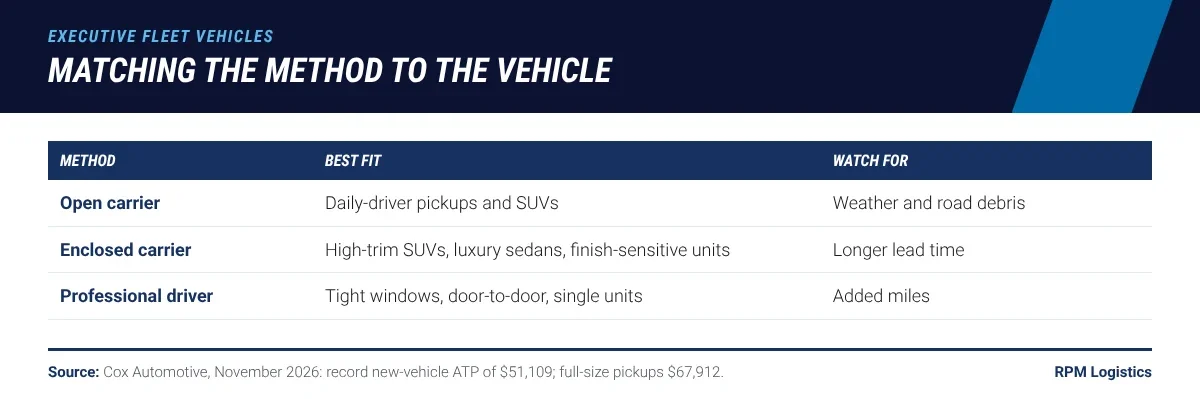
There is no single right method. Value, timing and condition expectations decide it.
What Makes an Executive Vehicle Move Different
An executive fleet vehicle is a company car or truck assigned to a leader as part of a compensation or role package. It is still a fleet asset. The difference is who is waiting for it.
A field technician's van can arrive a day late without much notice. An executive's vehicle usually cannot. The move is often tied to a relocation package, a start date or a first week in a new market. A late, dirty or damaged vehicle reflects on the fleet team and on the company.
The vehicles themselves also cost more. The new-vehicle average transaction price reached a record $51,109 in October 2026 (Cox Automotive, November 2026). Full-size pickups averaged $67,912 (Cox Automotive, November 2026). Cadillac's average was $84,695 in September 2026 (GM Authority, citing Kelley Blue Book, 2026). Executive assignments tend to sit at the higher end of those ranges.
When Executive Vehicles Move
Most executive vehicle moves fall into a handful of events:
- Relocation. A leader moves to a new office, and the assigned vehicle goes with them.
- New hire. A new executive starts, and a vehicle is sourced, prepared and delivered to their home or office.
- Promotion or reassignment. A vehicle changes hands as roles change. RPM covers that workflow in its guide to fleet reassignment logistics.
- Cycle replacement. A new vehicle arrives and the outgoing one is collected for remarketing.
- Office consolidation. Several leaders relocate at once, which turns single moves into a project. See RPM's guide to multi-state fleet relocation.
Each event has a date that the business cares about. The transport plan should work back from that date.
Choosing the Method
Open carrier
Open transport is the standard for most fleet vehicles. It is efficient, widely available and fits a daily-driver pickup or SUV well. It exposes the vehicle to weather and road debris, which is usually acceptable for a working vehicle.
Enclosed carrier
Enclosed transport protects the vehicle from weather, debris and view. It fits high-trim SUVs, luxury sedans and anything with paint or finishes the company wants kept perfect. RPM explains the case for it in its guide to enclosed transport for luxury SUVs and high-line vehicles. How the vehicle is tied down also matters. See RPM's comparison of soft-tie versus hard-tie securement.
Professional driver
A professional driver can drive the vehicle door to door. This fits tight windows, single-vehicle moves to a home address and routes where a carrier load would take longer to build. It adds miles to the vehicle, so it suits vehicles where mileage is not the main concern. RPM screens professional drivers with motor vehicle record (MVR) checks and continuous MVR monitoring.
Timing the Move to the Executive's Calendar
The most common failure in executive vehicle moves is timing. The vehicle arrives before anyone is home, after the executive has started or on a day the building is closed.
Good timing starts with three dates:
- The release date, when the vehicle can leave its current location.
- The need date, when the executive must have it.
- The receive window, when someone can accept it at the destination.
Book transport once the release and need dates are set. Leave buffer for weather and holidays. If the vehicle must arrive before the executive, arrange a secure place for it to wait. RPM's guide to corporate fleet relocation lifecycle management covers how fleets coordinate these handoffs with relocation providers.
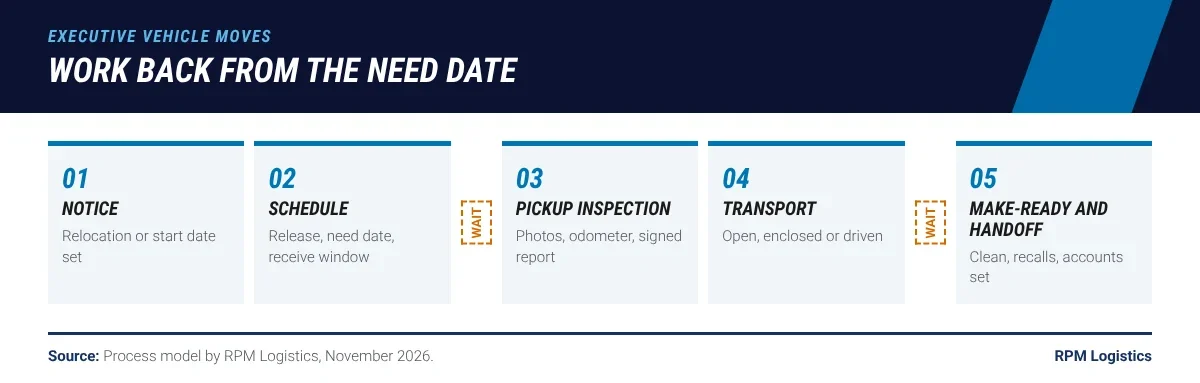
Work back from the need date. The two waits that slip most are the release and the receive window.
Electric Executive Vehicles
More executive assignments are electric. The average new EV sold for $56,220 in October 2026 (Cox Automotive, November 2026). EVs move like any other vehicle, with a few extra checks.
- State of charge. Ship with enough charge to load, unload and reach a charger, but follow the carrier's guidance on charge level.
- Weight. Large electric SUVs and pickups are heavy. Confirm the carrier's equipment and ramps suit the curb weight.
- Charging at the destination. Set up a home charger or a public charging account before the vehicle arrives.
- Transport mode. Some EVs need a specific mode for towing or winching. Share the manufacturer's guidance with the carrier.
Condition Reporting and Accountability
A vehicle assigned to a senior leader needs a clear record at both ends. If a scratch appears, the fleet team needs to know whether it happened in transit or before pickup.
A strong condition report includes:
- Time-stamped photos of every panel, wheel and the interior.
- Odometer and fuel or charge level at pickup and delivery.
- Notes on existing damage, signed by the releasing party.
- A delivery inspection signed by the receiving party.
RPM explains what separates a usable report from a checkbox in its guide to insurance-grade condition reporting. Before any move, confirm the carrier's operating authority on the FMCSA company snapshot and its insurance limits against the vehicle's value.
Delivered Ready, Not Just Delivered
An executive should be able to get in and drive. That means the vehicle arrives ready, not just on time. Before handoff, check:
- The vehicle is clean inside and out.
- Fuel or charge is at a usable level.
- Open recalls are cleared. Check the VIN on NHTSA's recall lookup.
- Toll transponders, fuel cards and charging accounts are set up for the new region.
- Personal items from a prior driver are removed, and old phone pairings and saved addresses are cleared.
RPM covers this last step in its guide to why delivered isn't ready in fleet deployment.
Paperwork Across State Lines
A relocated vehicle may need a new registration in the executive's new state. Some states require it within a set number of days after a move. Fleets that register in the company's name may handle this centrally. Others need the executive's address.
Check whether the move also triggers a VIN inspection, emissions test or new plates. RPM walks through the options in its guide to fleet title and registration across state lines.
Executive Moves Inside a Relocation Package
Many executive vehicle moves are one line in a larger relocation. A relocation management company may handle the household goods, temporary housing and travel. The vehicle often falls between that provider and the fleet team.
Settle three questions before the move starts:
- Who books the vehicle move? The relocation provider, the fleet team or the executive. One owner, not two.
- Who pays, and from which budget? A company-owned vehicle is usually a fleet cost. A personal vehicle shipped as a relocation benefit may sit in the relocation budget and carry different tax treatment.
- Who talks to the executive? Executives should get one schedule from one contact. Mixed messages from three vendors erode trust in the whole relocation.
Some packages include both the company vehicle and a personal vehicle. Moving both on the same schedule, with the same partner, cuts the number of handoffs the executive has to manage.
Discretion and Privacy
Executive moves often involve home addresses and personal schedules. Limit what goes on transport paperwork to what the carrier needs. Use a fleet contact as the primary phone number where possible. Share the executive's details only with the parties handling pickup and delivery.
Enclosed transport also keeps a high-profile vehicle out of view on the road. For some companies, that matters as much as paint protection.
Do Not Forget the Outgoing Vehicle
A new executive vehicle often means an old one has to go somewhere. It might move to another employee, a remarketing auction or a lease return. That outgoing vehicle is easy to overlook while attention is on the new one.
Plan both moves together. Collect the outgoing vehicle on the same trip that delivers the new one when the locations line up. Inspect it at pickup, record its condition and route it straight to its next stop. A vehicle left in an executive's driveway for weeks still carries insurance, registration and depreciation, and it delays the next driver or the sale.
What an Executive Vehicle Move Should Include
- A need date agreed with HR or the relocation provider.
- A method matched to the vehicle's value and the timeline.
- A verified carrier with insurance sized to the vehicle.
- A named release contact and a named receiver.
- Photo condition reports at pickup and delivery.
- A make-ready check before handoff.
- Registration and title updates for the new state.
- A plan for the outgoing vehicle, if there is one.
- One point of contact who owns the move end to end.
Working With a Fleet Transport Partner
Fleet teams often handle executive moves one at a time, by email, with a different vendor for each. That is where dates slip. A single partner with a standard process for executive moves makes them repeatable.
RPM Logistics moves fleet vehicles in all 50 states and Canada, by open carrier, enclosed carrier and professional driver. Its fleet vehicle transport service supports relocations, new hires and reassignments. For vehicles that need extra protection, its enclosed transport service covers high-value units.
Frequently Asked Questions
What is executive fleet vehicle transport?
It is moving a company-assigned vehicle for a senior leader, usually during a relocation, new hire or promotion. The move is timed to the executive's start date, documented at both ends and delivered ready to drive.
Should executive vehicles ship enclosed?
Not always. Enclosed transport fits high-trim SUVs, luxury sedans and vehicles where finish matters. A standard pickup or SUV usually ships well on an open carrier. The vehicle's value and the company's expectations decide it.
How far ahead should an executive vehicle move be booked?
Book as soon as the release date and need date are known. Leave buffer for weather and holidays. Arrange secure storage if the vehicle must arrive before the executive.
Can a professional driver deliver an executive vehicle?
Yes. A professional driver can move the vehicle door to door, which suits tight timelines and home deliveries. It adds miles, so it fits best where mileage is not the main concern. Drivers should be screened with MVR checks.
What should be checked before handing a vehicle to an executive?
Check that the vehicle is clean, fueled or charged, free of open recalls and set up with toll and fuel accounts for the new region. Remove a prior driver's personal items and clear old phone pairings.