

Quick Answer
Lease-end fleet returns are the logistics of turning in leased fleet vehicles at the end of their term. The car is recovered from the driver, inspected, cleared of company equipment and moved to the leasing company's chosen sale site. Condition and timing at turn-in affect residual value, wear charges and the fleet's final settlement.
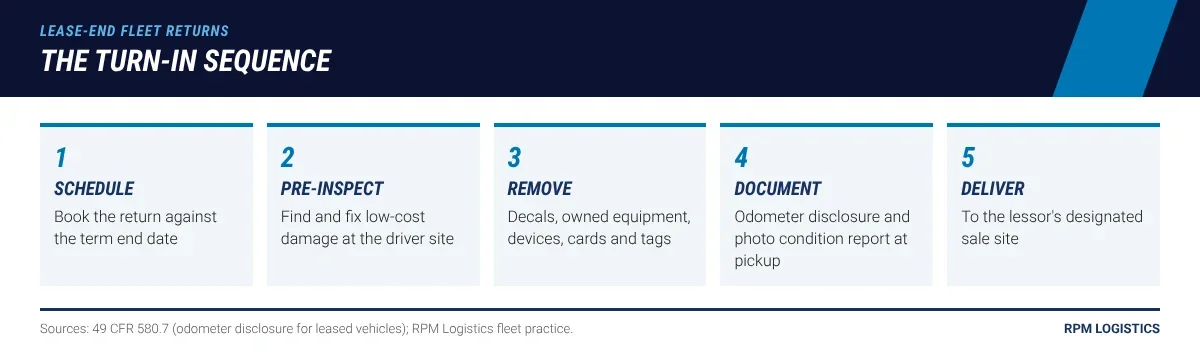
Steps two and three happen while the vehicle is still at the driver's location, which is the cheapest place to fix anything that would cost money at the auction.
What are lease-end fleet returns?
Lease-end fleet returns cover every step from the end of a vehicle's lease term to its arrival at the lessor's sale or storage site. For fleets that lease through a fleet management company, the vehicle usually goes to a remarketing channel the lessor chooses. The fleet's job is to deliver it on time and in the best condition the lease rewards.
The volume is steady because fleets buy in cycles. U.S. fleet sales reached 2,227,876 vehicles in 2025, including 781,986 commercial units (Bobit Business Media, 2026). Many of those units are leased, and each will come back at term.
A lease-end return typically involves:
- The fleet manager, who schedules turn-ins and approves repairs.
- The driver, who returns the keys, cards and equipment.
- The lessor or fleet management company, which sets the sale channel and settlement rules.
- The transport provider, who recovers the car and documents its condition.
- The remarketing site, which inspects, grades and sells the vehicle.
Lease returns differ from owned-vehicle retirement, which we cover in our guide to fleet decommissioning logistics. Here, the lessor owns the asset, and the lease decides who carries the value risk.
How does the lease type change turn-in priorities?
The lease type changes turn-in priorities because it decides who gains or loses when the car sells. Fleets commonly use open-end leases, while some use closed-end leases. Each one rewards a different kind of turn-in.
Lease type | Who carries residual risk | Turn-in priority |
|---|---|---|
Open-end lease | Usually the fleet, through a gain or loss against the agreed residual at sale | Maximize sale price: condition, timing and reconditioning decisions all count |
Closed-end lease | Usually the lessor, with charges for excess wear and mileage | Avoid chargeable wear and document condition clearly |
Under an open-end lease, every dollar of sale price can flow back to the fleet. That makes cheap pre-sale repairs and fast delivery to market worth more. Under a closed-end lease, the focus shifts to avoiding wear charges and disputes. Check your master lease agreement for the exact terms, since programs vary.
What should happen before the vehicle is picked up?
Before the vehicle is picked up, the fleet should inspect it, fix low-cost damage and remove anything that belongs to the company. These steps cost the least at the driver's location and the most once the car reaches the auction.
Pre-inspect and fix small damage
A pre-turn-in inspection finds the dents, chips, worn tires and warning lights that drive down a sale price or trigger wear charges. Small repairs, such as paintless dent removal or a windshield chip repair, often cost less than the deduction they prevent.
Remove company property
- Decals and graphics, unless the lessor's program removes them.
- Upfit equipment the fleet owns, such as racks, bins and inverters.
- Devices, such as dash cameras, phones and any tracking units the fleet installed.
- Fuel cards and toll tags, so charges stop when the vehicle leaves.
- Personal and company items from the cabin and cargo area.
Check recalls
Check for open safety recalls by VIN through NHTSA's recall lookup. Completing a recall repair before turn-in can avoid delays at the sale site.
What paperwork does a lease turn-in require?
A lease turn-in requires an odometer disclosure, a condition report and the lessor's return documents. The odometer statement is a federal requirement for leased vehicles.
Under 49 CFR 580.7, the lessor must notify the lessee that a mileage disclosure is required before ownership is transferred. The lessee then provides a signed statement with the odometer reading, the date and the vehicle's details. The lessee also certifies whether the reading reflects actual mileage.
A complete turn-in packet usually includes:
- Odometer disclosure statement, signed by the lessee.
- Photo condition report from pickup, covering every panel, the wheels, tires and interior.
- Key count, since missing keys can be charged.
- Maintenance records, if the lessor requests them.
- Delivery receipt from the sale site.
Fleet managers handling many turn-ins should confirm who signs the odometer statement for each vehicle. In fleet leases, the lessee is usually the company, not the driver.
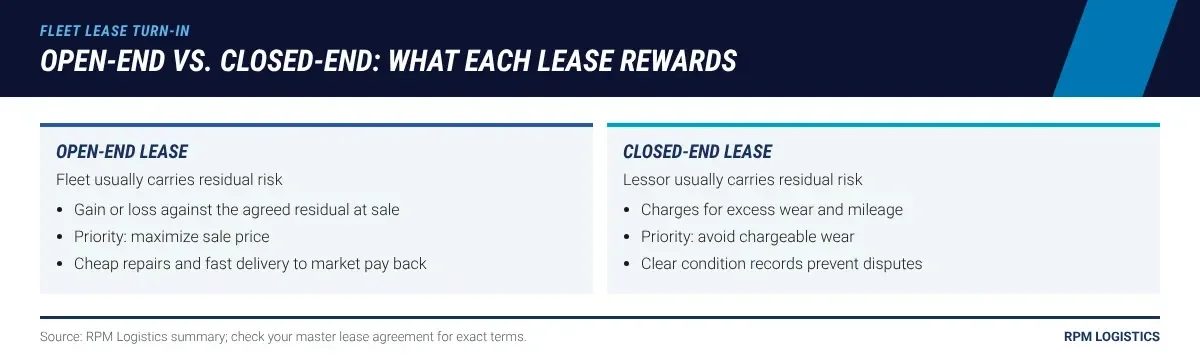
The same dented bumper costs an open-end fleet at the auction block and a closed-end fleet on the wear invoice; either way, fixing it before pickup is usually cheaper.
When should lease-end vehicles move to the sale site?
Lease-end vehicles should move to the sale site as soon as they are released and prepared. Every week a returned vehicle sits adds depreciation, storage and insurance cost, and it can push the sale into a weaker market.
The market rewards speed when values are soft. The Manheim Used Vehicle Value Index stood at 205.9 in September 2026, down 0.6% from a year earlier (Cox Automotive, 2026). Cox also reported that depreciation accelerated during the third quarter.
Timing practices that protect value:
- Schedule turn-ins before the term ends, not on the last day.
- Book transport with the recovery date, so the car does not wait at the driver's site.
- Batch returns by region to fill haulaway trucks to the same auction.
- Avoid holding returned units unless the lessor directs storage.
The lessor usually picks the sale site, but fleets can still affect timing. Our guide to auction lane strategy covers how timing and location interact.
Driveaway or haulaway for lease returns?
Driveaway and haulaway both work for lease returns, and the choice often comes down to distance and mileage. Every mile driven on the way to the auction shows on the odometer at sale.
- Driveaway suits single vehicles on short trips to a nearby sale site.
- Haulaway suits groups of returns heading to the same auction, or long distances where added miles would cut value.
- Enclosed transport may make sense for high-value executive vehicles.
For closed-end leases, added miles can also count against the mileage allowance if the reading is taken at the sale site. Confirm with the lessor which reading governs settlement before choosing driveaway for a long trip.
How do you avoid disputes over turn-in condition?
You avoid disputes over turn-in condition with dated photos at every handoff. When the sale site's grade differs from the fleet's expectation, the pickup report shows what the vehicle looked like before it moved.
Good practice includes:
- Photos at pickup covering every panel, the roof, wheels, tires, glass and interior.
- Odometer and fuel level recorded at pickup and delivery.
- Damage noted on the delivery receipt before it is signed.
- Reports stored by VIN, so they can be pulled when a settlement question arrives.
Our guide to photo condition reports that end claim disputes shows what each report should include.
How do you plan lease returns across a large fleet?
Lease returns across a large fleet work best on a rolling schedule tied to lease maturity dates. A list of every vehicle's term end date, location and replacement plan lets fleet teams book recoveries weeks ahead.
- Pull maturity dates for the next two quarters.
- Match each return to its replacement vehicle, if any, so the driver is not left without one.
- Group returns by region and sale site.
- Book pre-inspections and recoveries on a regional calendar.
- Track every unit from recovery to sale and final settlement.
Pairing returns with replacement deliveries saves a trip. Our guide to fleet reassignment logistics covers vehicles that move to a new driver instead of going back to the lessor. Vehicles waiting for a sale slot can be held as covered in our framework for fleet vehicle storage.
What changes for upfitted and electric lease returns?
Upfitted and electric vehicles add steps to a lease return. Both carry equipment or conditions that affect value, and both need clear instructions before pickup.
- Upfitted vehicles. Confirm which equipment belongs to the fleet and which stays with the vehicle under the lease. Removing an upfit that the lessor expects to sell with the vehicle can create a charge.
- Electric vehicles. Return the vehicle with a reasonable state of charge, the charging cable and any adapters. Note battery health if the vehicle reports it.
- Damaged EVs. An EV with battery damage needs special handling and should not be treated as a routine return.
Write these rules into the turn-in instructions for each vehicle type. Drivers and recovery teams then follow the same steps every time.
Which KPIs show a healthy lease return program?
A healthy lease return program moves vehicles from term end to sale quickly and with few surprises. A short set of measures shows where it slows down:
- Days from term end to recovery.
- Days from recovery to sale site arrival.
- Wear and damage charges per returned vehicle, for closed-end leases.
- Gain or loss against residual per vehicle, for open-end leases.
- Missing item charges, such as keys or equipment.
Review these by region and by vehicle type each quarter. Patterns, such as one region with slow recoveries, point to fixes that save money on every future return.
Where do fleet management companies fit?
Fleet management companies often run the remarketing side of a lease return, from choosing the sale channel to settling the lease. Programs differ, and some fleets arrange transport through their lessor while others book it directly.
Either way, the logistics goals are the same: a prepared vehicle, clean paperwork and fast delivery to the right site. Clear roles between the fleet, the lessor and the transport provider prevent duplicate bookings and missed pickups. Our article on how transport partners use data to reduce per-vehicle costs covers how programs coordinate with FMC and direct clients.
How RPM supports fleet lease returns
RPM Logistics recovers and delivers lease-end vehicles for corporate, government and commercial fleets across all 50 states and Canada.
- Recovery from driver locations by driveaway or haulaway.
- Photo condition reports and odometer readings at pickup and delivery.
- Delivery to the lessor's designated sale site on the schedule you set.
- 70+ storage locations in the U.S. and Canada when units need to wait.
- Driver screening through motor vehicle record checks at onboarding, with continuous monitoring after that.
For program details, see our fleet vehicle logistics services and our remarketing logistics guide. Talk to our fleet team about your next round of lease returns.
Frequently asked questions
What happens to a fleet vehicle at the end of its lease?
The vehicle is recovered from the driver, inspected, cleared of company equipment and moved to the lessor's sale site. The lessor sells it and settles the lease with the fleet.
Is an odometer disclosure required when returning a leased vehicle?
Yes. Under 49 CFR 580.7, the lessor must notify the lessee that a mileage disclosure is required, and the lessee provides a signed odometer statement.
Should you repair a fleet vehicle before lease turn-in?
Low-cost repairs often pay for themselves by avoiding wear charges or a lower sale price. Check what your lease charges for, then compare repair cost to the expected deduction.
What is the difference between open-end and closed-end fleet leases at turn-in?
In an open-end lease, the fleet usually carries residual risk through a gain or loss at sale. In a closed-end lease, the lessor usually carries that risk and charges for excess wear and mileage.
Should lease returns be driven or hauled to auction?
Driveaway suits single vehicles on short trips. Haulaway suits groups of returns or long distances where added miles would reduce value.
How soon should a returned fleet vehicle reach the auction?
As soon as it is released and prepared. Waiting adds depreciation, storage and insurance cost.