

Quick Answer
Lender recovery transport moves repossessed vehicles from a recovery agent's lot to an auction, reconditioning shop or lender storage. The lender controls the timing, because state law sets borrower notice rules before a sale. A clean move needs a release from the agent, a condition report, a personal property record and a clear chain of custody.
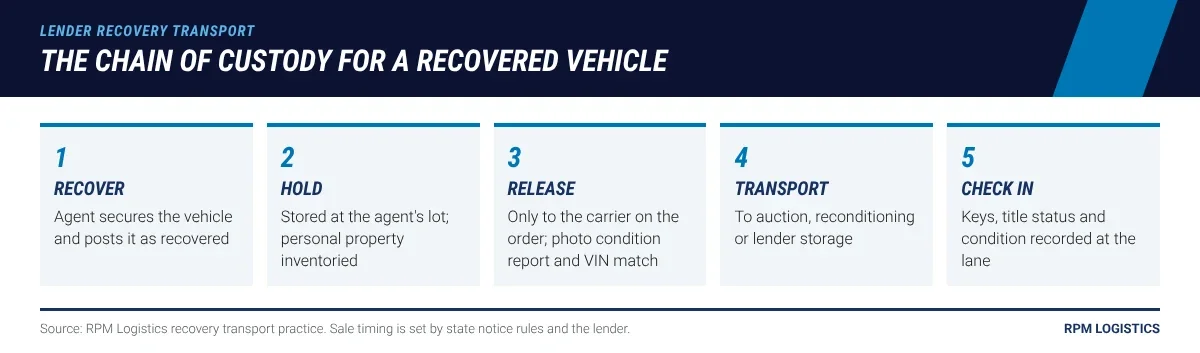
Each handoff is a point where the lender can lose time, value or a damage claim; the condition report at release is the one that settles most disputes.
What is lender recovery transport?
Lender recovery transport is the logistics that follow a vehicle repossession. Once a recovery agent secures the vehicle, the lender has to move it to wherever it will be sold or held. That usually means a wholesale auction, sometimes with a reconditioning stop first.
The volume behind this work has grown. About 1.73 million vehicles were repossessed in the U.S. in 2024, the most since 2009, according to estimates from Cox Automotive and Experian. The auto loan default rate reached 3.13% that year, the highest since 2011. For comparison, the same estimates put 2009 at about 1.77 million repossessions and a 4.12% default rate.
Recovery transport serves several kinds of lenders:
- Banks and credit unions with consumer auto portfolios.
- Captive finance companies tied to automakers.
- Independent and subprime lenders with higher recovery volumes.
- Lease companies recovering vehicles after a lease default.
- Servicers and forwarding companies that manage recoveries for lenders.
How is lender recovery transport different from auction transport?
Lender recovery transport differs from ordinary auction transport because the vehicle comes from an involuntary handoff. A dealer consigning a trade-in knows the car's history and condition. A lender recovering a car often does not.
That changes what the transport plan must cover:
- Unknown condition. The vehicle may not run, may lack keys or may have hidden damage.
- Personal property. Borrowers often leave belongings that must be inventoried and handled under the lender's policy.
- Legal timing. The lender cannot sell before borrower notice requirements are met.
- Storage clocks. Recovery lots charge daily storage, so delays cost money.
- Custody risk. A recovered vehicle is an attractive target for theft and fraud at release.
For the dealer and fleet side of auction moves, see our guide to auction vehicle transport. This article covers the lender side.
Who controls the timing of a repossessed vehicle's move?
The lender controls the timing, guided by state law and its own counsel. In most states, the lender must send the borrower notice before selling a repossessed vehicle. Many states also give the borrower a chance to redeem the vehicle before the sale.
Notice periods and redemption rights vary by state and by contract. Transport should not be planned around a guess. The lender or its servicer should confirm the earliest date the vehicle can go to sale, then work backward from that date.
That backward plan typically looks like this:
- Confirm the earliest sale date with legal or the servicer.
- Pick the sale channel: physical lane, online sale or retail reconditioning.
- Book transport to arrive a few days before the sale, with room for check-in.
- Schedule release from the recovery lot to limit storage days.
Moving the car early can be fine, as long as it is held, not sold, until notice periods end. Moving it late costs storage and pushes the sale into a later auction.
What happens at release from the recovery lot?
Release from the recovery lot is the most important handoff in the chain. It is where custody moves from the recovery agent to the transport provider, and where condition and contents get recorded.
Verify the carrier
The recovery agent should release a vehicle only to the carrier named in the lender's order. Recovered vehicles are targets for fictitious pickups, where a fraudster shows up with forged paperwork. Lenders can confirm a carrier's authority through FMCSA registration records. Our guide to stopping a fictitious pickup at the gate lays out a verification sequence that works at recovery lots.
Record the condition
A photo condition report at release protects the lender if damage is found later. It should cover every panel, the wheels, the interior and the odometer. Note whether the vehicle runs, whether keys are present, and any warning lights.
Handle personal property
Personal property is usually inventoried and handled at the recovery lot under the lender's policy and state rules. The transport provider should not take belongings unless the lender directs it. Note on the condition report that the vehicle was clear of personal items, or list what remained.
Confirm the VIN
Match the VIN on the vehicle to the VIN on the order before it leaves. Repossessed vehicles can include cloned or misidentified units. Our explainer on what VIN cloning is shows why that check matters.
Where should repossessed vehicles go: lane, recon or storage?
Repossessed vehicles should go to whichever channel recovers the most value after transport and holding costs. For most units, that is a wholesale auction close to the recovery location. Some units earn more after reconditioning, and a few need storage while legal steps finish.
Channel | Best for | Trade-off |
|---|---|---|
Nearest wholesale auction | Most running units in average condition | Lowest transport cost, but may not be the strongest market |
Higher-demand auction farther away | Trucks, SUVs and segments in short supply locally | Higher transport cost for a better sale price |
Reconditioning first | Newer units with fixable damage or wear | Added time and cost before the sale |
Salvage auction | Non-running or heavily damaged units | Lower prices, but faster disposition |
Lender storage | Units on legal hold or awaiting redemption | Holding cost and depreciation |
Market conditions shape the choice. The Manheim Used Vehicle Value Index stood at 205.9 in September 2026, down 0.6% from a year earlier (Cox Automotive, 2026). When wholesale prices soften, the gap between the nearest lane and a stronger market can matter more.
Our article on auction lane strategy covers how to weigh timing, location and transport cost.
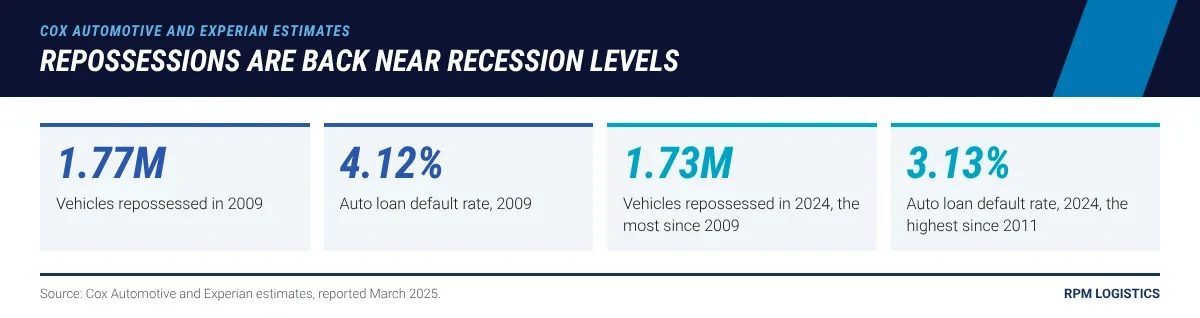
Repossession volume is back near recession levels, which puts more recovered units through the same auction lanes and carriers.
How do you move non-running and keyless recoveries?
Non-running and keyless recoveries need equipment planned before dispatch. A carrier that arrives expecting a runner cannot load a car with no keys, a dead battery or locked wheels without the right tools.
Tell the transport provider about:
- Whether the vehicle starts and steers. A non-runner needs a winch and enough deck space to load it.
- Whether keys are present. Keyless vehicles may need a tow dolly or skates if the steering is locked.
- Flat tires or missing wheels. These may require a rollback or flatbed instead of a multi-car carrier.
- Electric vehicles, which may need a transport mode setting to roll freely.
Recovery agents can usually confirm these details when they post the vehicle as recovered. Accurate details at order entry prevent dry runs, where a carrier arrives and cannot load. Dry runs add cost and push the vehicle to a later sale.
How do you keep storage fees from eating recovery value?
Storage fees eat recovery value when a vehicle waits at a recovery lot longer than it needs to. Most lots charge by the day, and a slow release or a missed auction date can stack up a week or more of fees.
Lenders keep those days short with a few habits:
- Order transport the day of recovery, even if the sale date is weeks away.
- Move units to lower-cost holding when legal steps will take a while.
- Batch pickups by lot so one truck clears several vehicles at once.
- Track days on lot for every unit and flag anything past the lender's target.
- Fix data errors early, such as a wrong lot address or missing release form.
The goal is not the cheapest single move. It is the lowest total of storage, transport and lost sale value. A slightly more expensive move that makes this week's auction often beats a cheaper one that misses it.
Do voluntary surrenders and lease defaults follow the same process?
Voluntary surrenders and lease defaults follow a similar transport process, with a few differences at the start. In a voluntary surrender, the borrower brings the vehicle in or arranges pickup. The handoff is calmer, and the borrower can often provide keys and remove belongings first.
Lease defaults involve the leasing company as the owner of record. The vehicle may go back to the lessor's chosen auction or remarketing channel, sometimes in another state. Lease returns also bring end-of-term inspection standards that can affect charges to the lessee.
In every case, the same three records protect the lender:
- A condition report with photos at pickup.
- A note of keys, personal property and odometer reading.
- A delivery receipt at the auction or storage site.
What should lenders measure in recovery transport?
Lenders should measure recovery transport by how quickly and cleanly units reach a sale, not only by cost per move. A short set of measures shows where the process slows down:
- Days from recovery to pickup at the agent's lot.
- Days from pickup to auction check-in.
- Dry-run rate, where a carrier arrived but could not load.
- Damage claims per hundred moves, backed by condition reports.
- Units missing their target sale, and why.
What documents travel with a repossessed vehicle?
A repossessed vehicle should travel with enough paperwork to prove who controls it and where it is going. The title itself usually stays with the lender or its title processor until sale.
- Transport order naming the lender, pickup lot, destination and carrier.
- Release form from the recovery agent.
- Condition report from release, with photos.
- Key and personal property notes, as recorded at the lot.
- Auction check-in details, such as a work order or stock number.
Title work runs in parallel. A vehicle can be at the auction before the title is ready, but it usually cannot sell until title status is clear. For multi-state recoveries, our guide to bulk titling and registration for national programs covers the paperwork side.
Before a unit goes to a retail buyer after reconditioning, check for open safety recalls by VIN through NHTSA's recall lookup.
Review these measures by recovery agent and by auction, not only in total. One slow lot or one lane with frequent check-in problems can drag down the whole program's numbers.
How RPM supports lender recovery programs
RPM Logistics moves recovered vehicles for lenders, servicers and remarketers across all 50 states and Canada. A network of more than 15,000 active carriers covers recovery lots and auction lanes nationwide.
- Verified pickups, with carrier details shared with the recovery lot before release.
- Photo condition reports at release and at auction check-in.
- Equipment matched to runners, non-runners and keyless units.
- Storage options at 70+ locations for units on hold.
For program details, see our services for financial institutions and our remarketing logistics guide.
Frequently asked questions
Who pays for transporting a repossessed vehicle?
The lender usually arranges and pays for transport, then accounts for it under the loan contract and state law when the vehicle is sold.
How soon can a lender move a repossessed car to auction?
The lender can move it once it has custody, but it generally cannot sell until state notice requirements are met. Confirm the earliest sale date with counsel or the servicer, then plan transport backward from it.
What happens to personal property left in a repossessed car?
Personal property is usually inventoried and handled at the recovery lot under the lender's policy and state rules. The transport provider should not take belongings unless the lender directs it.
Can a non-running repossessed vehicle be transported?
Yes. Tell the carrier in advance so it brings a winch, dolly or flatbed. Note missing keys, flat tires or locked steering on the order.
How many vehicles are repossessed each year?
Cox Automotive and Experian estimated about 1.73 million repossessions in 2024, the most since 2009.
How do lenders prevent fraud at vehicle release?
Lenders name the carrier on the order, share driver and truck details with the recovery lot, and verify carrier authority through FMCSA records. The lot releases only to the verified carrier.
Move recovered vehicles with a clear chain of custody
Every day a recovered vehicle sits on a lot costs storage and value. RPM Logistics coordinates verified pickups, condition reporting and delivery to the lane you choose. Talk to our team about your recovery transport program.