

Quick Answer
VIN cloning is a fraud in which thieves copy the vehicle identification number of a legally registered car and attach it to a stolen vehicle of the same make, model and year. The stolen car then passes database checks because the copied VIN is clean. Only a physical match of every VIN on the vehicle against its paperwork exposes it.
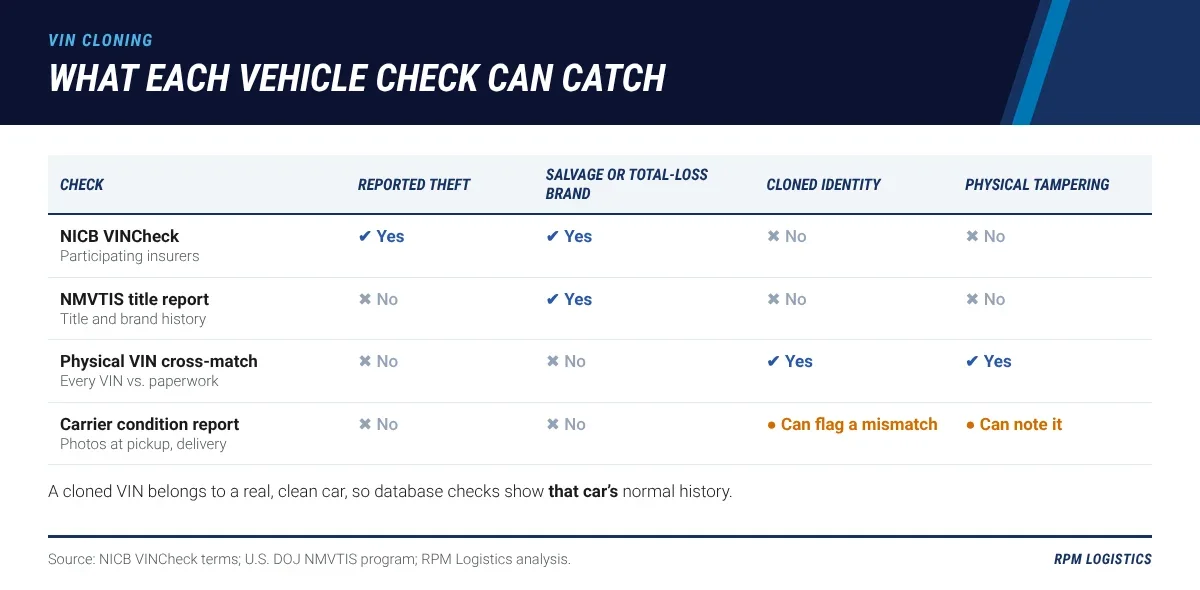
A cloned VIN is designed to pass the two database checks, which is why the physical cross-match is the only column that reliably catches it.
What is VIN cloning?
VIN cloning is the theft of a vehicle's identity rather than the vehicle itself. Criminals find the VIN of a legitimate car, often by photographing it through a windshield on a dealer lot or street. They then make counterfeit VIN plates and labels and place them on a stolen car of the same model. Many also forge a title to match.
The result looks clean on paper. A buyer who runs the VIN sees the history of the real, legally owned car, not the stolen one. That is what makes cloning different from simple theft and harder to catch.
The scale of the fraud can be large. In a case the FBI described in 2009, a Tampa-area ring sold more than 1,000 cloned vehicles in 20 states and several countries, with losses above $25 million (FBI, 2009). No reliable national count of cloned vehicles exists today. That gap is part of why buyers and shippers need their own checks.
How VIN cloning works, step by step
VIN cloning follows a predictable pattern, and each step leaves a chance to catch it.
- Steal a vehicle. The car is usually a popular model, which makes a matching donor VIN easy to find.
- Find a clean donor VIN. Thieves look for a legal car of the same make, model, year and often color.
- Replace the visible VINs. They swap the dash plate and the door-jamb label, and sometimes the VINs on major parts.
- Create matching paperwork. A forged or fraudulently obtained title makes the identity look complete.
- Sell or move the car. The vehicle enters a private sale, a dealer trade, an auction or an export shipment.
Theft volume is falling overall. U.S. vehicle thefts dropped 23% in 2025 to 659,880, and fell another 21% in the first half of 2026 to 268,415, according to NICB. The Hyundai Elantra was the most stolen model in 2025, with 21,732 thefts. Fewer thefts do not mean fewer cloned identities, since one stolen car can carry a clean identity for years.
VIN cloning vs. VIN swapping vs. title washing
VIN cloning, VIN swapping and title washing are related frauds, but each hides a different problem.
Fraud | What happens | What it hides |
|---|---|---|
VIN cloning | A clean VIN from a legal car is copied onto a stolen car of the same model | That the car is stolen |
VIN swapping | The VIN from a salvage or wrecked car is moved onto a stolen car | That the car is stolen, behind a salvage history |
Title washing | A branded title is re-registered in a state that does not carry the brand forward | Salvage, flood or total-loss history |
VIN swapping often shows up in rebuilt-vehicle sales. In an August 2025 case, federal prosecutors in Texas described a Dallas-Fort Worth ring that moved salvage VINs onto stolen cars and sold them as rebuilt vehicles. Three defendants received federal prison sentences of 78, 21 and 18 months (U.S. Attorney's Office, Eastern District of Texas, 2025).
Which vehicles are most at risk of cloning?
The vehicles most at risk of cloning are common, in-demand models where a matching donor VIN is easy to find. A cloner needs a legal twin of the stolen car, so popular trims in popular colors make the job easier.
- High-volume sedans and SUVs. Thousands of identical units on the road give thieves many donor VINs to choose from.
- Full-size pickups. Strong resale demand and a deep pool of matching trucks make them attractive.
- Luxury and performance models. Fewer units exist, but the payoff per car is high enough to justify the effort.
- Late-model vehicles. Recent cars sell quickly and carry little history that might look odd to a buyer.
High-value units deserve the closest checks. Our high-value vehicle transport service adds controls for those moves, from driver vetting to enclosed trailers.
Where cloned vehicles enter the transport chain
Cloned vehicles move through the same channels as legitimate ones, which puts shippers, carriers and receivers on the front line. Three entry points carry the most risk.
- Fictitious pickups. A criminal posing as a carrier collects a real vehicle, which can then be stolen and given a cloned identity. Our guide on how to stop a fake driver at your gate covers driver verification.
- Auction and dealer trades. Units change hands quickly, often between parties who never meet. See our guide to moving inventory out of auction lanes.
- Rebuilt and salvage resales. A swapped salvage VIN gives a stolen car a believable history of repair.
Vehicles are a high-value target in the broader cargo theft picture. Our guides to where vehicles fit as high-value freight and how freight fraud changed in 2026 explain why. The same identity tricks used on freight carriers show up in vehicle transport, as our guide to verifying who actually hauls your vehicle describes.
How to tell if a car has a cloned VIN
You can tell if a car has a cloned VIN by checking that every VIN on the vehicle matches every other VIN and the paperwork. Federal rules place VINs in several locations, and thieves rarely replace all of them well.
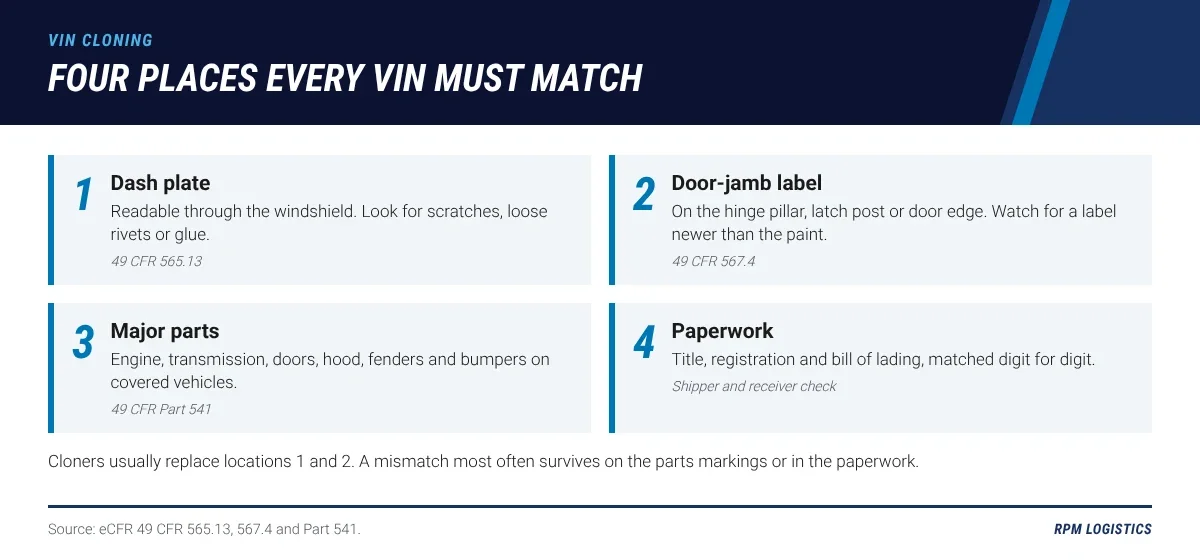
Cloners usually replace the two VINs a buyer looks at first; the parts markings are where a mismatch most often survives.
Check these locations against the title and the bill of lading:
- The dash plate. Federal rules require the VIN to be readable through the windshield, under 49 CFR 565.13. Look for scratches, loose rivets, glue or replacement fasteners.
- The door-jamb certification label. It must carry the VIN on the hinge pillar, door-latch post or door edge, under 49 CFR 567.4. A label that looks newer than the paint around it is a warning sign.
- Major parts. On covered vehicles, the federal theft prevention standard requires VIN markings on parts such as the engine, transmission, doors, hood, fenders and bumpers (49 CFR 541).
- The paperwork. Compare the title, registration and bill of lading digit for digit. Misspellings, odd fonts or a missing lienholder on a late-model car deserve a second look.
A cloned VIN will still pass the check-digit test, because it is a real VIN. Our guide on how to read and understand a VIN explains the check digit. For every location where a VIN appears, see where to find a VIN number.
What VIN checks can and cannot catch
Database checks are useful, but none of them can detect a cloned VIN on its own. Each one reports the history of the VIN, not the identity of the car in front of you.
- NICB VINCheck. The free tool searches theft and salvage records from participating insurers. It allows five searches per IP address per day, and NICB says it is not a comprehensive vehicle history report.
- NMVTIS title reports. The National Motor Vehicle Title Information System holds title, brand and junk, salvage and total-loss data. Since March 31, 2009, junk and salvage yards, recyclers and insurers have had to report those vehicles to NMVTIS at least monthly (U.S. Department of Justice).
- A physical VIN cross-match. Matching every VIN on the car against the documents is the only check aimed at the clone itself.
- A carrier condition report. A detailed report records the vehicle's physical state and can note a mismatched or damaged VIN plate. It cannot prove the car's legal identity.
The key point is that a cloned VIN passes database checks because the original car is clean. Records will look normal. Only the physical inspection shows that the car and the number do not belong together.
What shippers and receivers should do at pickup and delivery
Shippers and receivers can add a VIN-match step to every pickup and delivery with little extra time. The goal is to confirm the vehicle and its paperwork describe the same car.
- Record the VIN from the dash plate and the door label on the condition report, not just from the paperwork.
- Compare both against the bill of lading and title before the car loads.
- Photograph the VIN plate and label with the rest of the condition photos.
- Flag any mismatch or tampering and hold the vehicle until it is resolved.
- Repeat the check at delivery and note any difference on the receipt.
This step protects every party in the chain. A receiver who documents a VIN mismatch at delivery has evidence that the problem existed before the car arrived. Our guide to insurance-grade condition reports shows what a complete record includes. The broader controls are in our cargo theft prevention playbook.
What to do if you suspect a cloned VIN
If you suspect a cloned VIN, stop the transaction and keep the vehicle where it is. Moving or selling it can complicate the investigation and your own legal position.
- Do not complete the purchase or release. Hold the vehicle and the paperwork.
- Document everything. Photograph every VIN location and keep copies of all documents.
- Contact local law enforcement. Police can run the VIN against theft records and inspect the car.
- Tell your insurer and your transport provider. Both may need the record for a claim or investigation.
Buyers who already own a car that turns out to be cloned often lose the vehicle, because it is returned to the theft victim or the insurer. That is why the check belongs before money changes hands. Online purchases carry extra risk, as our guide to spotting online car-buying scams explains.
Frequently asked questions
What is VIN cloning and how does it work?
VIN cloning is when thieves copy the VIN of a legally registered car and put it on a stolen car of the same make, model and year. They replace the visible VIN plates and labels and often forge a title, so the stolen car appears to be the legal one.
How can I tell if a car has a cloned VIN?
Check that the VIN on the dash plate, the door-jamb label and any marked parts all match each other and the title. Look for signs of tampering such as scratches, loose rivets or a label that looks newer than the surrounding paint.
Will a VIN check or NICB VINCheck show a cloned VIN?
Usually not. A cloned VIN belongs to a clean, legal car, so database checks show that car's normal history. Only a physical match of the VINs on the vehicle against its paperwork can reveal a clone.
What is the difference between VIN cloning and a VIN swap?
VIN cloning copies a clean VIN from a legal car. A VIN swap moves the VIN from a salvage or wrecked car onto a stolen one. Both hide a theft, but a swap also carries a salvage history.
What happens if I buy a car with a cloned VIN?
The car is usually returned to the theft victim or the insurer, and the buyer may lose both the car and the money paid. Report it to police right away and keep every document.
Where else is the VIN on a car besides the dashboard?
Federal rules require a VIN on the door-jamb certification label. Many vehicles also carry VIN markings on major parts such as the engine, transmission, doors, hood, fenders and bumpers.
Can a cloned vehicle be shipped or sold through an auction?
Yes, which is why shippers and receivers should match the VINs on the vehicle against the paperwork at pickup and delivery. A documented mismatch protects every party in the chain.
Protect every handoff with documented VIN checks
Every pickup and delivery is a chance to catch a cloned vehicle before it moves further down the chain. RPM Logistics documents vehicle condition with timestamped photos at pickup and delivery across all 50 states and Canada, and screens its drivers' motor vehicle records continuously. Talk to our team about adding VIN-match steps to your transport program.