

Quick Answer
Mustang transport is the professional shipping of a Ford Mustang by car carrier, from a first-generation fastback to a late-model Shelby GT500. How the car should move depends on its generation and value. Early cars need care with fluids, brakes and trim. Modern performance models need low-angle loading. High-value cars need enclosed transport and agreed-value coverage.
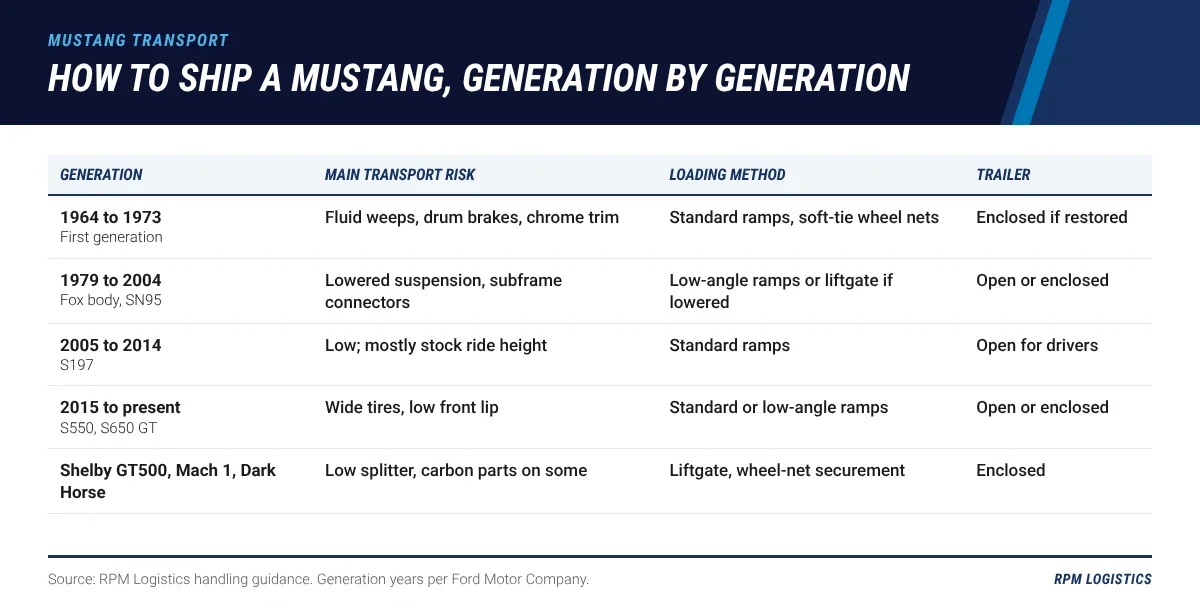
The risk moves from the underside of the car to the front splitter as you go from early cars to modern performance models, and the loading method has to follow it.
Why Mustangs need their own transport plan
A Mustang is not one kind of car. The nameplate covers more than 60 years of production, and a 1966 coupe and a 2024 Dark Horse share almost nothing mechanically. That range is why a single "classic car shipping" checklist misses the details that cause damage.
The demand is real and growing. Ford sold 45,333 Mustangs in the U.S. in 2025, and sales rose 22% in the first half of 2026 to 27,725 units (Ford, 2026). On the collector side, the 1965 to 1973 Mustang is the most insured car in Hagerty's book, with an average guide value of $23,350 (Hagerty). The Mustang was also the second most-quoted car among Hagerty's insurance quotes in 2024, behind only the Corvette (Hagerty Agent, 2025).
That mix of everyday cars and six-figure collectibles is why the shipping plan should start with two questions: which generation is it, and what is it worth? Our complete guide to classic car transport covers the general process. This guide covers what changes for Mustangs.
How to ship a Mustang by generation
The right way to ship a Mustang depends on which generation you own, because each era fails in a different place during loading and transit.
First generation (1964 to 1973)
First-generation Mustangs are light, simple and old, and age is the main risk. Many have manual drum brakes, aging rubber lines and carburetors that can weep fuel when the car sits at an angle. Chrome bumpers and trim are expensive to replace and easy to scratch.
- Check for leaks before pickup, and tell the carrier about any that exist.
- Confirm the parking brake works, or tell the driver it does not.
- Use soft-tie securement through the wheels, not hooks on old suspension parts.
- Choose enclosed transport for restored, show-quality or numbers-matching cars.
Fox body and SN95 (1979 to 2004)
Fox body and SN95 cars are often modified, and modifications change the loading plan. Lowered suspension, aftermarket exhausts and front air dams reduce clearance. Many also run subframe connectors, which can hang lower than the stock floor.
- List every modification on the order, including ride height changes.
- Measure the lowest point under the front of the car and share it.
- Ask for low-angle ramps or a liftgate if the car is lowered.
S197 (2005 to 2014)
The S197 is usually the easiest Mustang to ship, but condition still matters. Most of these cars ride at stock height and load on standard ramps without trouble. They are also the one recent generation losing value, so owners often ship them on open carriers to control cost.
Hagerty's valuation data shows condition-3 Mustangs from 1965 to 2014 gained value over five years, with one exception. The 2005 to 2014 cars fell 3.9% to $32,400 (Hagerty Agent, 2025). For a daily-driver S197, open transport is usually the sensible choice.
S550 and S650 performance models (2015 to present)
Late-model performance Mustangs are the hardest to load safely. The Shelby GT500, Mach 1 and Dark Horse carry low front splitters, wide tires and, on some GT500s, carbon fiber wheels. A standard carrier ramp can catch the splitter before the front tires reach the deck.
- Require a liftgate or extended low-angle ramps. State this on the order, not at pickup.
- Specify wheel-net securement so straps never touch carbon or painted wheel surfaces.
- Book enclosed transport for any car with track packages, carbon parts or low mileage.
Securement is where most low-clearance damage starts. Our breakdown of soft-tie versus hard-tie securement explains why wheel straps protect suspension and bodywork better than hooks.
Open or enclosed transport for a Mustang?
Choose enclosed transport for collectible, restored or high-performance Mustangs, and open transport for daily drivers. The deciding factors are value, finish and clearance, not the badge on the fender.
Mustang profile | Recommended method | Why |
|---|---|---|
Driver-quality S197 or S550 GT | Open carrier | Stock height, durable finish, lower cost |
Modified Fox body or SN95 | Open or enclosed with low-angle loading | Clearance matters more than weather |
Restored first-generation car | Enclosed, soft-tie | Paint, chrome and originality drive value |
Shelby GT500, Mach 1, Dark Horse | Enclosed with liftgate | Splitter clearance and carbon parts |
Concours or auction-grade Shelby | Enclosed, single-car if possible | Value and documentation outweigh cost |
RPM Logistics offers both options through its enclosed vehicle transport service and a carrier network of more than 15,000 active carriers (client-confirmed, October 2026). For high-value cars, our luxury and collector car transport team handles the single-car and white-glove options.
What insurance covers a Mustang in transit?
The carrier's cargo policy covers your Mustang in transit, and its limit is set by the carrier, not by federal law. Many owners assume federal minimums protect their car. They do not, and the gap matters most for valuable Mustangs.
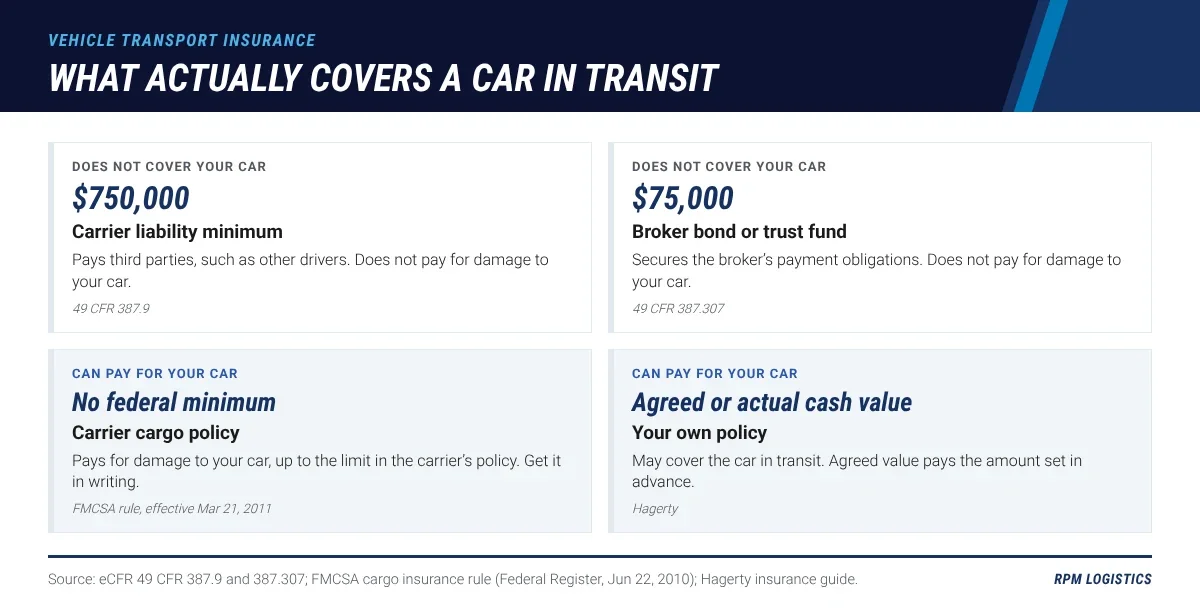
The two layers with federal dollar figures are the two that do not pay for damage to your car.
Four layers apply to a car on a carrier, and only two of them can pay for damage to it:
- Carrier liability coverage. For-hire carriers must carry at least $750,000 under 49 CFR 387.9. It protects third parties, such as other drivers, not the cargo.
- Broker bond. Brokers must hold a $75,000 surety bond or trust fund under 49 CFR 387.307. It secures payment obligations, not vehicle damage.
- Carrier cargo insurance. FMCSA removed the federal cargo insurance requirement for most property carriers effective March 21, 2011. The cargo limit is whatever the carrier's policy says, so get it in writing.
- Your own policy. A collector policy may cover the car in transit. Check whether it pays agreed value or actual cash value.
The difference between those last two is large for a collectible. Agreed value pays the amount you and the insurer set in advance. Actual cash value pays the market value on the day of the loss (Hagerty). Our explainer on agreed value versus actual cash value walks through the math.
Consider the top of the market. Mecum estimated a 1967 Shelby GT500 fastback at $350,000 to $400,000 for its 2026 Kissimmee sale (Classic Motorsports, 2026). A carrier cargo limit set for everyday cars may not come close. Confirm the limit before the car loads, and ask for a certificate naming your vehicle if the value is high.
Shipping a Mustang home from an auction
Shipping a Mustang from an auction means moving a car you may know only from a catalog description. Mecum, Barrett-Jackson and similar sales move a large share of high-value Mustangs each year. The handoff from auction lot to carrier is where documentation gaps appear.
- Book transport before the hammer falls if you plan to bid seriously. Release windows at large sales are short.
- Get the gate pass and release paperwork to the carrier the same day you receive them.
- Request a full photo condition report at pickup. It becomes the first independent record of the car's condition since the sale.
- Keep provenance documents with you. Marti Reports, build sheets and Shelby registry paperwork should never travel in the car.
Our guide to moving cars out of Mecum, Barrett-Jackson and RM Sotheby's covers auction logistics in general. For cars bought sight-unseen, pre-purchase inspection logistics can catch problems before the car ships.
How to prepare a Mustang for shipping
Preparing a Mustang for transport takes less than an hour and prevents most disputes at delivery.
- Wash the car so existing marks are visible in photos.
- Photograph every panel, the wheels, the interior and the underside of the front end.
- Write down the mileage at pickup and compare it at delivery.
- Remove loose items, toll tags and aftermarket parts that could detach, such as removable spoilers or wind deflectors.
- Leave about a quarter tank of fuel and a charged battery.
- Fold mirrors and secure convertible tops fully closed.
- Write down any quirks, such as a hard-starting carburetor or a weak parking brake, and give them to the driver.
A detailed condition report protects you if anything goes wrong. Our guide to insurance-grade condition reports shows what a complete record includes. If the car is coming from or going to a shop, see our guide to transport to and from restoration shops.
What to check when your Mustang is delivered
Delivery is your last chance to note damage before you sign, so check the car against the pickup report before the driver leaves. A careful inspection takes 15 to 20 minutes and protects any claim you might need to make.
- Inspect in good light. If the car arrives after dark, use a strong flashlight or ask to move it under lights.
- Walk the car panel by panel with the pickup report in hand, and compare each photo.
- Check the front lip and splitter on performance models, since loading is where that damage happens.
- Look at the wheels for strap marks, especially on painted or carbon fiber wheels.
- Check under the car for new fluid spots, and confirm the mileage matches what was recorded at pickup.
- Write any damage on the delivery receipt before you sign it, and photograph it with the driver present.
Noting damage on the receipt matters more than any later phone call. A clean signature usually means you accept the car as delivered. If something is wrong, our guide to how photo condition reports settle damage claims explains how the documentation is used. RPM Logistics also lists its claims process on the shipper claims page.
Frequently asked questions
How much does it cost to ship a classic Mustang?
The cost depends on distance, route demand, open or enclosed transport and how the car must be loaded. Enclosed, liftgate and single-car options cost more than standard open transport. Our guide to what goes into a classic car transport quote explains each line.
Should I ship my Mustang open or enclosed?
Ship daily-driver Mustangs on an open carrier and restored, collectible or high-performance models in an enclosed trailer. A Shelby GT500, Mach 1 or Dark Horse should also be loaded by liftgate or low-angle ramps.
How do you load a Mustang with a low front splitter?
Use a trailer with a hydraulic liftgate or extended low-angle ramps, and state the requirement on the order. Measure the lowest point under the front of the car and share it with the carrier before dispatch.
How old does a Mustang have to be to be considered a classic?
There is no single answer. State DMVs set their own age rules for antique or historic plates. Collector insurers focus more on how the car is used and stored than on its age.
Can you ship a Mustang that doesn't run?
Some carriers can move non-running cars with a winch, but it must be arranged in advance. If you are moving a project car, see our guide to moving a non-running barn find.
Who insures my Mustang while it is being shipped?
The carrier's cargo policy covers the car in transit, up to its stated limit. There has been no federal cargo insurance minimum for most carriers since 2011, so ask for the limit in writing. Your own collector policy may add coverage.
How do I get a Mustang I bought at Mecum or Barrett-Jackson shipped home?
Book transport before the sale, send the gate pass and release paperwork to the carrier right away, and request a full photo condition report at pickup. Keep Marti Reports and other provenance documents with you rather than in the car.
Ship your Mustang with the right protection
Every Mustang generation needs a slightly different plan, and the right plan protects both the car and its value. RPM Logistics moves Mustangs by open and enclosed carrier across all 50 states and Canada, with liftgate loading, soft-tie securement and photo condition reports at both ends. Request a quote and tell us the year, model and any modifications.