

Quick Answer
RV shipping cost depends on the RV's type and size, the transport method, distance, route, season and any permits the unit needs. Towables like travel trailers and fifth wheels move by towaway. Motorhomes move by driveaway, which adds fuel, tolls and driver return travel. An accurate price starts from your exact unit and route.
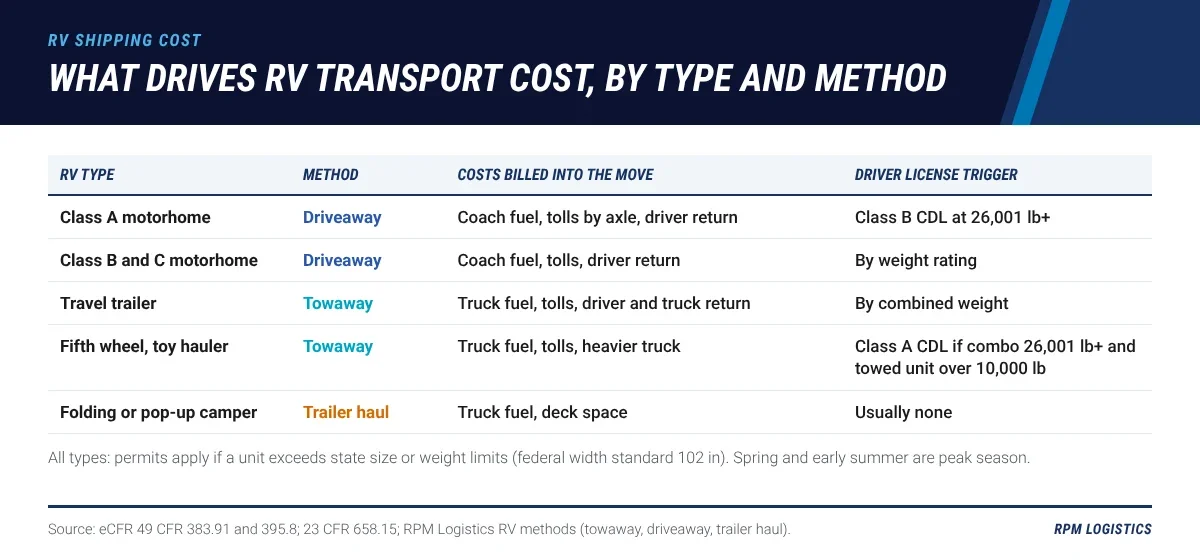
Two RVs of the same length can price very differently because the method, not the size alone, decides which costs land on the bill.
What determines RV transport cost?
RV transport cost is set by six factors: the RV's type, its size and weight, the transport method, the distance and route, the season, and any permits or special handling. Each one changes which truck and driver can take the job, and how long the move takes.
The method comes first, because it follows from the RV type. At RPM Logistics, towables move by towaway, motorhomes move by driveaway, and folding campers move on a trailer. Our RV transport services page explains each method and the RV types it fits. This guide explains how each one affects the price.
Volume also shapes the market. RV makers shipped 342,220 units wholesale in 2025, up 2.5% from 2024 (RV Industry Association, 2025). Towables made up 306,191 of those, and motorhomes 36,029. Every one of those units had to reach a dealer, and many move again when they sell.
How RV type and method affect the price
RV type affects price because it decides the transport method, and each method carries different costs. Here is how the main RV types compare.
Travel trailers
Travel trailers move by towaway, with a driver towing the unit behind a properly rated truck. Cost rises with length and weight, since heavier trailers need heavier trucks. A light travel trailer is usually the simplest towable to price.
Fifth wheels and toy haulers
Fifth wheels and toy haulers also move by towaway, but their weight raises the bar for the truck and the driver. Weight also decides licensing. A combination rated at 26,001 lb or more, towing a unit rated over 10,000 lb, requires a Class A commercial driver's license under 49 CFR 383.91. Fewer drivers qualify for the heaviest units, and that limits the pool of available trucks.
Class A, B and C motorhomes
Motorhomes move by driveaway, with a driver taking the coach to its destination on its own chassis. The bill reflects the coach's own running costs, not a carrier's truck. Larger Class A coaches also need a driver licensed for the weight. A single vehicle rated at 26,001 lb or more requires a Class B commercial license.
Folding and pop-up campers
Folding campers are light and low, so they ship on a trailer rather than being towed on their own wheels. They are typically the simplest RVs to move.
What goes into a driveaway quote for a motorhome?
A driveaway quote for a motorhome covers more than the miles. Because the coach moves under its own power, several costs belong to the motorhome itself.
- Fuel for the coach. Large motorhomes burn a lot of fuel, and diesel prices move quickly. The U.S. average diesel price was $6.179 a gallon on October 12, 2026 (EIA), up $2.514 from a year earlier.
- Tolls charged by axle. Toll roads often bill by axle count, so a large coach towing a car pays more than a passenger vehicle.
- Driver return travel. The driver has to get home after delivery, usually by air or bus.
- Hours-of-service limits. Long trips need overnight stops. Federal rules allow paper logs instead of an electronic logging device when the driveaway vehicle is a motor home or recreational vehicle trailer, under 49 CFR 395.8.
- Miles on the coach. Driveaway adds the trip's miles to the odometer, the same as if you drove it yourself.
Ask whether fuel, tolls and driver return are included in the quote or billed separately. That single question explains many of the gaps between quotes. Our guide to how professional driveaway works covers the method in more detail.
Why per-mile RV quotes mislead
Per-mile RV quotes mislead because a large share of the cost does not depend on distance. Pickup, inspection, paperwork, getting the truck or driver to the RV, and getting the driver home all cost about the same whether the trip is 200 miles or 2,000.
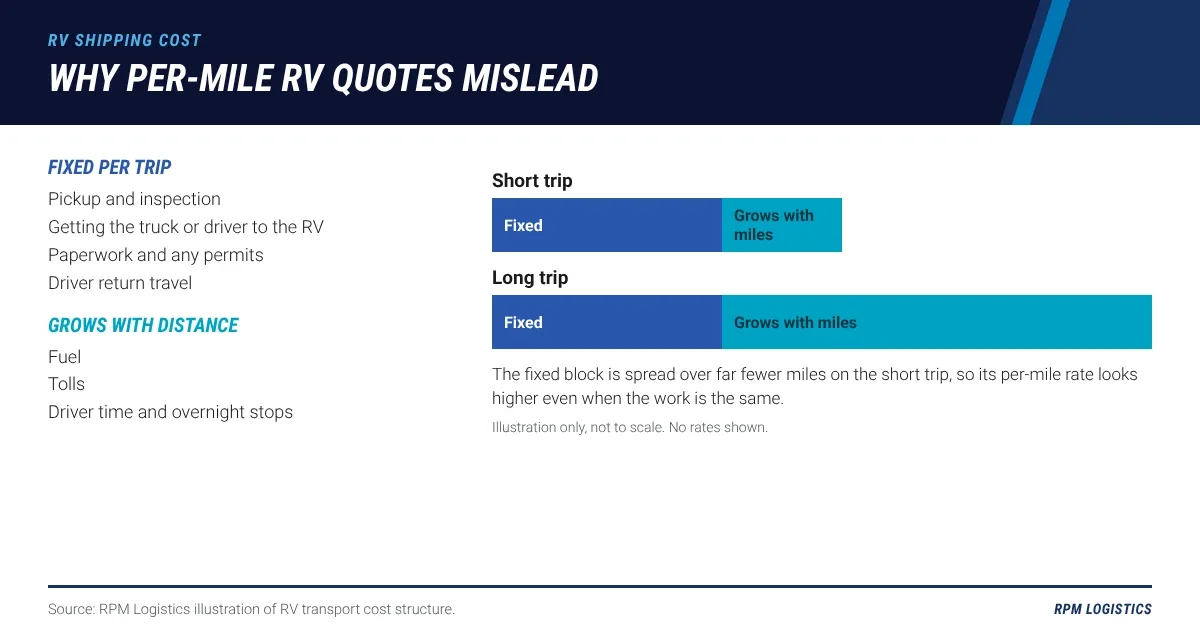
Fixed costs are spread across every mile of the trip, which is why the same RV can show a very different per-mile rate on a short move and a long one.
On a short move, those fixed costs are spread over few miles, so the per-mile rate looks high. On a long move, they are spread over many miles, so the rate looks low. Neither number tells you the real price. Published per-mile ranges on broker sites also differ widely and rarely state what they include.
Compare total prices for the same route and the same inclusions instead. The same logic applies across vehicle transport, as our piece on why transport quotes aren't apples to apples explains.
When does an RV become an oversize load?
An RV becomes an oversize load when its width, height, length or weight exceeds state limits for the route. On the National Network, states may not set a vehicle width limit other than 102 inches (23 CFR 658.15). Height, length and escort rules vary from state to state.
Most RVs are built to stay within road limits, so permits are the exception rather than the rule. Very large coaches, units with wide slide-outs that cannot fully retract, or loads that combine a coach and a towed vehicle can cross a threshold. When they do, permits, route planning and sometimes escorts add to the cost. Our guide to when a motorhome becomes an oversize move covers those cases.
How season and route affect RV transport cost
Season and route affect RV transport cost because they control how many drivers and trucks are available. Spring and early summer are peak RV season, when buyers take delivery before camping trips. Late fall and winter are often quieter, outside snowbird routes.
Route matters in a similar way. Busy corridors between major markets tend to cost less than rural routes, because carriers can match loads in both directions. A pickup far from a highway, or a delivery to a campground with tight access, can add time.
Market conditions shift too. RVIA's June 2026 forecast put 2026 wholesale shipments at 300,000 to 328,100 units, with a median of 314,000, down from 2025 (RVIA, 2026). Resale values also moved. J.D. Power reported Class A values down just over 4% and Class C values down 10% year over year in the second quarter of 2026 (J.D. Power, 2026). Lower values make transport a larger share of a used RV's total cost, so plan for it before you buy. For timing tips, see our guide to booking ahead of peak season capacity.
What an accurate RV quote should include
An accurate RV quote lists the method, the equipment and every cost included. Use this checklist to compare quotes on equal terms.
- Method and equipment. Towaway, driveaway or trailer haul, and the truck or license class required.
- Fuel and tolls. Included or billed separately, especially for driveaway.
- Driver return travel. Included or extra.
- Permits and escorts. Needed or not for your unit and route.
- Pickup window. A date range the carrier can commit to.
- Running condition. Motorhomes must run, and towables must be road-ready with working tires, brakes and lights. RPM Logistics does not move non-running RVs.
- Pickup access. Dealer lot, storage yard, campground or private seller, and any access limits.
- Insurance. The carrier's cargo and liability limits, confirmed in writing.
- Condition reports. Photo documentation at pickup and delivery. See how photo condition reports prevent disputes.
The more of this you share up front, the closer the first quote will be to the final price. It also lets you line up two quotes side by side and see exactly where they differ. A coordinator needs the RV type, length, height, GVWR, hitch type and both addresses.
Ways to lower your RV shipping cost
You can lower your RV shipping cost by giving the carrier more flexibility and fewer surprises.
- Offer a wider pickup window so the carrier can fit your RV onto an efficient route.
- Ship outside the spring peak if your timing allows.
- Retract slides and remove add-ons such as bike racks that change height or width.
- Have the RV road-ready before pickup, so the driver does not lose time.
- Empty tanks and remove cargo to keep weight down.
- Confirm the release with the dealer or seller before the driver arrives.
Moving an RV across the border? Our guide to cross-border vehicle moves into Canada covers the extra paperwork.
What happens on pickup and delivery day
Pickup and delivery day are when the condition of your RV gets documented, so a little preparation keeps both days short. Delays at either end can add cost, especially for driveaway moves where the driver's time is part of the price.
At pickup, the driver inspects the RV and photographs it from every side, including the roof edge, slides and awnings. You or the seller sign the condition report with the driver. For a motorhome, the driver also checks that it starts, that the brakes and lights work, and that it is registered and road-legal. For a towable, the driver checks the hitch, tires, brakes and lights before hooking up.
At delivery, the process runs in reverse. Walk the RV with the driver, compare it to the pickup photos, and note any new marks on the delivery receipt before you sign. Check that slides extend and retract and that nothing shifted inside. Our guide to how transport insurance responsibility works explains what happens if something does go wrong.
Driveaway and towaway each have trade-offs beyond cost. Driveaway adds miles to a motorhome but needs no second truck. Towaway puts no miles on a trailer's engine because it has none, but it does add tire and bearing wear. The broader comparison is in our piece on driveaway vs. haulaway cost trade-offs.
Frequently asked questions
Why do RV transport quotes vary so much for the same route?
Quotes vary because providers include different costs. One may include fuel, tolls and driver return, while another bills them separately. Method, equipment, pickup window and permit needs also change the price.
Does shipping a fifth wheel cost more than a travel trailer?
Often, yes. Fifth wheels are usually heavier, which can require a larger truck and a driver with a higher license class. That narrows the pool of available carriers.
Is shipping an RV cheaper in winter?
It can be. Spring and early summer are peak RV season, so demand for drivers and trucks is highest then. Winter can be quieter outside snowbird routes, though weather can add time.
Why don't RV shippers quote a flat per-mile rate?
Much of the cost is fixed, such as pickup, inspection and driver return. Those costs make the per-mile rate change with distance, so a total price for your exact route is more accurate.
Are fuel and tolls included in a motorhome driveaway quote?
It depends on the provider. Driveaway uses the coach's own fuel, and tolls are often charged by axle. Ask whether both are included before you compare quotes.
Does buying from a private seller instead of a dealer change the cost?
It can. Private sellers may have tighter access or less flexible release times, which affects scheduling. Confirm the title, the seller's availability and the RV's road-readiness before booking.
Get an accurate quote for your RV
The fastest way to know your RV shipping cost is a quote built from your exact unit and route. RPM Logistics moves travel trailers, fifth wheels, toy haulers, campers and Class A, B and C motorhomes across all 50 states and Canada, with photo condition reports at pickup and delivery. Share your RV's details through our RV transport page, and a coordinator will respond within one business day.