

Quick Answer
Total loss vehicle transport moves a car an insurer has declared a total loss from a tow yard, body shop or owner's home to a salvage auction yard. The move waits on the settlement, the title and the release, and storage fees run until pickup. Fast, documented moves protect the salvage value the insurer recovers at auction.
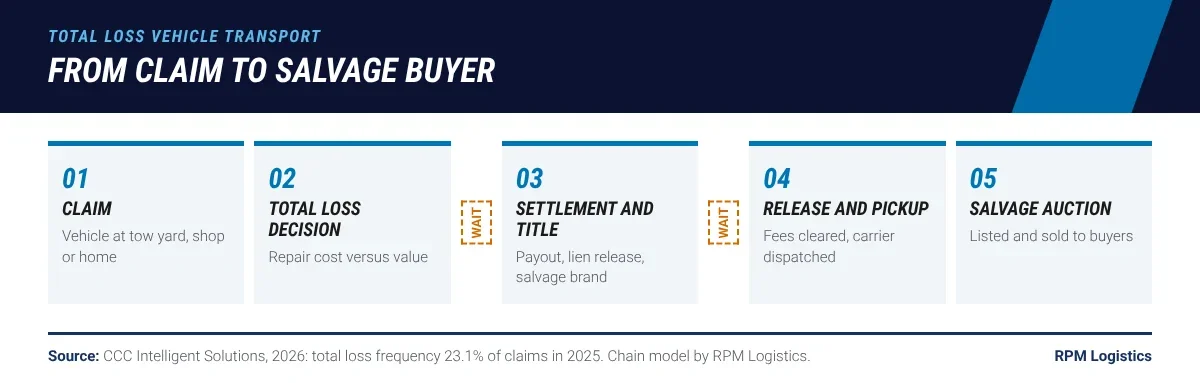
The transport leg sits in the middle of the claim. Delays on either side of it add storage days.
Why Total Loss Volume Keeps Climbing
A total loss is a vehicle the insurer decides is not worth repairing. Usually that means repair cost plus salvage value exceeds the car's actual cash value. Each state sets its own threshold or formula.
The share of claims ending this way has hit record levels. Total loss frequency reached 23.1% of claims in 2025, the highest in the industry's data (CCC Intelligent Solutions, 2026). Through the second quarter of 2026, it rose again to 23.5% (CCC Intelligent Solutions via Repairer Driven News, 2026).
Older vehicles drive much of the trend. About 72% of 2025 total loss valuations were for vehicles seven years old or older (CCC Intelligent Solutions, 2026). Lower values and higher repair costs push more of them past the repair line. Even newer cars are not immune: about 1 in 10 vehicles three years old or newer gets flagged as a total loss (CCC Intelligent Solutions, 2026).
More total losses mean more vehicles to move, often from places that charge by the day.
The Claim Chain Behind Every Salvage Move
Transport is one link in a longer chain. Most delays come from the links around it, not the drive itself.
1. Claim and first location
After a crash, flood or theft recovery, the vehicle lands somewhere. That might be a tow yard, a body shop, a police impound lot or the owner's driveway. Each location has different release rules and fees.
2. Total loss decision
An adjuster or appraiser inspects the vehicle and compares repair cost with its value. Once it is declared a total loss, the clock starts on settlement and removal.
3. Settlement and title
The insurer pays the owner, or the owner's lender, and takes ownership. The owner signs the title to the insurer. If there is a lien, the lender must release it first. The insurer then applies for a salvage title or similar brand in the state. RPM's guide to title jumping explains why the chain of ownership has to stay clean.
4. Release and pickup
The insurer or its salvage partner arranges pickup. The holding location needs proof that the insurer can take the vehicle, and fees must be settled. This is where transport begins.
5. Salvage auction
The vehicle goes to a salvage auction yard, gets photographed and listed, and sells to rebuilders, exporters, dismantlers or dealers. RPM's beginner's guide to how car auctions work covers the auction side.
6. Buyer pickup
The winning buyer arranges transport from the auction yard. That second move is often across state lines or to a port for export. See RPM's overview of auction vehicle transport.
Why Speed Matters: Storage Fees and Salvage Value
Every day a total loss sits at a tow yard or body shop usually adds a storage charge. These fees are billed to the insurer once it owns the vehicle. Long holds also tie up space the shop needs for paying repair work.
Value moves too. Salvage prices follow the wider used market. Wholesale used-vehicle prices fell 2.3% from September to October 2026 (Cox Automotive, November 2026). A vehicle that reaches auction a few weeks late may sell into a softer market.
The biggest delays come from:
- Title paperwork. Missing signatures, lien payoffs and out-of-state titles hold the vehicle in place.
- Release confusion. The holding location may not know who is authorized to collect the vehicle.
- Unpaid fees. Some yards will not release until every charge is cleared.
- Wrong equipment. A carrier that arrives without a winch for a non-runner has to come back.
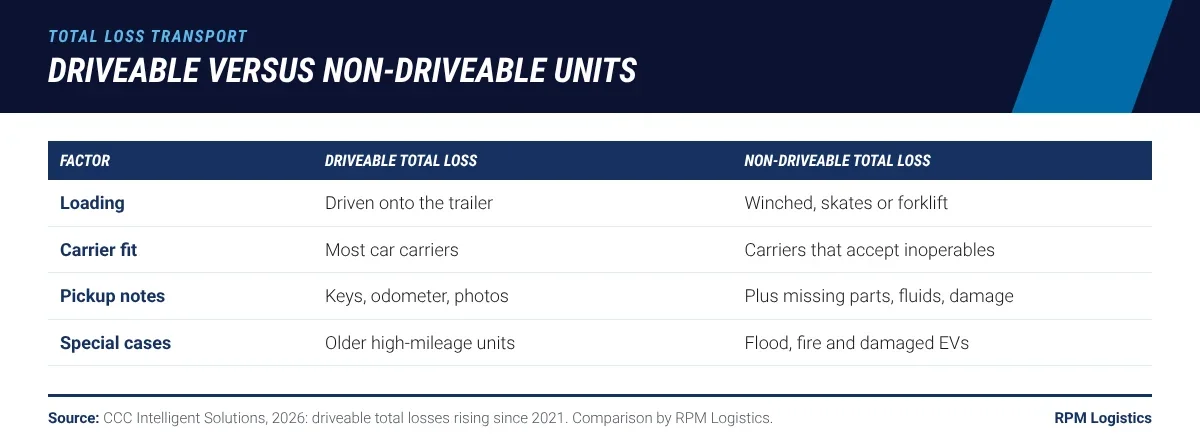
Tell the carrier whether the vehicle rolls, steers and brakes. That one detail decides the equipment.
Driveable and Non-Driveable Total Losses
Not every total loss is a wreck. Driveable total losses have risen since 2021 (CCC Intelligent Solutions, 2026). These are vehicles that still run but cost too much to fix relative to their value.
Driveable units load like any used car. Non-driveable units need more planning:
- A winch to pull the vehicle onto the trailer.
- Wheel skates or dollies if wheels are locked or missing.
- Forklift support at the pickup site for badly damaged units.
- A carrier willing to take inoperable vehicles, since some will not.
RPM answers common questions about moving cars that do not run in its guide to shipping a non-running car.
Flood and fire losses
Flood vehicles may leak fluids and carry mold. Fire-damaged units can be structurally weak. Both need clear notes to the carrier so the right trailer and handling are used.
Electric vehicle total losses
A damaged EV battery can overheat days after the incident. Many salvage yards quarantine EV total losses away from other vehicles. Tell the carrier the vehicle is electric, describe the damage and confirm the destination yard accepts damaged EVs.
Documentation That Protects the Insurer
Once the insurer owns the vehicle, any change in condition between pickup and auction is its loss. Good documentation keeps that clear.
At pickup, the carrier should record:
- Photos of every side, the interior and the odometer.
- Whether keys are present.
- Missing parts, open panels and loose items.
- The VIN, checked against the claim file.
VIN checks matter more than they seem. Total loss yards hold many similar vehicles. Decoding the VIN with NHTSA's VIN decoder and matching make, model and year catches mix-ups before the wrong car leaves. RPM's guide to insurance-grade condition reporting covers what a usable report includes.
Insurers also report total loss vehicles to the National Motor Vehicle Title Information System, the federal database that tracks title brands. Clean records at each step support that reporting and help prevent a branded vehicle from being retitled as clean later.
How Total Loss Moves Differ From Fleet Damage Recovery
Fleet owners face a related problem when their own vehicles are damaged. That move usually goes from the crash site or tow yard to a repair shop or storage, and the fleet still owns the vehicle. RPM covers that path in its guide to fleet damage recovery logistics.
A total loss move is different. Ownership changes to the insurer, the title is branded and the destination is a salvage auction. Lenders face a similar handoff when they recover vehicles. See RPM's guide to lender recovery vehicle transport.
Catastrophe Events: When Total Losses Arrive at Once
Hurricanes, floods and hailstorms turn a steady flow of total losses into a surge. Thousands of vehicles can be declared total losses in one region within days. Tow yards fill, local carriers are booked solid and storage costs climb.
Insurers that handle these events well tend to do a few things early:
- Stage overflow yards close to the affected area so vehicles leave tow yards quickly.
- Bring in outside carrier capacity from unaffected regions before local trucks run out.
- Batch releases by location so each truck loads several vehicles at one stop.
- Flag flood vehicles clearly in the claim file and on transport orders, since they need separate handling.
Planning for a surge before storm season costs far less than scrambling after one. A transport partner with national reach can shift trucks into a region while local carriers are overwhelmed.
What a Transport Partner Needs at Booking
Most failed salvage pickups trace back to missing booking details. Send these with every order:
- Claim number and VIN.
- Pickup address, contact name, phone and hours.
- Release authorization and any fee confirmation.
- Condition: driveable, non-driveable, flood, fire or EV.
- Whether keys are with the vehicle.
- Destination yard and its receiving rules.
With these in hand, the carrier can send the right equipment the first time. A second trip for a missing winch or an unpaid fee adds days to the claim.
Total Loss Transport Checklist for Claims Teams
- Confirm the vehicle's location, contact and hours.
- Confirm ownership has passed and the title or lien release is in progress.
- Send a release authorization to the holding location.
- Settle or confirm storage and tow fees before pickup.
- Tell the carrier whether the vehicle is driveable, electric, flood- or fire-damaged.
- Confirm the destination yard's receiving hours and requirements.
- Require a photo condition report and VIN check at pickup.
- Record delivery at the auction yard and close the transport file.
Choosing a Transport Partner for Salvage Moves
Salvage volume is uneven. A storm or hail event can create hundreds of total losses in one region at once. Insurers need a partner that can add capacity fast and handle non-runners.
Before you assign a carrier, confirm its operating authority on the FMCSA company snapshot. Ask how it handles inoperable vehicles, how quickly it reports pickup and delivery, and what its condition reports include.
RPM Logistics moves remarketing and salvage vehicles in all 50 states and Canada, with a network of 15,000+ active carriers. Its retail and remarketing vehicle transport service covers moves to and from auctions. For the broader picture, see RPM's guide to remarketing logistics.
Frequently Asked Questions
What happens to a car after it is declared a total loss?
The insurer pays the owner or lender and takes ownership. The title transfers to the insurer and is usually branded salvage. The vehicle then moves to a salvage auction yard, where it sells to rebuilders, dismantlers, exporters or dealers.
Who pays to transport a total loss vehicle?
The insurer usually pays once it owns the vehicle. Storage and tow fees at the holding location are also typically billed to the insurer. The buyer at auction pays for the next move from the auction yard.
How fast should a total loss vehicle be picked up?
As soon as ownership and release are confirmed. Storage fees usually accrue daily at tow yards and body shops. Faster pickup also gets the vehicle to auction sooner, which can protect its salvage value.
Can a non-running total loss vehicle be shipped?
Yes. Non-driveable total losses ship on trailers equipped with a winch, and sometimes need wheel skates or a forklift at pickup. Tell the carrier the vehicle's condition when booking.
How common are total loss claims?
Total loss frequency reached a record 23.1% of claims in 2025, according to CCC Intelligent Solutions. It climbed to 23.5% through the second quarter of 2026.
Are electric vehicle total losses handled differently?
Often, yes. A damaged EV battery can overheat after the incident, so many salvage yards quarantine EV total losses. Tell the carrier the vehicle is electric and confirm the destination yard accepts damaged EVs.
Is a total loss the same as a salvage title?
Not exactly. A total loss is the insurer's decision that repair is not worth the cost. A salvage title is the brand the state puts on the vehicle's title afterward. Most total losses end up with a salvage or similar brand, though the rules vary by state.