

Quick Answer
Growing an auto haul fleet means financing new trucks and trailers that must pay for themselves from loaded miles. The second truck adds your first employee driver and its compliance costs. By the fifth truck, dispatch, maintenance and cash reserves become the limit. Lenders approve growth faster when you show steady revenue per unit.
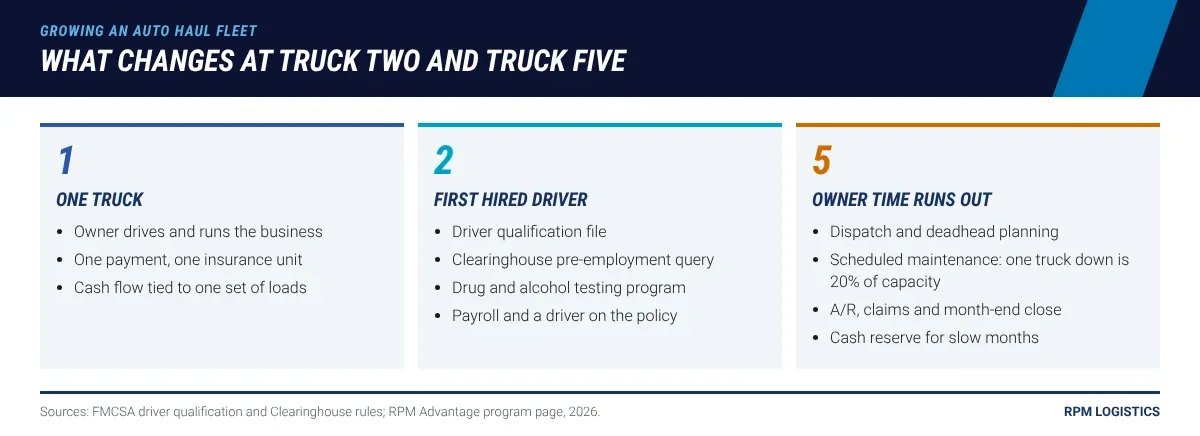
The payment on truck two is the easy part to model; the new fixed costs that arrive with the first hired driver are what most growth plans miss.
What does it mean to grow an auto haul fleet?
Growing an auto haul fleet is the step from one owner-operated rig to several trucks and trailers run as a business. Each added unit needs equipment financing, a qualified driver, insurance and enough freight to keep it loaded. The financing decision and the operating decision are the same decision.
The stakes are high because equipment is one of the largest costs in trucking. The average marginal cost of operating a truck reached $2.336 per mile in 2025, the highest in ATRI's annual cost report (ATRI, 2026). Truck and trailer lease or purchase payments alone ran 40.4 cents per mile, up from 39 cents a year earlier (ATRI, 2026).
That payment share is why growth math matters more than growth ambition. A new rig adds a fixed payment from the day it is delivered. It only adds profit once it runs enough loaded miles to cover that payment and everything else it brings with it.
When is a car hauling business ready for a second truck?
A car hauling business is ready for a second truck when the first one is consistently turning away loads, not just busy. Turned-away freight is evidence that demand exists beyond what one rig can carry. Lenders and insurers will ask for that evidence too.
Check these signals before applying for financing:
- Turned-away loads: you decline good loads most weeks because the trailer is full.
- Stable lanes: a few shippers or lanes account for repeat freight, month after month.
- Clean books: monthly profit and loss statements close on time and match the bank account.
- Cash reserve: you hold enough cash to cover several months of the new payment.
- Clean safety record: no open compliance issues that would complicate a new driver or unit.
Cash matters most. Small carriers can fold within 90 days of a cash crunch, according to the RPM Advantage carrier program page. A second truck makes the business bigger, but it also makes a slow month more expensive.
What changes when you add the second truck?
The second truck changes the business more than any truck after it, because it usually brings the first employee driver. The owner stops being the only driver and becomes an employer with new compliance duties.
Driver qualification and drug testing
Every employee driver needs a driver qualification file under FMCSA rules, with the application, motor vehicle record and medical certificate. Before the driver's first load, you must run a full pre-employment query in the FMCSA Drug and Alcohol Clearinghouse. The driver must also be enrolled in a drug and alcohol testing program.
CDL class and equipment fit
Most car hauler combinations need a Class A CDL. Under 49 CFR 383.91, a combination rated at 26,001 pounds GCWR or more, towing a unit rated over 10,000 pounds, is a Class A vehicle. Smaller hotshot setups may fall under that line. Your trailer choice for truck two decides which drivers you can hire.
Insurance and authority
Interstate carriers hauling general property must carry at least $750,000 in public liability coverage under 49 CFR 387.9. Adding a truck and a driver changes the premium, and cargo coverage must match the vehicles you haul. New carriers also stay under FMCSA's new entrant safety monitoring for their first 18 months, which affects how insurers price growth.
For a full checklist of carrier compliance, see our guide to DOT compliance for automotive carriers.
How do you run the financing math on a new truck?
The financing math on a new truck starts with its monthly fixed cost, then asks how many loaded miles it needs to cover that cost. If the answer is more miles than your freight can reliably supply, the truck will drain cash instead of adding profit.
Work through the numbers in this order:
- Add the fixed costs. Truck payment, trailer payment, insurance, permits and any parking or yard fees.
- Add the variable costs per mile. Fuel, tires, maintenance, tolls and driver pay.
- Estimate realistic loaded miles. Use your own history, not your best month.
- Subtract deadhead. Empty miles cost money and pay nothing.
- Find the break-even. Divide the fixed costs by the margin each loaded mile leaves after variable costs.
Here is a hypothetical example, not a market rate. Suppose the new rig's fixed costs come to $9,000 a month. Each loaded mile leaves $0.90 after variable costs. The truck must run 10,000 loaded miles a month to break even before it earns a dollar of profit.
Now change one input. If that rig only finds 8,000 loaded miles in a slow month, it loses money on fixed costs alone. That is why lenders ask about revenue stability, and why the reserve matters as much as the rate.
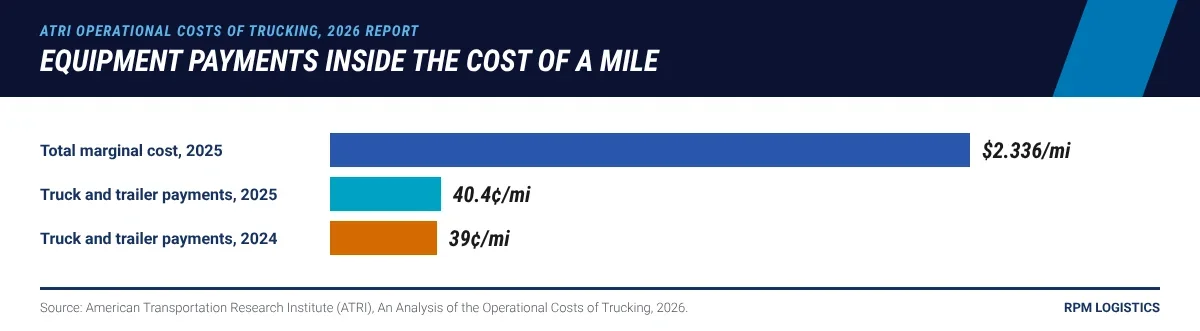
Equipment payments are a fixed line in a per-mile world: they do not shrink when the truck sits, which is why utilization decides whether a financed unit pays off.
What do lenders want to see from a growing carrier?
Lenders want proof that a growing carrier can carry another payment through a bad month. For a first truck, they focus on credit and down payment. For the second through fifth truck, the business's own numbers carry more weight.
Expect a lender to review:
- Time in authority and a clean safety history.
- Bank statements that show steady deposits, not occasional large ones.
- Profit and loss statements that tie to those deposits.
- Customer mix, including whether a few accounts carry most of the revenue.
- Existing debt on the equipment you already run.
Customer concentration is a hidden risk. In one buy-side review published on the RPM Advantage page, 63% of a hauler's revenue came from two accounts (RPM Advantage, 2026). Losing one of them would have changed the value of the whole business.
For how lenders evaluate a single unit, see our guide to auto hauler equipment financing. For the choice between financing, leasing and renting trailers, see our breakdown of lease-to-own, rent or buy for car hauler trailers.
What changes by the fifth truck?
By the fifth truck, the owner's time becomes the main constraint, not equipment or credit. Someone has to dispatch, plan maintenance, chase receivables and close the books. If the owner still does all of it, growth slows or mistakes multiply. Many owners hire a dispatcher or office manager before they add a sixth driver, because that hire frees the time to run the business.
The common pressure points at this size are:
- Dispatch: keeping five trucks loaded and limiting deadhead takes daily planning.
- Maintenance: one truck down is now 20% of capacity, so scheduled service matters.
- Receivables: more invoices mean more chances for slow pay and disputes.
- Claims: more moves mean more damage claims to document and resolve.
- Month-end close: slow books can leave owners deciding with data that is 45 days old, per the RPM Advantage page.
This is also the size where profitable fleets can still run short of cash. Our article on car haulers who are profitable on paper but broke in the bank explains how that gap opens.
What growth mistakes do auto haulers make most often?
The most common growth mistakes come from planning around the best month instead of the average one. A truck financed on peak-season revenue still owes its payment in January. These are the patterns that show up most often in struggling small fleets.
- Buying before the freight exists. A new rig without committed lanes spends its first months hunting loads.
- Skipping the reserve. Putting every dollar into the down payment leaves nothing for a breakdown or a slow-paying customer.
- Mixing equipment types too early. A different trailer size can mean different drivers, parts and customers to manage.
- Ignoring deadhead. Growth that adds empty miles adds cost without adding revenue.
- Leaning on one customer. A fleet built around one shipper can lose most of its income in one phone call.
- Letting the books slip. Late numbers hide problems until they are expensive to fix.
Most of these mistakes share one cause: the owner is too busy driving or dispatching to watch the numbers. Fixing that, through hiring, outside help or simpler systems, is part of the cost of growth. It belongs in the plan alongside the truck payment.
A simple discipline helps. Review cost per mile, revenue per truck and days sales outstanding every month, on the same date. Trends in those three numbers show trouble long before the bank balance does.
Finance, lease-to-own or dedicated freight: what fits each growth stage?
Each growth stage has a different main risk, so the best tool changes as the fleet grows. The table below matches common options to the stage where they help most.
Growth stage | Main risk | Tool that fits |
|---|---|---|
Truck 1 to truck 2 | Cash reserve and first hire | Equipment financing with a credit-neutral prequalification |
Trucks 2 to 4 | Utilization gaps between loads | Lease-to-own or rental trailers to test demand before buying |
Trucks 5 and up | Owner time and stale numbers | Outside CFO support for close, A/R and claims |
Any stage | Revenue swings | Dedicated freight with predictable daily revenue |
Predictable revenue helps at every stage. RPM's dedicated carrier program guarantees daily revenue per piece of equipment by trailer type, assigned from contract-awarded freight (RPM Advantage, 2026). Steady revenue makes the break-even math easier to plan around.
How RPM Advantage supports fleet growth
RPM Advantage is RPM's program for owner-operators growing toward a fleet and for fleets of 5 to 30 or more trucks. It covers four areas, each tied to a growth stage above:
- Equipment financing through Equipment Funding Solutions, with access to 200+ niche transportation and small-business lenders and no effect on your credit score to apply.
- Preferred equipment through Sun Country Trailers, on a lease-to-own or rental basis.
- Financial consultation with Guastella Advisors, from a one-time assessment to full-charge CFO support.
- A dedicated carrier program that assigns contract freight on a daily-revenue model.
RPM also works with a network of more than 15,000 active carriers, so growing fleets can plug into steady vehicle freight. Seasonal peaks can help fill new capacity, as covered in our guide to peak-season carrier capacity. Learn more on the RPM Advantage page.
Frequently asked questions
How much cash should I have before adding a second truck?
Hold enough cash to cover several months of the new truck's fixed costs, including payment and insurance. Small carriers can fail within 90 days of a cash crunch, so the reserve protects the whole business.
Do I need a Class A CDL to drive a car hauler?
Most car hauler combinations need a Class A CDL. Under 49 CFR 383.91, a combination rated at 26,001 pounds GCWR or more, towing a unit rated over 10,000 pounds, is Class A. Some smaller hotshot setups fall below that line.
What compliance steps come with hiring my first driver?
You need a driver qualification file, a full pre-employment query in the FMCSA Clearinghouse and enrollment in drug and alcohol testing. Your insurance policy must also list the new driver.
How do lenders judge a carrier that wants to add trucks?
Lenders review time in authority, safety history, bank statements, profit and loss statements, customer mix and existing debt. Steady revenue across several customers improves approval odds.
Does applying for RPM Advantage equipment financing affect my credit score?
No. The RPM Advantage page states that the financing application has no effect on your credit score.
Is lease-to-own better than buying a trailer when growing?
Lease-to-own can help when demand for a new unit is not yet proven. It lowers the up-front cost and keeps an ownership path open. Buying can cost less over time once utilization is steady.
Grow your fleet with a plan
A new truck should add profit, not just payments. RPM Advantage pairs financing, equipment, financial guidance and dedicated freight for auto haulers ready to grow. Explore RPM Advantage or talk to our carrier team.