

Quick Answer
A month-end close for an auto hauler is the routine of locking each month's books. It means matching every load to its invoice, reconciling bank and fuel accounts, booking the month's costs and reviewing margin by truck. A clean close shows which lanes, customers and trucks make money. Without it, a carrier can look busy and still lose cash.
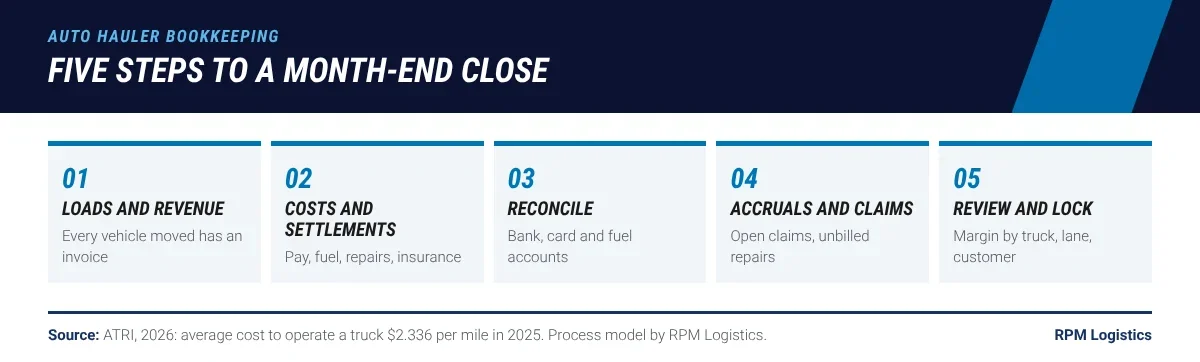
Five steps, in order. Skipping the review step is how a carrier closes the books without learning anything from them.
Why Auto Haulers Need a Real Month-End Close
Many small car hauling companies run their books once a year, at tax time. That tells them what happened twelve months ago. It does not tell them whether last month's lanes paid.
Costs are rising faster than most rates. The average cost to run a truck hit a record $2.336 per mile in 2025, up 3.4% (ATRI, 2026). Excluding fuel, costs rose 4.2% to $1.854 per mile (ATRI, 2026). Repair and maintenance rose 8.6% to 21.5 cents a mile (ATRI, 2026). Insurance averaged 10.6 cents a mile, up 23.9% since 2021 (ATRI, 2026).
When costs move that fast, a monthly view is the only way to catch a losing lane before it costs a quarter's profit. RPM explains how carriers end up profitable on paper and broke in the bank. A monthly close is the fix for that gap.
What Makes Car Hauling Books Different
Auto transport has a few features that generic trucking bookkeeping guides skip:
- Revenue is per vehicle, not per load. One trailer may carry eight or nine vehicles for several customers, each on its own rate and invoice.
- Claims are a real cost line. A scratched panel or broken mirror can erase the margin on a whole load.
- Deadhead is common. Return trips without full loads drive cost per loaded mile up.
- Payment terms vary. Dealers, brokers, auctions and OEM programs all pay on different schedules.
A close built for car hauling tracks all four.
Step 1: Match Every Vehicle Moved to an Invoice
Start with revenue. Pull every load completed in the month and list each vehicle on it. Every vehicle needs an invoice, and every invoice needs a delivered vehicle.
- Flag vehicles delivered but not yet invoiced. Bill them now.
- Flag invoices with no proof of delivery. Find the signed condition report.
- Check rates against the rate confirmation, including any agreed extras.
Before extending terms to a new broker or shipper, confirm its operating authority on the FMCSA company snapshot. A receivable from a customer with no valid authority is a risk on your books.
Step 2: Book Costs, Settlements and Payroll
Next, capture every cost the month incurred. The usual lines are:
- Driver pay and settlements, including per-vehicle or percentage pay.
- Fuel, from fuel card statements.
- Repairs, tires and maintenance.
- Insurance premiums, including the month's share of any annual policy.
- Truck and trailer payments or lease costs.
- Tolls, permits and parking.
Match driver settlements to logged trips. Electronic logging devices record miles and hours, which helps confirm what drivers ran. The FMCSA's ELD overview explains what those devices record. Mileage by state from the same data also supports fuel tax reporting.
Step 3: Reconcile Bank, Card and Fuel Accounts
Reconciliation means matching your books to the bank. Every deposit should tie to a paid invoice. Every withdrawal should tie to a recorded cost.
Unmatched items are the useful part. A deposit with no invoice may be a short payment. A charge with no receipt may be a personal expense on a business card, or a fuel card used outside a trip. Fix each one before you close. RPM covers the common ways money slips out in its guide to auto hauler cash flow leaks.
Step 4: Book Accruals and Claims Reserves
Some costs belong to the month even if the bill comes later. Book them now so the month's margin is real:
- Open damage claims, at your best estimate.
- Repairs done but not yet billed by the shop.
- Insurance and loan payments spread evenly across months.
- Depreciation on trucks and trailers.
Claims deserve extra attention. A claim reported in March for damage on a February load still belongs to February's margin. RPM explains how cargo claims work in its guide to OS&D and the claims process.
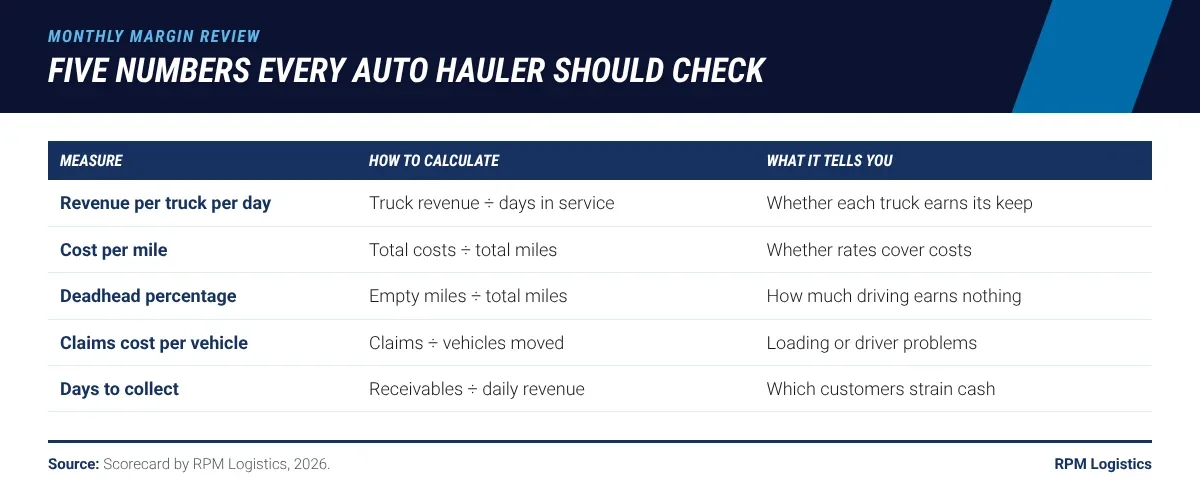
Five numbers, reviewed every month, show where margin is made or lost.
Step 5: Review Margin by Truck, Lane and Customer
This is the step that turns bookkeeping into decisions. Review a small set of measures each month:
- Revenue per truck per day. Shows whether each truck earns its keep.
- Cost per mile. Compare it to the month before and to your rates. RPM's cost per mile guide walks through the math.
- Deadhead percentage. Empty miles divided by total miles.
- Claims cost per vehicle moved. A rising number points to a loading or driver problem.
- Days to collect. How long customers take to pay.
Then lock the month so nobody edits closed numbers. Changes after the lock go into the next month with a note.
Common Month-End Mistakes in Car Hauling
Most carriers who struggle with month-end make the same few mistakes:
- Mixing personal and business accounts. Every personal charge on a business card has to be found and moved. Separate accounts remove that work.
- Booking revenue when paid, not when earned. A load delivered in March and paid in April belongs to March. Cash-basis books hide which month made money.
- Ignoring small claims. A $300 mirror claim looks minor. Ten of them a month is a pattern worth fixing.
- Paying drivers from memory. Settlements that do not tie to logged trips create disputes and errors. Driver logs under the FMCSA hours-of-service rules give you a record to match against.
- Closing without reviewing. Books that are reconciled but never read do not change any decisions.
The fix for each is a habit, not software. Pick one mistake to remove each month.
A Month-End Close Checklist for Auto Haulers
- List every vehicle delivered and confirm each has an invoice.
- Bill any delivered but uninvoiced vehicles.
- Book driver settlements, fuel, repairs, insurance and equipment costs.
- Reconcile bank, credit card and fuel card accounts.
- Accrue open claims, unbilled repairs and depreciation.
- Review revenue per truck per day, cost per mile, deadhead, claims and days to collect.
- Note what changes next month, then lock the period.
How Long a Close Should Take
A small carrier with clean records can close in a few days. Larger fleets with several entities or terminals may need a week. A carrier that rebuilds records from receipts each month can take weeks, and by then the numbers are too old to act on.
Speed comes from habits during the month, not effort at the end. Invoice on delivery. Upload receipts the day they happen. Reconcile weekly instead of monthly. Then the close becomes a review, not a rescue.
Results from outside support can be large. Guastella Advisors worked with one fast-growing automotive logistics company that had no budget and little view of true margins. The result was a 5x faster month-end close and 25%+ margin expansion (Guastella Advisors client results, RPM Advantage, 2026).
When to Bring in Financial Help
Many carriers start with a bookkeeper. As the fleet grows, they need someone who can read the numbers, not just record them. Signs it is time:
- You cannot say which customer or lane is most profitable.
- Cash is tight even in busy months.
- Claims costs are rising and you do not know why.
- You are planning to add trucks and need a lender-ready forecast.
RPM Advantage includes financial consultation for carriers in the RPM network, through a preferred-advisor partnership with Guastella Advisors. It starts with a financial assessment. Full-charge CFO services cover month-end close, cash-flow predictability, cost tracking and rolling forecasts. Learn more on the RPM Advantage carrier program page.
Clean monthly books also help when you apply for financing. See RPM's guides to auto hauler equipment financing and financing fleet growth. If steady revenue is the bigger issue, RPM compares dedicated and spot freight for car haulers.
Frequently Asked Questions
What is a month-end close in trucking?
It is the process of finishing a month's books. You invoice every load, record every cost, reconcile bank and card accounts, book accruals and review margin. Then you lock the month so the numbers stay fixed.
How is bookkeeping different for car haulers?
Car haulers bill per vehicle, often for several customers on one trailer. Damage claims are a regular cost, deadhead is common and payment terms vary by customer type. A good close tracks each of these.
What numbers should an auto hauler review every month?
Review revenue per truck per day, cost per mile, deadhead percentage, claims cost per vehicle moved and days to collect. Together they show which trucks, lanes and customers make money.
How long should a month-end close take for a small carrier?
With clean records kept during the month, a small carrier can close in a few days. Invoicing on delivery and reconciling weekly keeps the close short.
Should open damage claims be booked at month end?
Yes. Book an estimate for open claims in the month the damage happened. That keeps each month's margin accurate, even if the claim settles later.
What is an accrual in trucking bookkeeping?
An accrual is a cost or revenue booked in the month it belongs to, before cash changes hands. Examples include a repair finished but not yet billed, or a load delivered but not yet paid. Accruals keep each month's margin honest.
Can a carrier do its own month-end close?
Yes, especially with one or a few trucks and good habits during the month. As the fleet grows, many carriers add a bookkeeper for the recording and a financial advisor to review the numbers and plan ahead.