

Quick Answer
Car-sharing fleet rebalancing is moving shared, subscription or Turo fleet vehicles from zones or markets with idle cars to where bookings are waiting. Short moves inside a metro use staff or local drivers. Single cars between nearby metros usually go by driveaway. Batches between distant markets go by haulaway, which keeps miles off the odometer.
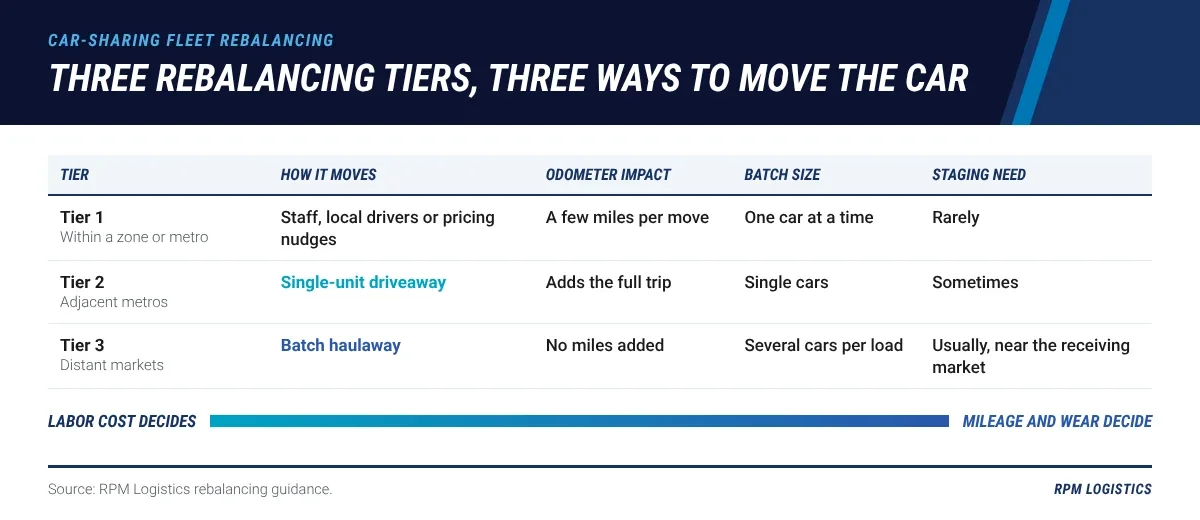
The farther the move, the more the decision shifts from labor cost to mileage and wear, because every driven mile comes off the car's resale value.
What is car-sharing fleet rebalancing?
Car-sharing fleet rebalancing, a core job in Turo fleet management, is putting vehicles where renters will book them. Demand in a shared fleet never stays even. Cars pile up in one neighborhood or city while another runs short, and every idle car still costs money in payments, insurance and parking.
The fleets that need rebalancing come in several forms:
- Round-trip car sharing, where members return cars to a home location.
- One-way and free-floating car sharing, where cars end trips anywhere in a zone.
- Vehicle subscriptions, where cars come back off-term in whatever city the subscriber lives in.
- Peer-to-peer hosts, such as Turo hosts who run small fleets as a business.
Peer-to-peer fleets have grown into real operations. In its 2022 public filing, Turo reported more than 85,000 active hosts and more than 160,000 active vehicle listings in more than 7,500 cities as of September 30, 2021 (Turo Form S-1). Turo has reported average host earnings of $10,868 per car per year for the year ending June 30, 2023 (Turo, 2024). At that scale, moving cars becomes a fleet logistics problem, not a side task.
Three tiers of rebalancing, and how to move each one
Rebalancing breaks into three tiers by distance, and each tier calls for a different way of moving the car. Matching the method to the tier controls both cost and wear.
Tier 1: within a zone or metro
Short moves across town are usually handled by the operator's own staff, contract drivers or pricing nudges that encourage renters to return cars to busy areas. These moves add a few miles and happen often. They rarely need an outside transport provider.
Tier 2: between adjacent metros
Moving single cars between nearby cities, such as from one metro to the next one a few hours away, is a natural fit for driveaway. A screened professional driver moves the car the same day or next day. The trade-off is that driveaway adds the trip's miles to the odometer. Our guide to driveaway vs. haulaway explains when each wins.
Tier 3: batches between distant markets
Moving several cars between distant markets usually calls for haulaway on a car carrier. One truck can move a batch, and none of the cars gains miles. For a shared fleet, where resale value matters at the end of a car's service life, keeping miles off the odometer protects the exit price.
RPM Logistics offers both driveaway services and carrier haulaway across all 50 states and Canada. That lets one provider handle Tier 2 and Tier 3 moves.
When should a shared fleet move cars to another market?
A shared fleet should move cars when a zone's idle time or booking pressure crosses a threshold you set in advance, not on a fixed calendar. Rebalancing on triggers keeps cars working instead of waiting.
Useful triggers to watch:
- Sustained idle days. Cars in a zone sit unbooked for longer than your target over several weeks.
- Booking lead time. Renters in another zone book far in advance because cars are scarce.
- Event demand. A concert, convention or sports season raises bookings in a market for a set period.
- Recall groundings. Cars that cannot be rented until a recall repair leave gaps that need filling.
- Charging access. Electric cars may need to move to zones with reliable charging.
- Market exit or entry. A platform or operator leaving a city creates a large one-time move.
Market exits happen. Getaround announced an orderly wind-down of its U.S. operations on February 11, 2025, according to its SEC filing. Hosts and fleets in affected markets had to relocate or remarket their vehicles. Rebalancing for rental peaks follows a different, seasonal calendar, as our guide to seasonal fleet repositioning for rental peaks explains.
Why odometer miles matter in a shared fleet
Odometer miles matter because a shared car earns twice: once from bookings and once at resale. Every mile added during a move is a mile no renter paid for, and it still counts against the exit price.
Wholesale prices move with mileage and condition. Cox Automotive tracks those prices through the Manheim Used Vehicle Value Index, which read 205.9 in September 2026 (Cox Automotive, 2026). With wholesale values still near historic highs, a car's condition and mileage at sale carry more dollar value, which makes low-mile moves worth planning for.
A practical rule for shared fleets:
- Drive it when the move is short and the car is early in its service life.
- Haul it when the move is long, the car is near its planned exit, or the car is a higher-value model.
- Batch it when several cars share the same origin and destination, so one truck replaces several drivers.
Electric vehicles need extra planning
Electric cars add a charging step to every rebalancing move. A car that arrives in a new zone with a low battery cannot go straight back on the platform.
- Set a state of charge for transport. Agree on a target charge level with your transport provider before pickup, so the car can be loaded and unloaded under its own power.
- Confirm charging at the receiving site. Staging lots without chargers turn a quick deployment into a wait.
- Note charge level on the condition report. Recording the battery percentage at pickup and delivery prevents disputes over range at handoff.
- Match the move to the charging network. Moving electric cars into zones with dependable public charging helps renters and cuts support calls.
A worked example: a host moving cars for the summer season
Consider a hypothetical professional host with 14 cars in a desert metro. Bookings fall in summer, while a mountain market about 800 miles away gets busier. The host decides to move six cars for the season.
- Set the trigger. Idle days in the home market pass the host's target for three straight weeks.
- Pick the cars. The host moves the six cars with the most bookable value, not the six that sit longest.
- Choose the mode. At 800 miles, driving six cars would add about 4,800 miles to the fleet, so one carrier load is the better fit.
- Stage and prep. The cars go to storage near the receiving market for cleaning and inspection before listing.
- Plan the return. The host books the return move before the season ends, so the cars are home for the busy winter months.
The same steps scale up. A subscription operator moving 60 cars between regions follows the same sequence, just with more loads and a larger staging plan.
Recall checks before a car goes back into service
Check every rebalanced car for open recalls before it goes back on the platform. A car moving between markets is a good moment to catch a recall, since it is already out of service.
Federal law sets specific rules for rental fleets. Under 49 U.S.C. 30102, a "rental company" is one that runs a fleet of 35 or more covered rental vehicles. A covered rental vehicle is one rented without a driver for an initial term of less than four months. Whether those rules reach a particular car-share or subscription program depends on its fleet size and rental terms, so confirm with counsel. Regardless of the legal threshold, running each VIN through NHTSA's recall lookup before redeployment is good practice.
Staging and make-ready between zones
Cars moving between markets rarely go straight from one renter to the next. Staging and make-ready in between keep the receiving market from getting cars that are not ready to rent.
- Use storage as a buffer. Stage cars near the receiving market so they can deploy when demand arrives. RPM Logistics operates 70+ storage locations across the U.S. and Canada. See our guide to storing fleet vehicles between assignments.
- Complete make-ready before listing. Cleaning, inspection and minor repairs should happen before the car goes live in the new zone. Our guide to the make-ready and reconditioning pipeline covers the steps.
- Plan for yard operations. Batches of cars need organized check-in and check-out. See our guide to compound and yard operations.
Arrival is not the same as availability. A car that reaches the new market without keys, charge or cleaning still cannot earn. Our piece on why delivered isn't the same as ready covers that gap.
Condition documentation when a third party moves the car
Condition documentation matters more in shared fleets than in most others, because so many people touch each car. Hosts, platforms, renters and transport drivers all handle the vehicle, and damage disputes can fall between them.
Turo's 2022 filing describes host reimbursement for physical damage up to the car's actual cash value or $125,000. Claims like that depend on proving when damage happened. A transport move needs its own record:
- Photograph the car at pickup from every side, plus the interior and odometer.
- Have the driver and releasing party sign the condition report.
- Repeat the photos at delivery and note any change on the receipt.
- Store the records with the car's rental history, so they are available if a renter disputes damage later.
RPM Logistics documents condition with photos at pickup and delivery on every move. Our guide to photo condition reports and damage claims explains how those records settle disputes.
How fleet size changes the logistics
A host with two cars and an operator with two hundred face different logistics problems. Turo's filing groups hosts into three tiers: consumers with one or two cars, small businesses with three to nine, and professionals with ten or more.
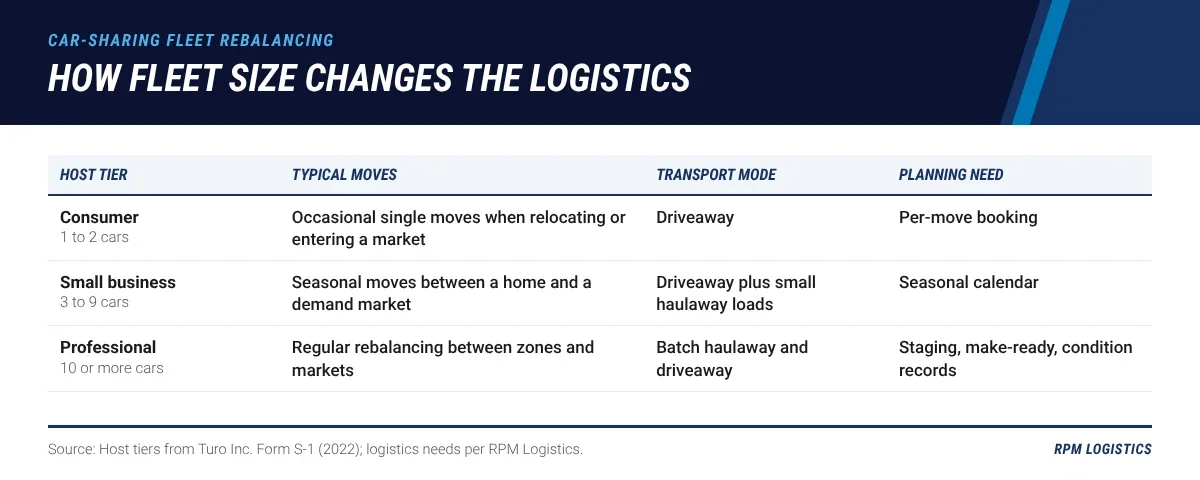
Once a host passes about ten cars, moves stop being occasional favors and start needing a repeatable transport and staging plan.
- One or two cars: occasional single moves, usually by driveaway when the owner relocates or enters a new market.
- Three to nine cars: seasonal moves between a home market and a demand market, often a mix of driveaway and small haulaway loads.
- Ten or more cars: regular rebalancing, staging, make-ready and condition documentation, managed like a commercial fleet.
Broader fleet demand is strong. Cox Automotive projected U.S. fleet sales of 3 million units in 2026 after raising its forecast (Cox Automotive, 2026). Shared and subscription fleets draw on the same vehicle supply and the same transport capacity as rental and corporate fleets. Track your moves with clear metrics, as our guide to fleet transport KPIs describes.
Frequently asked questions
What is vehicle rebalancing in car sharing?
Vehicle rebalancing is moving shared cars from zones or markets with idle vehicles to places where renters are waiting. It keeps utilization high and cuts the cost of cars that sit unbooked.
Is driveaway or haulaway better for repositioning shared fleet vehicles?
Driveaway suits single cars between nearby metros, since it is fast and needs no truck. Haulaway suits batches between distant markets, because it keeps miles off the odometer and moves several cars at once.
When should a car-share or Turo fleet move cars to another market?
Move cars when idle time, booking lead time or event demand crosses a threshold you set in advance. Market exits, recall groundings and charging needs can also trigger a move.
Where should shared-fleet vehicles be staged between markets?
Stage them at storage near the receiving market, and complete make-ready before listing them. That lets cars deploy quickly when demand arrives.
How do hosts document condition when a third party moves the car?
Photograph the car at pickup and delivery, have both parties sign the condition report, and keep the records with the car's rental history. That evidence helps settle damage disputes with renters or platforms.
What happens to fleet vehicles when a car-sharing platform exits a market?
Hosts and operators must relocate the cars to another market, move them to a different platform or remarket them. A large exit is usually handled with batch haulaway and staging.
Keep your shared fleet where the bookings are
Idle cars cost money in every market. RPM Logistics rebalances shared, subscription and peer-to-peer fleets with driveaway, haulaway and staging across all 50 states and Canada. Learn more about our rental and shared fleet logistics, or request a quote for your next move.