

Quick Answer
Corvette transport is moving a Chevrolet Corvette by carrier, open or enclosed, with loading matched to its generation. Classic C1 to C3 cars need straps kept off fiberglass panels. C4 to C7 cars need low-angle ramps for their front fascias. A C8 needs its front lift used at loading and soft wheel straps instead of chains.
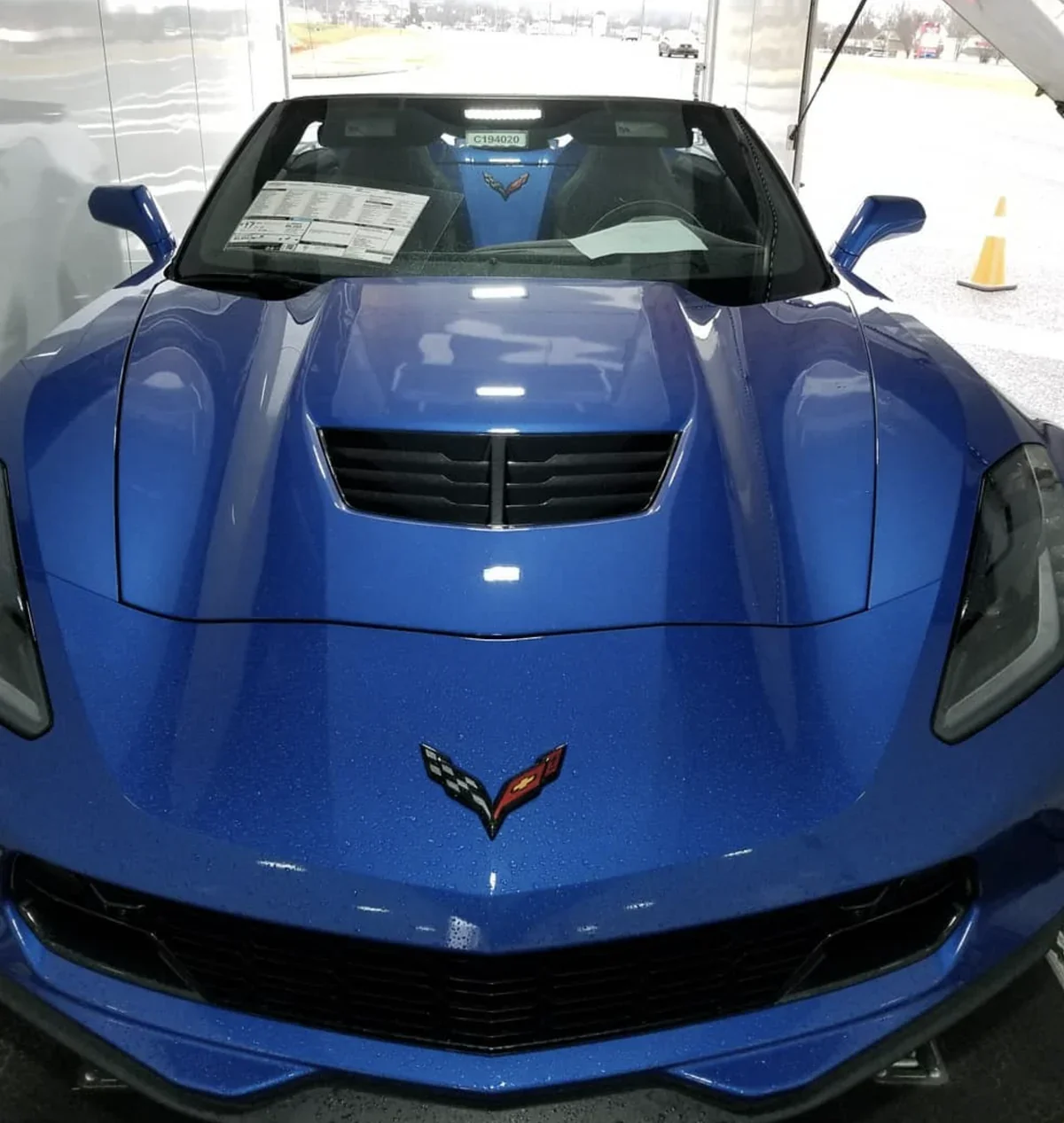
A dealer-stock C7 convertible loaded in an enclosed trailer. The window sticker and stock tag belong in the pickup photos, since they tie the car to its paperwork.
What Corvette Transport Involves
Corvette transport covers any carrier move of a Corvette: a dealer trade, an online purchase, a collector move or a car headed to a show. The car itself sets the rules. A 1963 split-window coupe and a 2026 Z06 share a badge, but they load, strap and inspect very differently.
Most damage claims on low cars start in two places. The first is the front fascia or splitter touching a ramp. The second is a strap or chain pressing on a body panel. Both are avoidable when the carrier knows the generation before the truck arrives.
Why Corvettes Need Their Own Loading Plan
The Corvette is the volume leader among American sports cars, so carriers see it often. Chevrolet delivered 24,533 Corvettes in the U.S. in 2025 (GM sales report via Corvette Blogger, January 2026). Production for the 2025 model year reached 25,835 cars (National Corvette Museum, 2025).
Body style matters too. Buyers chose coupes 57% of the time and convertibles 43% of the time in 2025 (CarBuzz, 2026). That means a large share of cars arriving at pickup have a folding hardtop or a removable roof panel. Each one changes what the driver checks before the doors close.
Loading a Corvette by Generation
Each generation has its own weak point at loading. The table below sums up where the risk sits and how a careful carrier handles it.
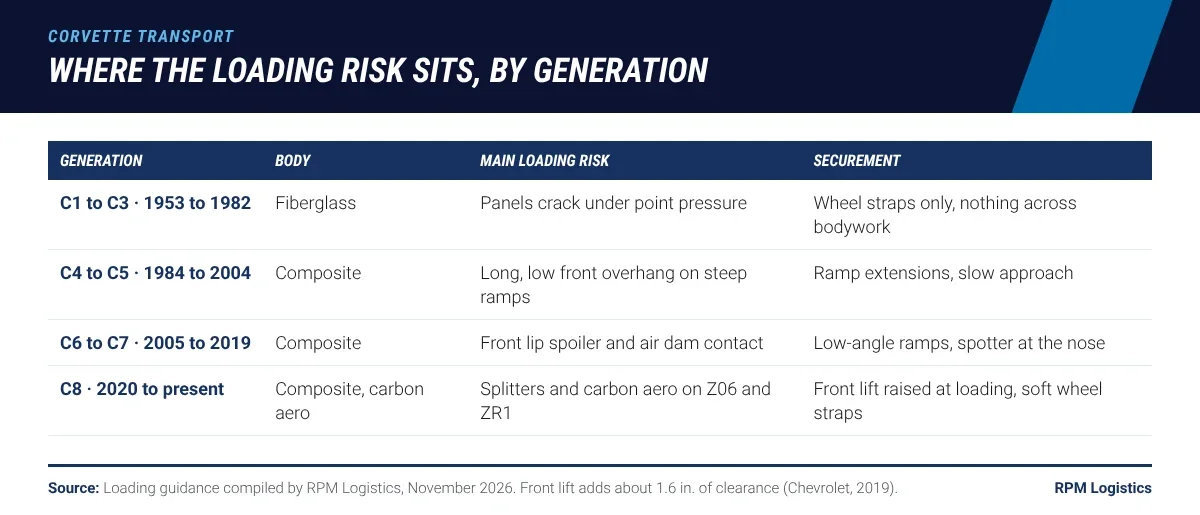
The risk moves from the body panels on early cars to the nose and aero parts on later ones. Securement through the tires covers every generation.
Generation | Years | Main loading risk | How to handle it |
|---|---|---|---|
C1 to C3 | 1953 to 1982 | Fiberglass panels crack under point pressure | Wheel straps only, no straps across bodywork, no chain to frame near panels |
C4 to C5 | 1984 to 2004 | Long, low front overhang scrapes on steep ramps | Ramp extensions or race ramps, slow approach |
C6 to C7 | 2005 to 2019 | Front lip spoiler and air dam contact | Low-angle ramps, spotter at the nose |
C8 | 2020 to present | Splitters and carbon aero on Z06 and ZR1 | Front lift raised at loading, spotter, soft wheel straps |
The C8 Nose: Front Lift, Splitters and Ramp Angle
The mid-engine C8 put the weight behind the driver and dropped the nose. Many cars carry the optional front lift system. Chevrolet says it raises front ground clearance by about 40 mm, or 1.6 inches, in roughly 2.8 seconds (Chevrolet, 2019).
That 1.6 inches is often the difference between a clean load and a scraped splitter. Tell the carrier at booking whether your car has front lift. The driver should raise it before the front wheels reach the ramp and keep it raised through the transition onto the deck.
Cars without front lift, and Z06 or ZR1 cars with carbon aero packages, need a lower ramp angle. Ask whether the carrier uses ramp extensions or lift-gate loading. A spotter at the nose during loading is a reasonable request for any C8.
Fiberglass and Composite Bodies: Where Straps Go
Every Corvette since 1953 has used fiberglass or composite body panels rather than steel. Those panels do not dent like steel. They crack, and the crack can spread under paint before anyone sees it.

On a C6 the lowest point is the front air dam, inches ahead of the wheel. That is where a steep ramp makes contact first.
The safe approach is to secure the car through its tires. Wheel nets or soft straps over each tire hold the car to the deck while the suspension works normally. Our guide to soft-tie vs hard-tie enclosed transport explains why this matters on any high-value car.
Avoid any plan that runs a strap over a fender, hood or bumper cover. On classic cars, also ask the carrier to keep chain hooks away from frame points near the body. A loose hook can swing into a rocker panel in transit.
Convertibles, Targa Roofs and Open Cockpits
Convertible Corvettes need the top fully closed and latched before loading. On C8 convertibles, the power hardtop should be cycled once at pickup so the driver sees it working. That record protects you if a problem appears later.
Coupes with a removable roof panel are a different case. Decide with the carrier whether the panel rides installed or stowed. If it rides stowed, it needs padding and a secure position inside the car. A loose roof panel is one of the most common in-transit scuffs.
Open or Enclosed Carrier for a Corvette
Open transport is common for newer Corvettes moving dealer to dealer. It costs less and capacity is wider. Dealers moving high-trim stock can see our guide to supercar dealer inventory transport. The tradeoff is road debris, weather and dust on a car that may be sold within days of arrival.
Enclosed transport makes sense for classics, Z06 and ZR1 cars, show cars and anything with fresh paint. It also allows liftgate loading, which removes the ramp-angle problem entirely. RPM moves Corvettes on both trailer types through its luxury car transport service, with enclosed transport for cars that need full protection.
Whatever the trailer, confirm the carrier's operating authority on FMCSA's SAFER system before you book. For a classic Corvette, check its value as well. Hagerty's valuation tools give a condition-based value you can match to the carrier's cargo coverage. Our article on agreed value vs actual cash value covers how that number affects a claim.
What to Document at Pickup
A Corvette condition report should go further than a standard vehicle inspection. Low cars hide damage underneath, and that is where ramp contact shows up.
- Front fascia and splitter underside: photograph from ground level before loading.
- Rocker panels and side skirts: both sides, full length.
- Wheels: each rim face, since strap contact can mark them.
- Roof or top: panel position and condition, or the convertible top closed.
- Dash with ignition on: mileage and any warning lights.
- Window sticker or stock tag: on dealer cars, to link the car to its VIN and paperwork.
Our guide to insurance-grade condition reporting lists the full photo set for high-value cars.
How to Prepare a Corvette for Shipping
- Tell the carrier the generation, trim and whether the car has front lift.
- Remove or stow any loose aero parts, roof panels and personal items.
- Leave the fuel tank about a quarter full.
- Check that the battery holds a charge, since a dead C8 cannot use its front lift.
- Close and latch the convertible top or targa panel.
- Check for open recalls through NHTSA's recall lookup, so known issues are on record before the move.
- Walk the car with the driver and sign the condition report together.
Shipping another American performance car? Our Mustang transport guide covers the same low-nose issues. If the car is going to a show, see our guide to race car and motorsport transport. For cars going into storage for the season, read about collector car winter storage transport.
Frequently Asked Questions
Can a C8 Corvette be shipped on an open carrier?
Yes. Many new C8s move on open carriers between dealers. The driver needs to raise the front lift at loading or use low-angle ramps, and to secure the car through its tires. Enclosed transport is the better choice for Z06, ZR1 and cars with carbon aero.
Does the C8 front lift work during transport?
The front lift is used at loading and unloading, when the car crosses the ramp. Chevrolet rates it at about 1.6 inches of added clearance. The car needs a charged battery for the system to work, so check the battery before pickup.
How should a classic fiberglass Corvette be strapped down?
Through the tires, with wheel nets or soft straps. Nothing should press on the fiberglass panels. Chain hooks should stay away from frame points near the body, because fiberglass cracks rather than dents.
Is enclosed transport worth it for a Corvette?
For classics, high-trim C8s, show cars and fresh paint, usually yes. Enclosed trailers keep debris and weather off the car, and liftgate loading removes ramp contact. Daily-driver Corvettes often move safely on open carriers.
What photos should I take before my Corvette is loaded?
Photograph the front fascia from ground level, both rocker panels, every wheel face, the roof or top, and the dash with the ignition on. Dealer cars should also show the window sticker or stock tag.
Should I remove the roof panel before shipping a Corvette coupe?
Agree on it with the carrier first. The panel can ride installed or stowed. If stowed, it needs padding and a fixed position inside the car so it cannot shift.