

Quick Answer
OEM auto show and press fleet logistics is the movement of display vehicles to shows and reveals, and of media loan cars between journalists. Display moves are built around venue move-in windows, often in enclosed, confidential transport. Press fleets run on a rotation of deliver, loan, collect and refresh, with a condition report at every handoff.
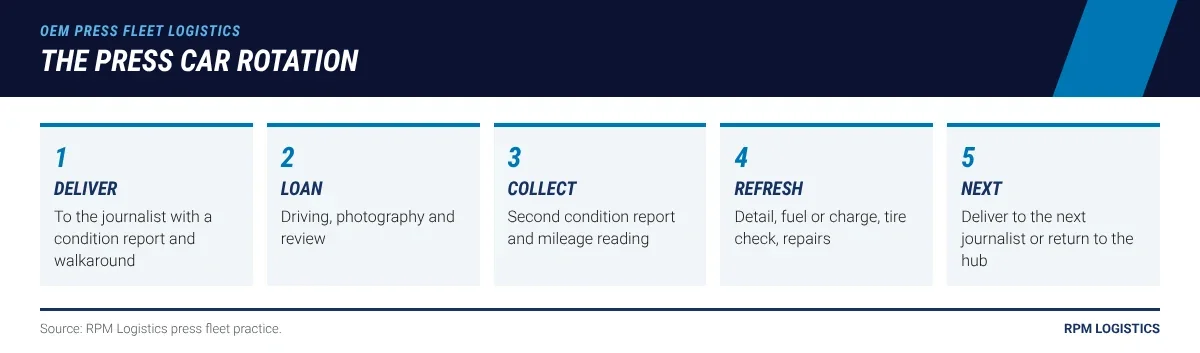
A press car can run this loop dozens of times in a season; the refresh step is what keeps every reviewer getting the same first impression.
What is OEM auto show and press fleet logistics?
OEM auto show and press fleet logistics covers the vehicles automakers use for public display and media coverage. It has two parts that run on different clocks. Display logistics moves cars to shows, reveals and events on fixed dates. Press fleet logistics moves loan cars between journalists, photographers and video crews all year.
These vehicles matter far beyond their numbers. A display car may be one of a handful built before production. A press car may be the first example a reviewer, and through them thousands of buyers, ever sees. U.S. new-vehicle sales reached about 16.3 million in 2025, and Cox Automotive forecast about 15.8 million for 2026 (Cox Automotive, 2025). Launch coverage shapes how those buyers first meet new models.
The vehicles involved include:
- Show and concept cars built only for display.
- Pre-production units shown ahead of launch.
- Cutaway and technical displays that cannot be driven.
- Press fleet vehicles loaned to media for reviews and photo shoots.
- Ride-and-drive units used at media drives and consumer events.
How do auto show vehicle moves work?
Auto show vehicle moves work backward from the venue's move-in window. Large shows give each exhibitor a narrow time slot to bring vehicles through the loading docks. Missing it can mean waiting for the next slot or missing setup entirely.
A typical show move follows this sequence:
- Confirm the move-in window, dock assignment and venue rules from the show's exhibitor manual.
- Stage vehicles nearby, often at a marshaling yard close to the venue, a day or more early.
- Deliver to the dock in the assigned slot, in the order the stand builders need.
- Position vehicles on the stand, following venue rules on fuel, batteries and fluids.
- Reverse the process at move-out, again in an assigned window.
Venue rules shape how vehicles are prepared. Many indoor venues limit fuel levels, require battery disconnection or set other fire-safety conditions for display vehicles. Check the current exhibitor manual and the local fire code for each show.
Our guide to museum and exhibition car loans covers indoor display preparation in more detail.
Why do display vehicles need enclosed, confidential transport?
Display vehicles need enclosed, confidential transport because many are irreplaceable and some are secret until the reveal. A concept or pre-production car photographed on an open carrier can spoil months of launch planning.
Common requirements for display moves include:
- Enclosed trailers, often unmarked, so the vehicle stays out of sight.
- Fitted covers during loading and unloading, when doors are open.
- Named drivers under confidentiality agreements, with no personal photos.
- Lift gates or low-angle ramps for low show cars and concepts.
- Winch loading for cutaways and non-running units.
- Soft-tie securement so one-off bodywork never touches a strap.
RPM's luxury transport service is built for this kind of work, with enclosed trailers and confidential handling for flagship and limited-run models. See our luxury car transport service for details. For securement methods, our comparison of soft-tie and hard-tie enclosed transport explains the options.
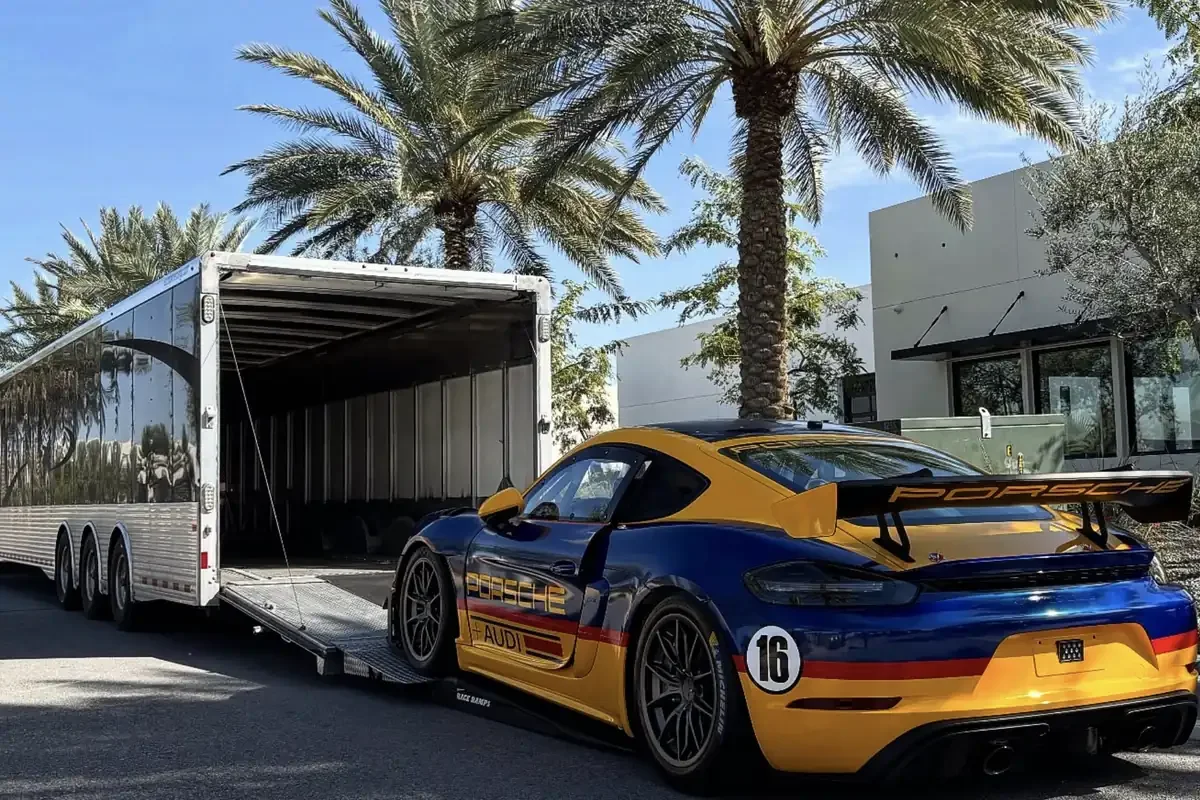
Event cars usually sit low and wide, so the ramp angle and the room to open doors inside the trailer are planned before the truck is dispatched.
What paperwork do show and pre-production vehicles need?
Show and pre-production vehicles often need paperwork that production cars do not, because many are not certified for sale or road use. The documents depend on where the vehicle was built and whether it will touch a public road.
Imported display vehicles follow federal rules. Under 49 CFR 591.5(j), a vehicle that does not meet U.S. safety standards may be imported for show or display, among other limited purposes. The importer must hold NHTSA permission or be a manufacturer of certified vehicles. At the end of the import period, proof of export or destruction is due within 30 days.
For transport teams, this means two things. The permission letter or reference number should travel with the car. And the final move, to a port or back to the manufacturer, should be planned at the start.
Domestic show cars that ship on a trailer rarely need more than internal documents and a bill of lading. Any car driven on a public road needs plates and insurance that cover that use.
How does a press fleet rotation work?
A press fleet rotation moves each loan car from one journalist to the next on a set schedule. Loan lengths vary by program and outlet, often several days to a week. Between loans, the car is collected, inspected, refreshed and delivered again.
Each rotation has five steps:
- Deliver the car to the journalist's home or office, with a condition report and a short walkaround.
- Loan period, during which the journalist drives, photographs and reviews the car.
- Collect the car at the end of the loan, with a second condition report and mileage reading.
- Refresh it with detailing, fuel or charging, tire checks and any repairs.
- Deliver to the next journalist, or return the car to the fleet hub.
The refresh step is where press fleets succeed or fail. A car that arrives dirty, low on fuel or with a warning light can color a review. Many programs set a standard for fuel level, cleanliness and tire pressure at every delivery.
Before each loan, check for open safety recalls by VIN through NHTSA's recall lookup. A press car should never go out with an unrepaired recall.
Driveaway or haulaway for press fleets and shows?
Driveaway and haulaway each fit different parts of a press and show program. The right choice depends on the vehicle, the distance and whether miles on the odometer matter.
Move | Usual method | Why |
|---|---|---|
Press car between local journalists | Driveaway | Fast, flexible door-to-door delivery |
Press fleet between cities or regions | Enclosed or open haulaway | Keeps miles and wear off loan cars |
Show and concept cars to a venue | Enclosed, often dedicated | Confidentiality and one-off bodywork |
Ride-and-drive fleet to an event | Haulaway | Many units arriving together |
Non-running displays and cutaways | Enclosed with winch | Cannot be driven on or off |
Most programs use both. Driveaway handles the steady local rotation, while haulaway handles regional moves and event waves. For high-value displays, a dedicated enclosed truck carries only that program's vehicles.
How do you plan around show season and launches?
You plan around show season and launches by treating them as capacity peaks, like model-year changeover. Enclosed carriers and lift-gate trucks are in high demand during major show and concours seasons, and reveal dates rarely move.
Practical steps include:
- Book enclosed capacity early for each major show and media drive.
- Stage vehicles regionally when several events fall close together.
- Build buffer days before every move-in window.
- Coordinate with launch timing, so press fleets reach journalists as embargoes lift.
- Plan move-out on the same booking, since venues clear quickly after a show closes.
Show season often overlaps with the fall model-year changeover. Our guide to model-year changeover logistics explains how that crunch affects carrier capacity. Collector events add their own peaks, as covered in our guide to concours and white-glove transport.
What goes wrong in auto show logistics?
Most auto show logistics problems come from timing and information, not from the road. The vehicle usually travels fine. It is the handoffs at each end that fail.
- Missed move-in slots because a truck arrived late or at the wrong dock.
- Wrong load order, so the car needed first on the stand is last off the trailer.
- Unprepared vehicles that arrive with too much fuel or a connected battery.
- No staging plan, leaving trucks waiting on city streets near the venue.
- Move-out surprises, when the return booking was never made.
A single run sheet shared by the OEM team, stand builder and carrier prevents most of these. It should list each vehicle, its load order, dock slot, contacts and move-out plan.
What should press fleet managers measure?
Press fleet managers should measure how reliably cars reach reviewers in the right condition. A short set of numbers shows where the rotation is slipping:
- On-time delivery against the scheduled loan start.
- Refresh time between collection and the next delivery.
- Delivery standard misses, such as low fuel or a dirty interior.
- Damage found at collection, backed by condition reports.
- Days out of rotation for repairs.
Reviewing these monthly shows which hubs, carriers or car lines need attention before a launch.
How do you protect press and display cars from theft and fraud?
You protect press and display cars with the same release discipline used for any high-value vehicle. A known schedule and a public event make these cars attractive targets for fraud.
- Release only to named carriers and drivers, verified at pickup.
- Share driver and truck details with venues and hubs in advance.
- Keep keys controlled at the venue and at the fleet hub.
- Record VINs and condition at every handoff.
- Confirm any change to a pickup or delivery through a known contact.
Our guide to stopping a fictitious pickup at the gate lays out a verification sequence that works at venues and fleet hubs.
How RPM supports OEM show and press programs
RPM Logistics coordinates enclosed and open transport for OEMs, agencies and event teams across all 50 states and Canada. Programs use us for show move-in and move-out, regional press fleet moves, media drives and returns to the manufacturer.
- Enclosed and dedicated trucks for confidential display vehicles.
- Lift-gate and winch equipment for low cars and non-runners.
- Photo condition reports at every pickup and delivery.
- Timing built around move-in windows and launch dates.
For OEM program details, see our OEM logistics services. For a look at how we scale during production peaks, read our case study on an OEM production surge.
Frequently asked questions
What is a press car?
A press car is a vehicle an automaker loans to journalists and media for reviews, photo shoots and videos. It moves from one reviewer to the next on a set rotation.
How are cars transported to auto shows?
Most display cars travel in enclosed trailers to a staging area near the venue. They move to the loading dock during the exhibitor's assigned move-in window, then onto the stand.
Can a concept car that is not road legal be shipped?
Yes. It ships on a trailer, usually enclosed, with a winch if it cannot be driven. Imported concept and show cars must meet NHTSA's import rules for show or display.
How long is a typical press car loan?
Loan lengths vary by program and outlet, often several days to a week. Between loans, the car is collected, refreshed and delivered to the next journalist.
Should press fleet cars be shipped or driven between cities?
Driveaway suits local rotations. For moves between cities or regions, haulaway keeps miles and wear off cars that reviewers will judge.
What do venues require for display vehicles?
Requirements vary by venue and local fire code. Common conditions include limited fuel levels and disconnected batteries. Check each show's exhibitor manual.
Hit every move-in window
Show dates and launch embargoes do not move. RPM Logistics plans enclosed transport, staging and press fleet rotations around them. Talk to our team about your next show or media program.