

Quick Answer
Prototype vehicle transport is the secure movement of pre-production, engineering and test vehicles between suppliers, test sites, plants and events. These cars are often uncertified, unregistered and confidential. Shippers usually require enclosed trailers, vetted drivers, direct routing, sealed loads and a documented chain of custody. Imported test vehicles also need NHTSA paperwork.
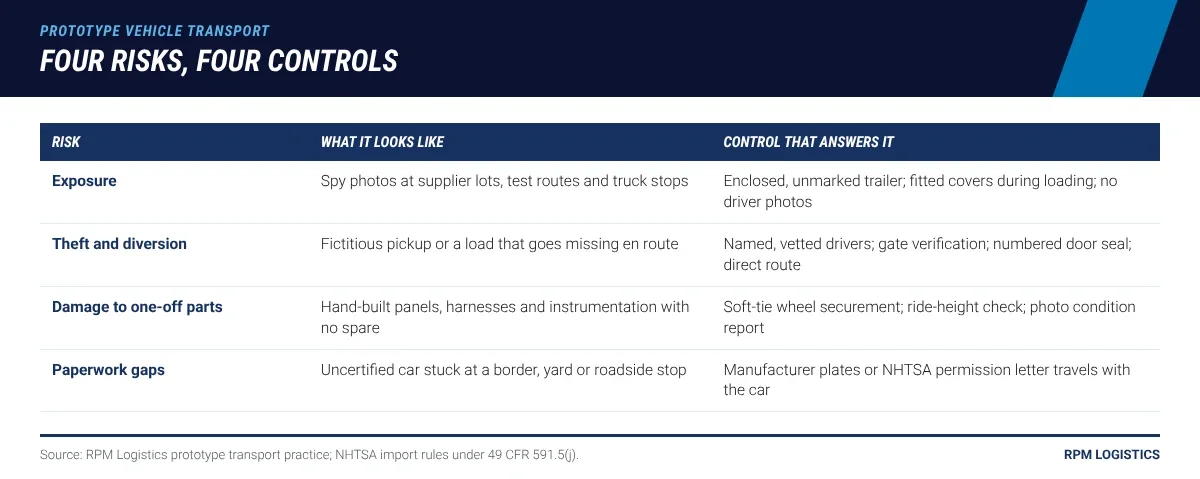
Most programs over-invest in the first row and under-invest in the last; a missing permission letter can strand a test car longer than any damage claim.
What is prototype vehicle transport?
Prototype vehicle transport is the movement of vehicles built before a model reaches regular production. That includes engineering mules, validation builds, pre-production units, crash-test candidates and show cars. Tier 1 suppliers, OEM engineering teams and test facilities ship them on tight schedules.
These moves differ from finished vehicle logistics in three ways. The vehicle is often one of a handful in existence. It may not be certified to federal safety standards, so it cannot be sold or freely registered. And its design is usually confidential until launch.
The volume behind these programs is large even when the fleet is small. U.S. new-vehicle sales reached about 16.3 million units in 2025, and Cox Automotive forecast about 15.8 million for 2026 (Cox Automotive, 2025). Every model behind those sales started as a small group of test vehicles that had to move between labs, tracks and plants.
Common prototype shipments include:
- Supplier to OEM: a Tier 1 or Tier 2 supplier returns a vehicle after fitting or testing a new component.
- Plant to proving ground: validation builds travel to hot-weather, cold-weather or durability test sites.
- Test site to test site: a vehicle rotates through emissions, NVH and electrical labs.
- Program to event: pre-launch units go to press drives, dealer previews or auto shows.
- End of program: the vehicle goes back for teardown, export or destruction.
Why do prototype and pre-production vehicles need special handling?
Prototype and pre-production vehicles need special handling because their value is mostly in what they reveal, not what they would sell for. A damaged bumper can be replaced. A leaked photo of an unreleased design cannot be pulled back.
Four risks shape every move:
- Exposure. Spy photographers watch test routes, supplier lots and truck stops. One photo of an uncovered car can undo months of launch planning.
- Theft and diversion. A prototype has resale value to competitors and collectors, even when it cannot be titled. Fictitious pickups target high-value loads of every kind.
- Damage to one-off parts. Hand-built panels, test harnesses and instrumentation often have no spare. A broken part can stall a test plan for weeks.
- Paperwork gaps. Uncertified vehicles need specific plates, permissions or import documents. Without them, a car can sit at a border or a yard.
Each of these risks has a matching control. Programs that plan for all four before the first move have fewer surprises than programs that react to them one at a time.
What security controls do OEMs and suppliers require?
OEMs and Tier 1 suppliers usually write security controls into the transport agreement before a single prototype moves. The most common requirements cover the trailer, the driver, the route and the handoff.
Enclosed, unmarked equipment
Enclosed transport is the default for prototypes because it keeps the vehicle out of sight from pickup to delivery. Many programs also ask for unmarked trailers, so the equipment does not advertise its cargo. Fitted car covers add a second layer during loading and unloading, when the doors are open.
RPM coordinates enclosed vehicle transport for confidential loads, with soft-tie securement for vehicles that cannot take hard tie-downs on the frame.
Vetted drivers and verified pickups
Driver vetting matters more for prototypes than for almost any other vehicle load. Programs often require named drivers, signed confidentiality agreements and no personal photos at any stage. The pickup site should verify the driver, truck and trailer against the booking before releasing the car.
That gate check is the same defense used against cargo theft. Our guide to stopping a fictitious pickup at the gate lays out a verification sequence that works for prototype releases.
Direct routing and limited stops
Every stop is a chance for exposure. Prototype loads usually run direct, with no mixed loads and no overnight parking in public lots. Where a long haul needs a rest stop, the program may name secure yards in advance or assign a team of two drivers.
Seals and chain of custody
A numbered seal on the trailer door shows whether the load was opened in transit. The seal number goes on the bill of lading at pickup and is checked at delivery. Together with timestamped handoff records, it gives the program a clean chain of custody for every move.
Shippers that rate cargo by value can use the same tiers they apply to other freight. Our breakdown of high-value freight security by cargo tier shows which controls scale with value.
How do you protect a one-off test vehicle from damage?
Protecting a one-off test vehicle starts with knowing what is non-standard about it. Prototypes often carry instrumentation, temporary wiring, cameras, ballast or hand-built body parts. Each one changes how the car can be loaded and tied down.
Before pickup, the shipper should tell the transport team:
- Ride height and approach angle, especially for low splitters or lowered test builds.
- Tie-down points that are safe to use, and any that are not.
- Whether the car runs and steers, or needs a winch and skates.
- Instrumentation and loose equipment that must stay in place or be removed.
- Battery state for electrified prototypes, including whether a high-voltage pack is fitted.
Soft-tie securement holds the car through the wheels and tires rather than the chassis. That avoids stress on frames, subframes and suspension parts that may be prototypes themselves. Our comparison of soft-tie and hard-tie enclosed transport explains when each method fits.
A photo condition report at pickup and delivery closes the loop. For prototypes, the report should also note instrumentation, seals on test equipment and any covered or masked areas. The standard in our guide to insurance-grade condition reporting applies here.
What paperwork does a prototype or test vehicle need?
A prototype or test vehicle needs paperwork that explains why it is on the road or crossing a border. It usually cannot be registered like a production car. The documents depend on where the vehicle was built and how it will be used.
Domestic prototypes
Domestically built prototypes that never touch a public road can ship with internal program documents and a bill of lading. Vehicles that must be driven on public roads for testing usually run under manufacturer plates issued under state law. Rules vary by state, so the program's compliance team should confirm plate status before a driveaway or a short road leg.
Imported test vehicles
A test vehicle that does not meet federal safety standards can enter the U.S. only for limited purposes. Under 49 CFR 591.5(j), those purposes are research, investigations, demonstrations or training, competitive racing, and show or display. The importer must either hold written permission from NHTSA or be an original manufacturer whose vehicles are certified to U.S. standards.
The rules after import are just as strict. At the end of the import period, the importer must send NHTSA proof of export or destruction within 30 days (49 CFR 591.5(j), 2026). If public road use is essential, the written request must ask for it, explain why and estimate how long it is needed (49 CFR 591.6(f), 2026).
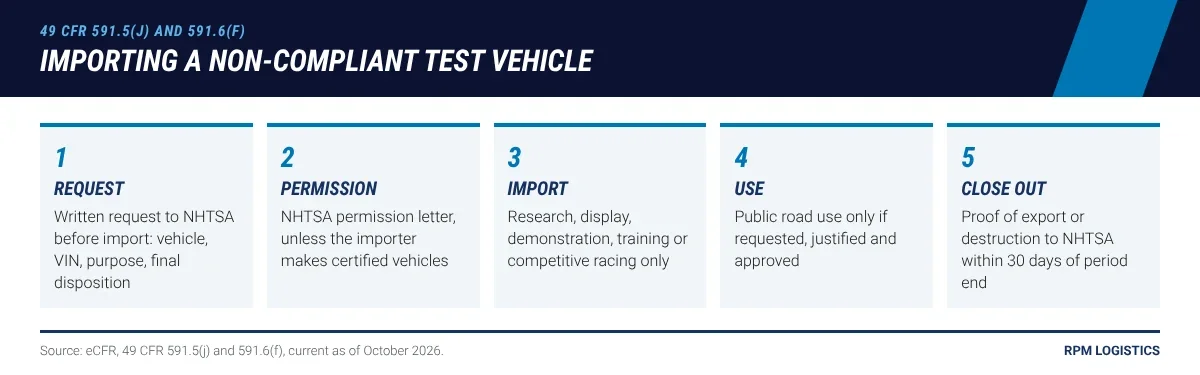
The transport plan touches the first and last boxes: the car should not move until the permission is in hand, and its final move often is the export or destruction leg.
For transport teams, the practical point is simple. The permission letter or its reference number should travel with the vehicle. The final move, to a port or a destruction site, should be planned at the start of the program, not at the end. Cross-border legs may also need bonded handling, covered in our guide to bonded transport and in-transit customs.
Enclosed carrier, driveaway or dedicated truck: which fits a prototype?
The right mode depends on how confidential the vehicle is, how far it travels and whether it can be driven. Most prototype moves use one of three options.
Mode | Best for | Main limit |
|---|---|---|
Enclosed multi-car carrier | Covered pre-production units on common lanes | Shares the trailer with other cars and adds stops |
Dedicated enclosed truck | Confidential or one-off builds, long hauls | Higher cost per vehicle |
Driveaway with manufacturer plates | Road-legal test fleets on short, approved routes | Puts miles on the car and exposes it to view |
A dedicated truck is the default for anything a program would not want photographed. It runs direct, carries only that program's vehicles and keeps the seal intact from door to door. Enclosed multi-car carriers fit later-stage builds that are already camouflaged or close to public reveal.
Driveaway suits test fleets that are meant to accumulate miles anyway. It only works when plates, insurance and route approvals are in place. Our explainer on driveaway vs. haulaway covers the trade-offs in more detail.
How do you plan prototype moves around a test schedule?
Prototype moves should be planned backward from the test slot, because test time is usually scarcer than truck capacity. A missed slot at a proving ground can push a validation step by weeks.
A practical planning sequence looks like this:
- Lock the test date and site. Confirm the receiving window, gate rules and who signs for the car.
- Confirm the vehicle's status. Note whether it runs, its ride height, instrumentation and battery state.
- Clear the paperwork. Check plates, import permissions and any export plan before booking.
- Book the equipment. Reserve a dedicated or enclosed truck with the right ramp angle and securement.
- Set the security plan. Name the driver, set the seal and route, and share contacts at both ends.
- Build in buffer. Plan arrival a day early where the test slot cannot move.
Lead times for enclosed and dedicated equipment run longer than for open carriers on many lanes. Our benchmarks for finished vehicle lead times give a realistic starting point. Capacity also tightens in the fall, when model-year changeover competes for the same trucks, as covered in our guide to model-year changeover logistics.
How RPM supports supplier and OEM prototype programs
RPM Logistics moves vehicles for OEMs, suppliers and dealers across all 50 states and Canada, through a network of more than 15,000 active carriers. For prototype and pre-production work, that means access to enclosed and dedicated equipment on short notice, plus coordination of the details above.
Programs typically ask us to:
- Match enclosed or dedicated equipment to the vehicle's ride height and securement needs.
- Apply named-driver, seal and direct-routing rules from the shipper's security agreement.
- Record photo condition reports and handoff times at every stop.
- Coordinate timing around test slots, plant schedules and event load-in windows.
The same planning discipline shows up in our work during production ramps. Our case study on scaling logistics for an OEM production surge shows how that works at volume. For program details, see our OEM logistics services.
Frequently asked questions
What is a pre-production vehicle?
A pre-production vehicle is built before regular production starts, to validate parts, tooling and assembly. It may differ from the final car and is usually not certified for sale. Manufacturers use these units for testing, training and launch events.
Can a prototype vehicle be shipped on an open car carrier?
It can, but most programs avoid it. An open carrier exposes the car to photos, weather and road debris. Enclosed or dedicated transport is the usual requirement for any vehicle that is confidential or one of a kind.
Can a test vehicle that does not meet FMVSS be imported into the U.S.?
Yes, for limited purposes such as research, display, demonstrations, training or racing. Under 49 CFR 591.5(j), the importer needs NHTSA permission or must be a manufacturer of certified vehicles. Proof of export or destruction is due within 30 days after the import period ends.
Do prototype vehicles need license plates to be transported?
Not when they ship on a trailer. A vehicle that is driven on public roads for testing usually needs manufacturer plates under state law. Rules vary by state, so confirm plate status before any road leg.
How do shippers keep prototype vehicles confidential in transit?
Shippers combine enclosed or unmarked trailers, fitted covers, named drivers with confidentiality agreements, direct routing and numbered seals. A documented chain of custody shows who handled the car at every point.
What should a shipper tell the carrier about a prototype?
Share ride height, safe tie-down points, whether the car runs, any instrumentation and the battery state. Also share the test date, the receiving window and who signs at delivery.
Plan your next prototype move
Prototype programs run on test dates that rarely move. RPM Logistics can match secure, enclosed equipment to your vehicles and your schedule. Talk to our team about your next pre-production or test vehicle shipment.