

Quick Answer
Towaway means a driver tows a travel trailer, fifth wheel or toy hauler behind a rated truck. Driveaway means a driver drives a Class A, B or C motorhome on its own chassis. Folding and pop-up campers usually ride on a trailer instead. The RV's type, weight and running condition decide which method fits.
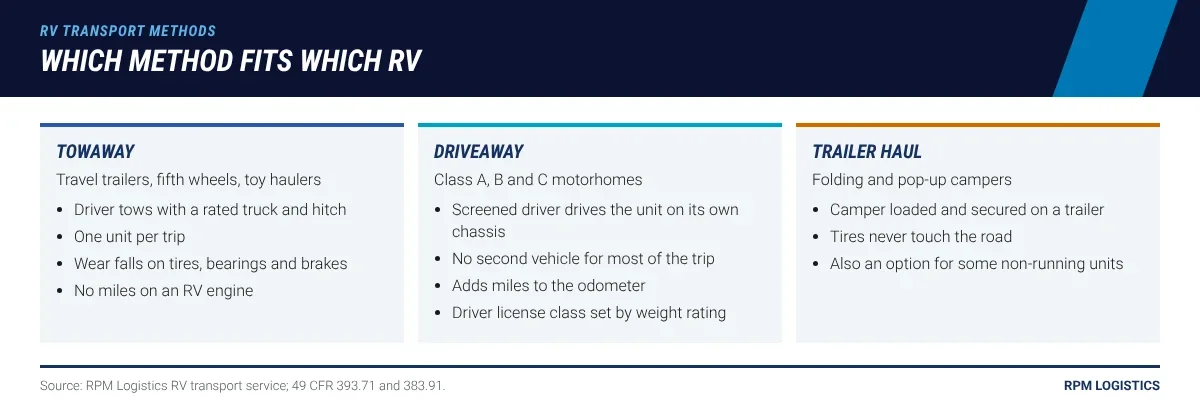
The question is rarely which method is better; it is whether the unit has an engine, and whether that engine should run for the whole trip.
What is the difference between towaway and driveaway for RVs?
The difference between towaway and driveaway is what supplies the power. In towaway, a professional driver hitches the RV to a properly rated truck and pulls it. In driveaway, a screened driver gets behind the wheel of the motorhome and drives it to its destination.
Both methods move the RV on its own wheels. That separates them from trailer haul, where the camper rides on a flatbed or car trailer and its tires never touch the road. Each method has a natural fit:
- Towaway: travel trailers, fifth wheels and toy haulers, which have no engine of their own.
- Driveaway: Class A, B and C motorhomes, which are built to be driven.
- Trailer haul: folding and pop-up campers, plus some non-running units.
Federal motor carrier rules group both under driveaway-towaway operations. In these moves, the vehicle being delivered is itself the cargo. Our guide to how driveaway transport works covers the cars-and-fleet side of the same model.
Which RVs ship by towaway?
RVs without an engine ship by towaway. That covers travel trailers, fifth wheels and toy haulers. A driver tows the unit with a truck and hitch rated for its weight, one unit per trip.
The hitch type follows the RV's design:
- Travel trailers use a bumper-pull ball hitch, often with weight distribution and sway control.
- Fifth wheels need a pickup or truck with a fifth-wheel hitch mounted over the rear axle.
- Toy haulers can be either style, and often weigh more because of their garage and fuel tank.
Federal coupling rules for towaway are specific. Under 49 CFR 393.71, a towed unit needs a safety device that keeps it attached if the coupling fails. Where chains are used, the rule calls for at least two, crossed under the tongue. The combined chain strength must at least match the coupling's required strength.
Towaway is usually the only practical way to move these units over the road. Our guide to how to ship an RV covers how weight labels decide the truck and hitch.
Which RVs ship by driveaway?
Motorhomes ship by driveaway, because they have their own engine and drivetrain. A screened driver drives the unit on its own chassis from pickup to delivery. That covers Class A coaches, Class B camper vans and Class C cutaway motorhomes.
Driveaway has clear strengths for motorhomes:
- No second vehicle on most of the trip, so it scales well for dealer and factory moves.
- No size penalty for long or tall coaches that would be hard to load on a trailer.
- Flexible routing for single units going to different destinations.
The trade-off is that the motorhome does the work. It adds engine miles and wear to the chassis, tires and brakes. For a new coach headed to a showroom, those miles appear on the odometer at delivery. Dealers and buyers should agree up front on what mileage is acceptable.
Some units are better moved another way. A non-running motorhome, a coach with known mechanical problems, or a high-value unit where buyers want zero added miles may call for haul-on transport. Our guide to over-dimensional vehicle transport for buses, RVs and chassis covers those larger moves.
Towaway vs. driveaway: how do they compare?
Towaway and driveaway compare differently on wear, equipment and paperwork, even when the route is the same. The table below sets the two side by side for the factors that matter most to owners and dealers.
Factor | Towaway | Driveaway |
|---|---|---|
Best for | Travel trailers, fifth wheels, toy haulers | Class A, B and C motorhomes |
Power source | The carrier's truck | The RV's own engine |
Wear on the RV | Tires, bearings, brakes and suspension | Engine miles plus tires, brakes and drivetrain |
Odometer impact | None on the RV | Adds miles to the motorhome |
Key equipment | Rated tow truck and correct hitch | The motorhome itself |
Driver credentials | Depend on combined weight of truck and RV | Depend on the motorhome's weight rating |
Main pre-trip check | Tires, bearings, brakes, breakaway and lights | Fluids, tires, brakes, generator and dash lights |
Neither method is cheaper in every case. Distance, unit size, season and permits all move the price. Our breakdown of what drives RV shipping cost explains why per-mile quotes mislead.
For mixed orders, such as a dealer moving a motorhome and two travel trailers together, each unit still gets its own method. The motorhome goes by driveaway, and each trailer goes by towaway with its own truck. Planning them on the same pickup date keeps the dealer's handoff simple.
Who can legally drive or tow an RV for delivery?
A professional RV delivery driver works under commercial rules that a private owner usually does not face. Once a move is for hire, weight thresholds decide what the driver and vehicle need.
The key thresholds are:
- 10,001 pounds or more: a vehicle or combination at this rating, used in interstate commerce, is generally a commercial motor vehicle. Driver medical certification and hours-of-service rules can apply.
- 26,001 pounds or more for a single vehicle: many large Class A motorhomes cross this line. For-hire driving then generally requires a Class B commercial driver's license.
- 26,001 pounds or more combined, towing over 10,000 pounds: a truck pulling a heavy fifth wheel can reach Class A territory under 49 CFR 383.91.
This is a big reason owners hire professionals for heavy units. A screened, qualified driver and a rated rig are part of what the shipper pays for. Ask any provider how it matches drivers and equipment to the unit's weight rating.
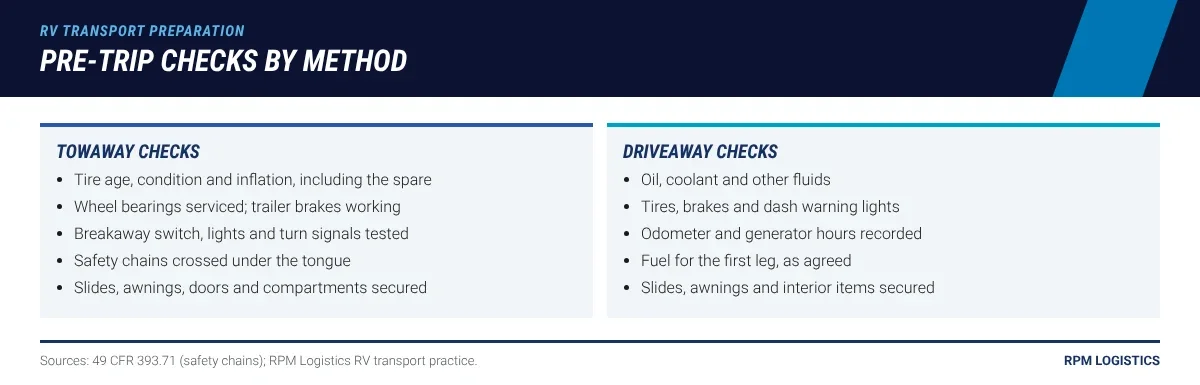
Bearings and trailer brakes cause more towaway delays than anything on the highway; a 20-minute check at pickup prevents most of them.
How should you prepare an RV for each method?
Preparation for each method focuses on the parts that will do the work. A towaway unit needs its running gear checked. A driveaway unit needs its engine and chassis ready for a long drive.
Towaway preparation
- Check tire age, condition and inflation, including the spare.
- Confirm wheel bearings are serviced and trailer brakes work.
- Test the breakaway switch, lights and turn signals.
- Retract slides, close and latch awnings, and lock all doors and compartments.
- Secure loose items inside so nothing shifts or breaks.
Driveaway preparation
- Top off or check oil, coolant and other fluids.
- Check tires, brakes and any dash warning lights.
- Record the odometer and generator hours at pickup.
- Leave enough fuel for the first leg, as agreed with the carrier.
- Retract slides, latch awnings and secure interior items.
For both methods, check for open safety recalls by VIN through NHTSA's recall lookup before the move. A photo condition report at pickup and delivery should cover the roof, slides and undercarriage, not just the sides. Our guide to insurance-grade condition reporting shows what a strong report includes.
Can you leave belongings inside an RV during transport?
Most carriers ask owners to remove personal belongings before transport, whichever method is used. Loose items can shift, break or damage cabinets and windows on the road. Carrier cargo coverage also generally does not extend to personal property inside the unit.
Some items are fine to leave if they are secured:
- Factory furniture and fixtures, with cabinets and drawers latched.
- Mattresses and cushions that came with the unit.
- Owner's manuals and keys for the driver and the delivery inspection.
Propane is a separate question. Many carriers ask that propane valves be closed and tanks kept at a low level for the trip. Confirm the carrier's propane policy when you book, since it can affect pickup.
What mistakes do owners make when choosing a method?
The most common mistakes come from guessing at weight or condition instead of checking. Each one can delay pickup or change the equipment needed on the day.
- Quoting the dry weight. A loaded toy hauler or fifth wheel can weigh far more than its brochure figure. Use the weight label on the unit.
- Calling a non-runner a runner. A motorhome that will not start cannot go by driveaway, and the carrier needs to know before dispatch.
- Skipping the bearing and tire check. Old tires and dry bearings are the top causes of roadside delays on towaway moves.
- Leaving slides or awnings unsecured. An awning that opens at highway speed can damage the unit and others on the road.
- Booking too late in season. Spring and show season fill up capacity on popular lanes.
Sharing accurate details at booking avoids most of these. A good provider will ask for the unit's type, length, weight rating, running condition and any modifications before it confirms a method.
How do dealers and manufacturers use towaway and driveaway?
RV dealers and manufacturers use both methods every day, often in the same week. Towables move from factories to dealer lots by towaway. Motorhomes move by driveaway. Dealer trades, show units and retail deliveries follow the same split.
Volumes are large even in a slower year. Wholesale RV shipments reached 342,220 units in 2025, according to the RV Industry Association (RVIA, 2026). Shipments through August 2026 totaled 207,191, down 14.2% from the same period a year earlier. RVIA's fall forecast puts 2026 at about 290,000 units.
For dealers, the planning points are:
- Book around shows and season, when towaway and driveaway capacity tightens.
- Agree on delivery mileage for new motorhomes before the move.
- Stage units near shows or high-demand markets instead of moving each to order.
- Inspect on arrival before the unit is prepped for a retail buyer.
Timing also affects how long a move takes. Driveaway and towaway both run on driver availability, so lead times stretch in spring and before major RV shows. Booking a week or more ahead on busy lanes helps keep pickup windows realistic. Seasonal timing matters in RV logistics as much as in car transport. Our guide to securing capacity before peak season applies to RV lanes too.
Factory programs often set their own rules for delivery drivers, such as mileage caps, routes to avoid and inspection steps at the dealer. Share those rules at booking so the carrier can plan around them.
Ship your RV with the right method
RPM Logistics moves towables by towaway, motorhomes by driveaway and folding campers by trailer haul across all 50 states and Canada. Drivers are screened before onboarding, and every move gets a photo condition report at pickup and delivery. Carriers in the network recorded 3.5 accidents per million miles in 2026 year to date (RPM Logistics, 2026).
Tell us the RV's type, length, weight rating and running condition, and we will match the method to the unit. Start with our RV transport service.
Frequently asked questions
What is RV towaway?
RV towaway is a transport method for RVs without an engine. A professional driver tows the travel trailer, fifth wheel or toy hauler behind a rated truck and hitch, one unit per trip.
What is RV driveaway?
RV driveaway is a transport method where a screened driver drives a Class A, B or C motorhome to its destination on its own chassis.
Does driveaway put miles on my motorhome?
Yes. Driveaway adds the trip's miles to the motorhome's odometer and wear to its chassis. If added miles are a concern, ask about haul-on transport for the unit.
Can a fifth wheel be shipped by driveaway?
No. A fifth wheel has no engine, so it ships by towaway behind a truck with a fifth-wheel hitch rated for its weight.
Do RV delivery drivers need a CDL?
It depends on weight. A single vehicle rated at 26,001 pounds or more generally requires a CDL for for-hire driving. Heavy truck-and-trailer combinations can require a Class A license.
How are folding and pop-up campers shipped?
Folding and pop-up campers are usually loaded onto a trailer and secured, rather than towed or driven.