

Quick Answer
To ship an RV from the U.S. to Canada, first confirm it is admissible with the Registrar of Imported Vehicles (RIV). Clear any open recalls and file title documents with U.S. Customs at least 72 hours before export. Declare it on Canada's Form 1, pay duties and taxes, then pass the RIV inspection within 45 days.
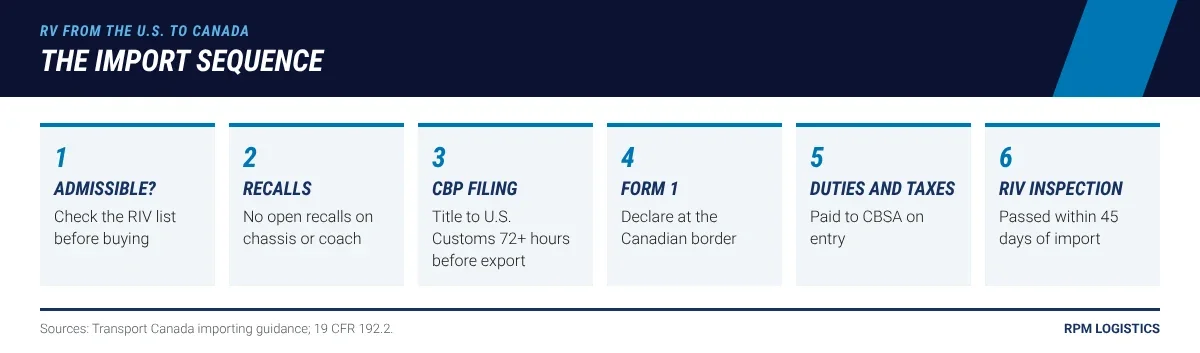
The first two steps decide whether the RV can come in at all; do them before buying, not after the truck is booked.
Can you ship an RV from the U.S. to Canada?
Yes, you can ship an RV from the U.S. to Canada, as long as the unit is admissible under Canadian rules. Canada's Registrar of Imported Vehicles (RIV) runs the program that checks U.S. vehicles against Canadian safety standards after import. Admissibility depends on the specific make, model and year.
Demand runs both ways across the border. Buyers in Canada shop U.S. dealers for selection and price, and U.S. buyers purchase units in Canada. The North American market is large: wholesale RV shipments reached 342,220 units in 2025, according to the RV Industry Association (RVIA, 2026). Shipments through August 2026 totaled 207,191, down 14.2% from a year earlier.
Cross-border RV moves involve four parties:
- The buyer or owner, who is the importer of record.
- U.S. Customs and Border Protection (CBP), which handles the export side.
- The Canada Border Services Agency (CBSA), which handles import, duties and taxes.
- Transport Canada and the RIV, which handle admissibility and inspection.
Many buyers also use a customs broker for the filings. The transport provider moves the RV and coordinates timing with whoever handles the paperwork.
Is my RV admissible in Canada?
Your RV is admissible in Canada if its make, model and year can meet Canadian safety standards, either as built or with modifications. Transport Canada directs importers to check eligibility on the RIV's website before buying.
RVs have two complications that ordinary cars do not:
- Multi-stage construction. Transport Canada notes that vehicles built by more than one manufacturer, including motorhomes, must meet additional requirements. A Class A or Class C motorhome built on another maker's chassis falls in this group.
- Modifications. Modified vehicles do not qualify. Transport Canada gives a van converted into a motorhome as an example. That rule matters for camper van conversions bought from independent upfitters.
If a vehicle cannot be brought into compliance, it must be exported from Canada, even after duties are paid. Checking admissibility before purchase avoids that outcome.
What do you need to do on the U.S. side before export?
On the U.S. side, you need to clear any open recalls and report the export to U.S. Customs and Border Protection. Both steps should be done before the RV reaches the border.
Clear open recalls
Transport Canada requires that the vehicle have no open recalls. Check the RV's VIN through NHTSA's recall lookup, and get any open recall repaired before export. Motorhomes can carry recalls from both the chassis maker and the coach builder, so check both.
Report the export to CBP
Under 19 CFR 192.2, the exporter submits the original title and two copies to CBP. They go to the port of export at least 72 hours before export. For land crossings, the vehicle itself is presented at the time of export, not 72 hours ahead. Each port sets its own location and procedures, so contact the port before the move.
The 72-hour rule is the same one that governs overseas vehicle exports. Our guide to exporting a classic car overseas covers how it works by vessel.
What happens at the Canadian border?
At the Canadian border, the RV is declared to the Canada Border Services Agency, and duties and taxes are paid. The importer completes Canada's Vehicle Import Form, known as Form 1.
Transport Canada's process includes:
- Form 1. Completed through the RIV's online form, printed and handed to border officers. It cannot be submitted online.
- Duties and taxes. Paid to CBSA at the border. Duty depends on the vehicle's origin, and sales taxes apply.
- RIV registration. The vehicle enters the RIV program for its post-import inspection.
Duty treatment can change with where the RV was built. Confirm current duty and tax amounts with CBSA or a customs broker before you buy, since they affect the total cost.
How does the RIV inspection work?
The RIV inspection confirms that an imported vehicle meets Canadian requirements after it crosses the border. Transport Canada requires the inspection to be passed within 45 days of import, or within one year for a salvage vehicle.
Plan for the inspection before the RV arrives:
- Complete required modifications, such as lighting or labeling changes, before the appointment.
- Bring the RIV paperwork issued at the border.
- Book an inspection site that can physically handle the RV's size.
- Keep the 45-day clock in view, since a vehicle that fails must leave Canada.
Large motorhomes can be hard to fit into some inspection facilities. Ask about bay height and length when booking.
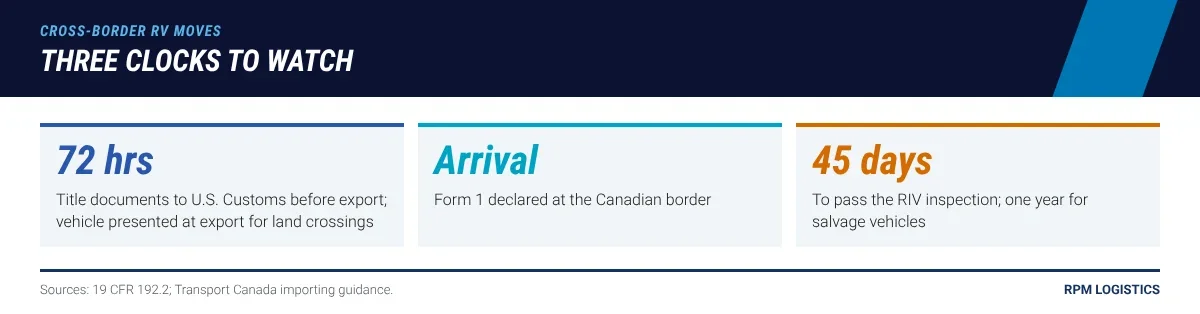
Two of the three clocks run on the Canadian side, but the first one starts at a U.S. customs office days before the truck reaches the border.
How do you ship an RV from Canada to the U.S.?
Shipping an RV from Canada to the U.S. follows a different set of rules, run by U.S. agencies. The importer must show that the vehicle meets U.S. safety and emissions requirements, or qualifies for an exemption.
The main steps are:
- Check eligibility. NHTSA's importing page includes guidelines and an eligibility list for vehicles imported from Canada.
- File the declarations. NHTSA's HS-7 declaration covers safety standards, and the EPA has its own import form for emissions.
- Clear customs. CBP processes the entry, with duty depending on the vehicle's origin.
- Register in your state after entry, following its rules for imported vehicles.
Towable RVs without an engine avoid the emissions question but still need safety compliance. Our article on importing a classic car and the 25-year rule explains how U.S. import eligibility works for older vehicles.
Towaway, driveaway or trailer haul across the border?
Towaway, driveaway and trailer haul all work across the border, using the same method that fits the RV domestically. The cross-border part adds paperwork and timing, not a different way to move the unit.
RV type | Usual method | Cross-border note |
|---|---|---|
Class A, B and C motorhomes | Driveaway | Driver presents the RV at the port of exit; recalls cleared first |
Travel trailers, fifth wheels, toy haulers | Towaway | Tow vehicle and RV both cross; RV paperwork travels with the driver |
Folding and pop-up campers | Trailer haul | Camper's title and import papers travel with the load |
Larger units can raise size and permit questions on either side of the border. See our guide to over-dimensional transport for buses, RVs and chassis. Some RVs cross the U.S. in transit to or from Canada. Those bonded moves have their own customs rules, covered in our guide to bonded transport and in-transit customs.
How long does a cross-border RV move take?
A cross-border RV move takes the domestic transit time plus the time needed for paperwork and the border crossing. The 72-hour CBP filing is the minimum on the U.S. side, and it starts before the RV reaches the port.
Build the schedule this way:
- Before booking: confirm admissibility and recall status.
- At least 72 hours before export: submit title documents to CBP at the port of exit.
- Crossing day: the driver presents the RV and paperwork at both borders.
- After arrival: complete modifications and the RIV inspection within 45 days.
Delays usually come from missing documents, not traffic. A title held by a lender, for example, needs a lien release or lender letter before CBP will process the export.
What should Canadian buyers ask a U.S. RV dealer?
Canadian buyers should ask a U.S. RV dealer about export experience before signing. Some dealers sell to Canadian buyers regularly and know the paperwork. Others rarely do, and the buyer ends up managing every step.
Useful questions include:
- Has the unit been checked against the RIV admissibility list?
- Are there open recalls on the chassis or the coach, and will the dealer complete them?
- Can the dealer provide a recall clearance letter?
- Will the title be clear of liens and available in time for the CBP filing?
- Has the dealer worked with a customs broker on prior sales?
- What is the latest date the RV can be picked up?
A dealer that can answer these quickly saves days at the border. Get the answers in writing, along with the VIN and bill of sale.
What costs should you budget for in a cross-border RV move?
A cross-border RV move carries costs beyond transport. Listing them before you buy shows the true landed cost of the unit.
- Transport from the seller to the border and on to the destination.
- Duties, depending on where the RV was built.
- Sales taxes collected at import.
- RIV fees for registration in the program.
- Modification costs to meet Canadian requirements, if any.
- Inspection costs, plus any repairs found at inspection.
- Customs broker fees, if you use one.
- Provincial registration and insurance after the inspection.
Duty, tax and fee amounts change, so confirm current figures with CBSA, the RIV and your province before you commit to a purchase.
What paperwork should travel with the RV?
The paperwork that travels with the RV should prove ownership, export clearance and the importer's details. Drivers should carry copies at both borders.
- Original title or CBP-stamped export documents.
- Bill of sale showing the buyer, seller, price and VIN.
- Recall clearance, such as a dealer letter or repair records.
- Form 1 printed from the RIV system, for Canada-bound units.
- Lien release, if the RV was financed.
- Importer contact details and the customs broker's details, if one is used.
How RPM supports cross-border RV moves
RPM Logistics moves RVs across all 50 states and Canada by towaway, driveaway and trailer haul. For cross-border moves, we handle the transport and coordinate pickup and crossing times with the owner or customs broker who manages the filings.
Every move includes photo condition reports at pickup and delivery. Carriers in the network recorded 3.5 accidents per million miles in 2026 year to date (RPM Logistics, 2026). Get a quote through our RV transport service. See our guide to how to ship an RV for preparation steps, and our breakdown of what drives RV shipping cost for pricing factors. For vehicle moves across the border more generally, see our guide to cross-border vehicle transport. Request a quote with the RV type, pickup city and destination.
Frequently asked questions
What is the Registrar of Imported Vehicles?
The Registrar of Imported Vehicles (RIV) runs Canada's program for checking vehicles imported from the U.S. against Canadian safety requirements. Importers register the vehicle and pass an RIV inspection after import.
How long do I have to pass the RIV inspection?
Transport Canada requires the RIV inspection to be passed within 45 days of import, or within one year for a salvage vehicle. A vehicle that fails must leave Canada.
Do I need to notify U.S. Customs before taking an RV to Canada?
Yes. Under 19 CFR 192.2, title documents must be submitted to CBP at the port of export at least 72 hours before export. For land crossings, the vehicle is presented at the time of export.
Can a converted camper van be imported into Canada?
Transport Canada says modified vehicles do not qualify, and it gives a van converted into a motorhome as an example. Check admissibility with the RIV before buying.
Does my RV need to be recall-free to enter Canada?
Yes. Transport Canada requires that the vehicle have no open recalls. Check the VIN through NHTSA's recall lookup and complete any repairs before export.
How do I ship an RV from Canada to the U.S.?
Check U.S. eligibility on NHTSA's importing page, file NHTSA's HS-7 declaration and the EPA import form where required, and clear U.S. Customs. Then register the RV in your state.