

Quick Answer
Switching fleet transport providers mid-program means moving open orders, stored vehicles, open claims and live lanes from one provider to another without stalling deliveries. A good transition runs in phases. Reconcile in-flight inventory first, run both providers in parallel on a few lanes, then cut over region by region against baseline KPIs.
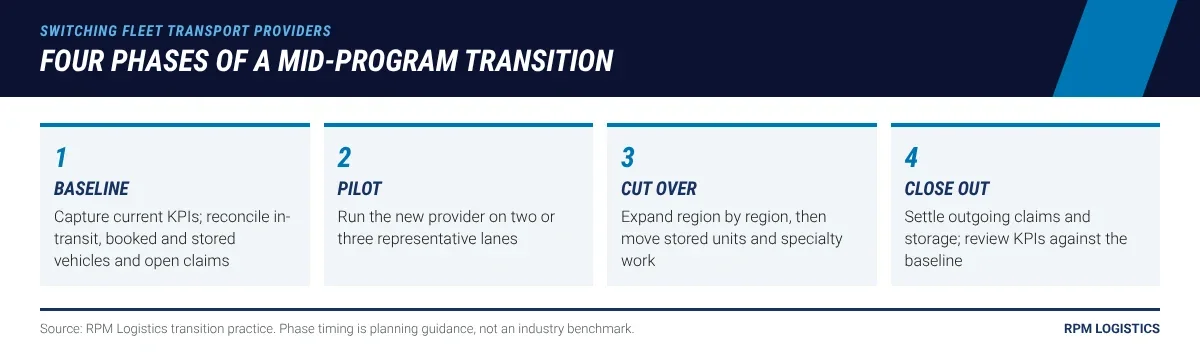
Phase one decides how the rest goes: vehicles nobody can locate on cutover day are the most common transition failure.
What does switching fleet transport providers involve?
Switching fleet transport providers is the handoff of an active vehicle logistics program from one vendor to another. It starts after the new provider is selected and ends when the old provider has no open work. Everything in between is the transition.
A mid-program switch is harder than a fresh start because work never stops. Vehicles are on trucks, in storage and waiting for pickup on the day the decision is made. Drivers, dealers and upfitters still expect deliveries on schedule.
Fleet programs carry a lot of volume. U.S. fleet sales totaled 2,227,876 vehicles in 2025, including 781,986 commercial fleet units and 239,177 government units (Bobit Business Media, 2026). Each of those vehicles moves several times across its life. A transition has to protect every one of those moves.
If you are still choosing a provider, start with our guide to questions to ask before signing and our automotive logistics RFP checklist. This article picks up after the choice is made.
Why do fleets switch transport providers mid-program?
Fleets switch transport providers mid-program when the cost of staying exceeds the cost of a transition. The trigger is usually a pattern, not a single bad move.
Common reasons include:
- Missed delivery windows that leave drivers or sites without vehicles.
- Damage claims that take too long to resolve or keep repeating.
- Poor visibility, with status updates that arrive late or not at all.
- Coverage gaps in regions where the program has grown.
- Invoices that do not match quotes, with accessorials added after the fact.
- Program changes, such as electrification, a merger or a new service line.
Invoice surprises often trace back to how quotes were compared in the first place. Our buyer's guide on why fleet transport quotes aren't apples to apples covers how to avoid repeating that problem with a new provider.
What should you reconcile before cutover?
Before cutover, reconcile every vehicle and every open item the outgoing provider is touching. A transition built on an incomplete list will lose track of vehicles. This is phase one, and it deserves the most time.
Build a single list that covers:
- In-transit vehicles, with pickup date, current location and promised delivery.
- Booked but not picked up, with the planned pickup window.
- Stored vehicles, by lot, with storage start date and daily rate.
- Open damage claims, with claim numbers, amounts and status.
- Recurring lanes, with volume and service standards for each.
- Contacts and access, such as gate codes, site rules and key locations.
Stored vehicles are the easiest to lose. A unit parked at a provider's lot can sit unnoticed for months once the relationship ends. Our framework for fleet vehicle storage between assignments covers how to track units on hold.
How do you handle open damage claims during a switch?
Open damage claims stay with the provider that had custody when the damage happened. Switching providers does not transfer them. They need their own close-out plan, or they drag on after the relationship ends.
Federal rules set the basic timeline for cargo claims with motor carriers. Under 49 CFR Part 370, a carrier must acknowledge a written claim within 30 days. It must pay, decline or make a firm settlement offer within 120 days. Your contract may set tighter terms.
To close claims cleanly:
- List every open claim with photos, condition reports and dates.
- Agree on a close-out date with the outgoing provider in writing.
- Hold back final payments where the contract allows, until claims settle.
- File any new findings fast for vehicles delivered just before cutover.
Strong condition reports make claims faster on both ends. Our guide to photo condition reports for fleet claims explains what both providers should capture.
Should you run both providers in parallel?
Yes, for a short period. A parallel run lets the new provider prove itself on real lanes while the outgoing provider still covers the rest. It limits the damage if something goes wrong in the first weeks.
A practical parallel run:
- Pick two or three lanes that represent the program: one routine, one tight-deadline, one long-haul.
- Give the new provider all moves on those lanes, not a random share.
- Measure the same KPIs on both providers for the same period.
- Hold a weekly review with both fleet and operations at the table.
- Set exit criteria for moving to full cutover.
Choose pilot lanes where problems will surface quickly. A lane with weekly volume shows results within a month, while a lane with one move a quarter tells you very little. A parallel run should last weeks, not months. A long overlap doubles the coordination work and confuses drivers and sites about who is coming.
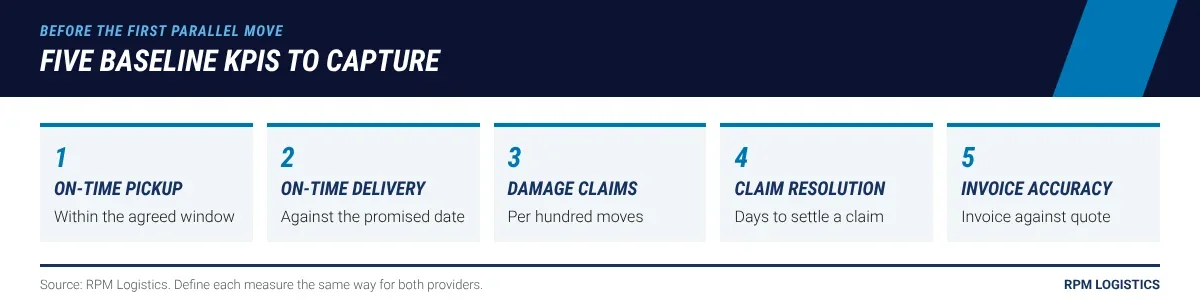
Without a baseline, a transition can only be judged on anecdotes; capture these five numbers for the outgoing provider before the first parallel move.
What KPIs prove the switch worked?
The KPIs that prove the switch worked are the ones you measured before it started. Capture a baseline for the outgoing provider, then track the same numbers for the new one.
Five measures cover most programs:
- On-time pickup within the agreed window.
- On-time delivery against the promised date.
- Damage claims per hundred moves.
- Days to resolve a claim.
- Invoice accuracy against the quote.
Define each measure the same way for both providers. A delivery counted as on time when it lands within a three-day window is not comparable to one counted against a single date. Our guide to fleet transport KPIs covers definitions in detail. The service levels themselves belong in the contract, as covered in our fleet transport SLA guide.
What contract and data steps come with a switch?
A switch has contract and data steps that run alongside the operational ones. Missing them can leave the program paying two providers or losing records it needs later.
- Check the notice period in the outgoing contract, and any minimum volume commitments.
- Confirm rates and accessorials with the new provider in writing before the pilot starts.
- Request a full data export of order history, condition reports and claim files from the outgoing provider.
- Set up integrations or order templates so sites can book with the new provider the same way they did before.
- Update insurance certificates and vendor records in procurement.
Transport is a meaningful share of logistics spend. U.S. business logistics costs equaled 7.8% of GDP in the 2026 CSCMP State of Logistics Report. A transition that leaks invoices or duplicate charges can erase the savings that drove the switch.
How do you tell drivers and sites about the change?
Drivers and sites should hear about the change before the new provider's first truck arrives. Surprised site staff may refuse to release a vehicle to an unfamiliar carrier, which is exactly the right instinct for security.
Send a short notice to every site, dealer, upfitter and storage lot on the program. Include:
- The new provider's name and what its drivers and trucks will look like.
- The date each region moves over.
- How to verify a driver at pickup, and who to call if something looks wrong.
- How booking and status updates will work from now on.
Drivers receiving vehicles need the same information. A clear notice prevents missed handoffs and keeps release-day verification strong during the overlap.
Keep the outgoing provider's data export even after the transition closes. Damage claims, warranty questions and audits can reach back months, and the condition reports in that file are the evidence.
How long should a fleet transport transition take?
Most mid-program transitions can be planned as a 30-60-90 day sequence, adjusted for program size. These are starting points for planning, not industry benchmarks.
Window | Focus | Done when |
|---|---|---|
First 30 days | Reconcile inventory and claims; set baseline KPIs; start the parallel pilot | Every vehicle and claim is on one list |
Days 31 to 60 | Expand lanes region by region; move stored units | New provider handles most new orders |
Days 61 to 90 | Close outgoing provider's open work; review KPIs | No open moves, storage or claims with the outgoing provider |
Small programs can move faster. Large national programs with storage, upfitting and remarketing may need longer. Avoid cutting over during peak periods, such as model-year changeover or a major fleet refresh.
Plan for the first week of each region to be slower than normal. Sites learn a new booking process, and drivers learn new sites. Building a few days of buffer into delivery promises during that week protects drivers and managers who are waiting on vehicles.
What should the new provider take over first?
The new provider should start with new orders on the pilot lanes, then new orders everywhere. Stored vehicles and complex work come last. Moving the hardest work first adds risk without adding proof.
A sensible order is:
- New orders on pilot lanes.
- New orders in the pilot's region.
- New orders across all regions.
- Stored vehicles, moved to the new provider's storage or straight to their next assignment.
- Specialty work such as upfit pickups, recoveries and remarketing.
Exceptions deserve a plan of their own. A mid-transition breakdown, missed pickup or damaged unit tests both providers at once. Our article on fleet transport exception management covers how to handle those moves.
After the 90 days, keep reviewing the same KPIs monthly. A new provider's first quarter is often its best behavior. Steady numbers over the following two quarters are the real proof that the switch worked.
How RPM supports fleet program transitions
RPM Logistics takes over vehicle transport programs for corporate, rental, government and commercial fleets across all 50 states and Canada. Transitions start with inventory reconciliation and a parallel pilot, not a single cutover date.
- Driveaway and haulaway matched to each lane.
- 70+ storage locations in the U.S. and Canada for units moved off an outgoing provider's lots.
- Driver screening through motor vehicle record checks at onboarding, with continuous monitoring after that.
- Photo condition reports at pickup and delivery from the first move.
Carriers in the network recorded 3.5 accidents per million miles in 2026 year to date, measured as accident frequency (RPM Logistics, 2026). New providers should also be verified through FMCSA registration records, whoever you choose. For program details, see our fleet vehicle logistics services.
Frequently asked questions
Can you switch fleet transport providers without stopping deliveries?
Yes, with a phased transition. Reconcile in-flight work first, run both providers in parallel on a few lanes, then cut over region by region.
What happens to vehicles in transit when you switch providers?
Vehicles already picked up should finish with the outgoing provider. Track them on the transition list until delivery is confirmed.
Who handles damage claims after a provider switch?
The provider that had custody when the damage happened handles the claim. Under 49 CFR Part 370, a carrier must acknowledge a claim within 30 days and resolve it within 120 days.
How long does a fleet transport transition take?
Many programs plan around 30, 60 and 90 day phases. Smaller programs can move faster, and large national programs may need longer.
What KPIs should you track when changing vehicle transport vendors?
Track on-time pickup, on-time delivery, damage claims per hundred moves, days to resolve a claim and invoice accuracy. Measure the outgoing provider first so you have a baseline.
Should you run two fleet transport providers at once?
For a short parallel run, yes. Keep it to a few weeks on selected lanes, with clear criteria for full cutover.
Plan your transition before you sign
A provider change should improve your program from the first week. RPM Logistics can build the transition plan with you, starting with your open inventory. Talk to our fleet team about switching your vehicle transport program.