

Quick Answer
Rail-to-truck transload for finished vehicles is the handoff at a rail ramp, where new vehicles come off autorack railcars and load onto car haulers for the final leg to dealers. Rail moves nearly 75% of new U.S. cars and light trucks (Association of American Railroads, 2026). The ramp handoff is where dwell time and damage disputes most often start.
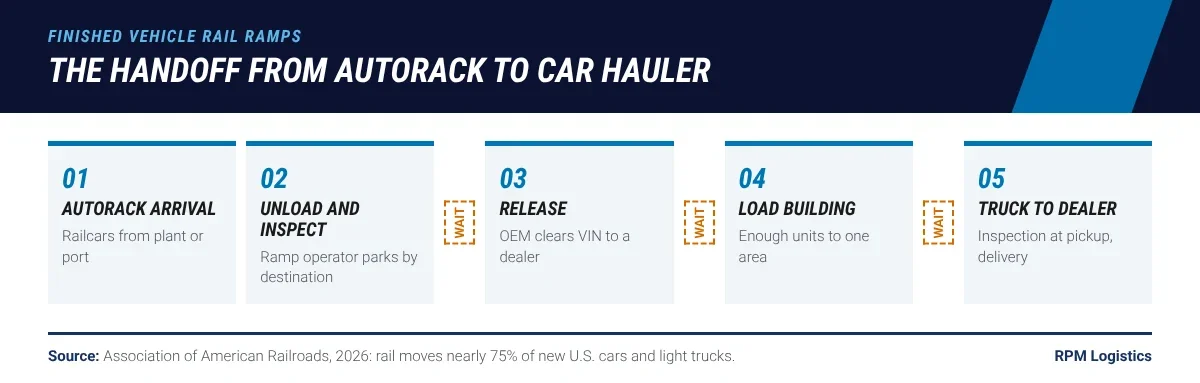
The rail and truck legs both run on schedules. The ramp in the middle runs on releases and capacity, and that is where vehicles wait.
What Happens at a Rail Ramp
A rail ramp, also called an auto ramp or mixing center, is the facility where finished vehicles move between rail and truck. Autorack railcars arrive from assembly plants or ports. The ramp operator unloads each vehicle, inspects it and parks it in a bay or row by destination.
From there, the vehicle waits for two things. It needs a release, meaning the manufacturer has cleared it to ship to a specific dealer. It also needs a truck with room for it on a load going that way. Once both line up, a car hauler collects it for the final leg.
The scale is large. Rail moves nearly 75% of new cars and light trucks purchased in the U.S. (Association of American Railroads, 2026). In a typical year, railroads carry 1.8 million carloads of motor vehicles and parts (Association of American Railroads, 2023). Railroads serve most of North America's 70-plus automobile plants (Association of American Railroads, 2023).
For the full factory-to-showroom picture, see our guide to how cars are transported to dealers. This article covers only the ramp-to-dealer leg.
Why the Last Leg Is Where Delays Start
Rail is efficient over long distances. A single train can move hundreds of vehicles at once (Association of American Railroads, 2026). But a train delivers in bulk, and dealers receive in small loads. The ramp is where one big delivery becomes dozens of small ones.
That conversion takes time. Vehicles wait for releases, for enough units to fill a truck to one area, and for carrier capacity. Some railroads give shippers VIN-level views of ramp dwell. Union Pacific's Automotive Management tool, for example, reports current inventory and dwell time by ramp (Union Pacific Automotive Management guide). Visibility helps, but it does not move the car.
When to use rail at all is a separate decision. Our guides to rail vs truck break-even distance and rail vs over-the-road distribution cover that choice.
The Four Causes of Ramp Dwell
1. Release Timing
A vehicle cannot leave the ramp without a release to a dealer. If allocation is late, or the release comes in batches, vehicles pile up. This is an OEM decision, not a carrier one.
2. Load Building
A car hauler carries several vehicles at once. The carrier wants a full load to one area. A single released vehicle for a remote dealer may wait until others are released nearby. The fewer vehicles heading to an area, the longer each one waits.
3. Carrier Capacity
When many vehicles release at once, such as at month-end or model-year changeover, trucks run short. Vehicles are ready but nobody is there to take them. Our article on model-year changeover logistics covers that crunch.
4. Holds
Some vehicles cannot ship even when released. A stop-sale or open recall can freeze specific VINs at the ramp. Checking status through NHTSA's recall lookup and the OEM's own notices keeps held units from being booked on a truck by mistake.
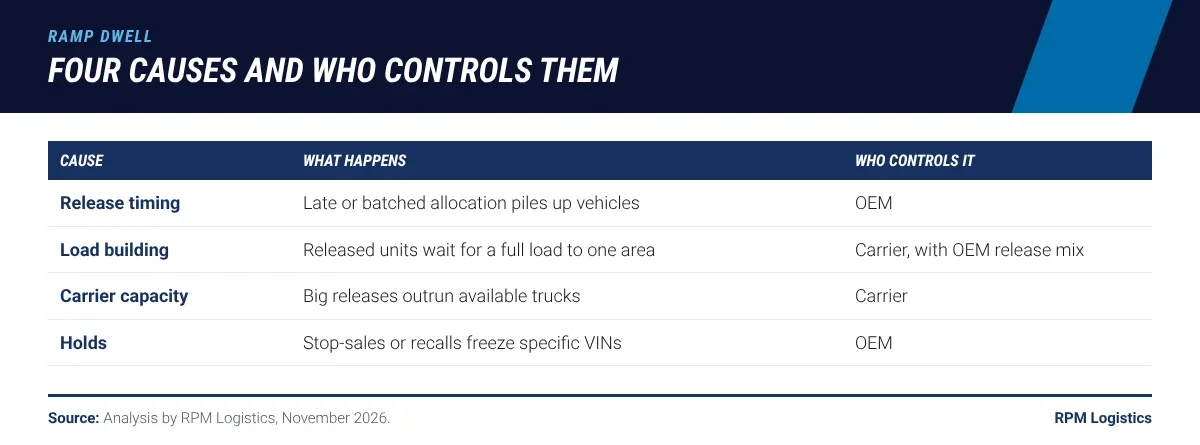
Only two of the four causes sit with the carrier. Cutting dwell needs the OEM and the carrier working from the same release data.
The Damage Handoff at the Ramp
Liability for a vehicle changes hands at the ramp. The railroad or ramp operator hands it to the truck carrier. Any damage found later will be traced back to this moment.
That makes the ramp inspection the most important record in the leg. The truck driver should inspect each vehicle before loading and note every existing mark on the condition report. Damage that was not noted at the ramp is hard to assign to the rail leg later.
Good ramp inspections cover:
- All body panels, in daylight or proper lighting.
- Glass, mirrors and wheels.
- Underbody contact points, since autorack loading can scrape low vehicles.
- Protective film or wrap, and whether it is intact.
- Mileage, since ramp moves add a few miles.
Our guide to photo condition reports covers the standard that settles disputes fastest.
Drayage vs Long-Haul From the Ramp
Not every truck leg from a ramp is the same. Two patterns are common:
Pattern | Typical use | What matters most |
|---|---|---|
Short-haul from ramp | Dealers within a day's round trip of the ramp | Fast turns, gate appointments, many loads per truck per day |
Long-haul from ramp | Dealers far from any ramp, or rural areas | Full loads, route planning, hours-of-service limits |
Long-haul legs run inside FMCSA hours-of-service limits, so a far dealer may take more than one driving day. Short-haul legs live or die on gate times and ramp congestion.
What OEMs and Dealers Can Control
Ramp dwell is not fixed. Shippers can shorten it in several ways:
- Release earlier and steadier. Smooth releases prevent pile-ups and truck shortages.
- Share release data with the carrier. A carrier that sees releases coming can position trucks.
- Group dealers by area. Releasing several vehicles to one area at once fills trucks faster.
- Set receiving windows. Dealers that accept deliveries after hours let trucks turn faster.
- Track dwell by ramp. Measure time from unload to truck pickup, not just transit time.
Those measures connect to the wider metrics in our guide to finished vehicle logistics KPIs. For transit expectations by lane and mode, see finished vehicle lead times.
Questions to Ask a Ramp Carrier
Before awarding ramp-to-dealer lanes, ask carriers how they handle the handoff:
- How do drivers inspect vehicles at the ramp, and what photo standard do they use?
- How quickly can trucks be positioned when a large release lands?
- Do they build loads by dealer area, and how long will they wait for a full load?
- Can they handle short-haul turns and long-haul legs from the same ramp?
- How do they confirm a VIN is not on hold before loading it?
Clear answers show whether the carrier treats the ramp as a pickup point or as the start of a managed delivery.
When Ramps Get Congested
Ramps share the same pressure points as ports. Volume spikes, weather and rail service problems all push vehicles into longer dwell. Our article on port congestion and finished vehicle throughput covers contingency planning that applies to ramps too.
At year-end, dealers also push to clear aged stock while new units arrive. See our guide to year-end aged inventory. National freight trends that affect both rail and truck are tracked by the Bureau of Transportation Statistics.
RPM moves finished vehicles from ramps, ports and plants to dealers in all 50 states and Canada through its OEM vehicle logistics service. Dealer groups can book through dealership vehicle transport.
Frequently Asked Questions
What is a rail ramp for cars?
It is a facility where finished vehicles move between autorack railcars and trucks. The ramp operator unloads, inspects and parks vehicles until they are released and picked up by car haulers for delivery to dealers.
How much of new vehicle volume moves by rail?
The Association of American Railroads says rail moves nearly 75% of new cars and light trucks purchased in the U.S. Nearly all of those vehicles still need a truck for the final leg.
Why do vehicles sit at rail ramps?
Mostly because of release timing, waiting for enough vehicles to fill a truck to one area, carrier capacity shortages and holds such as stop-sales or recalls.
Who is responsible for damage found after a rail-to-truck handoff?
It depends on where the damage was recorded. Damage noted on the condition report at the ramp points back to the rail leg. Damage that was not noted at the ramp is hard to assign to the rail leg later, so the ramp inspection matters most.
How can an OEM reduce ramp dwell time?
Release vehicles earlier and more evenly, share release data with carriers, group releases by dealer area and track dwell from unload to truck pickup at each ramp.
Can a recalled vehicle ship from a rail ramp?
Not if it is under a stop-sale or a hold that blocks shipment. Those VINs stay at the ramp until the OEM clears them. Check recall and hold status before booking a truck.