

Quick Answer
Telecom technician fleet deployment gets an upfitted van or truck from the factory to a technician who can run calls on day one. The vehicle moves from OEM to upfitter, gets stocked with tools and inventory, picks up plates and fuel cards, then reaches the technician. It counts as deployed only when the first truck roll can happen.
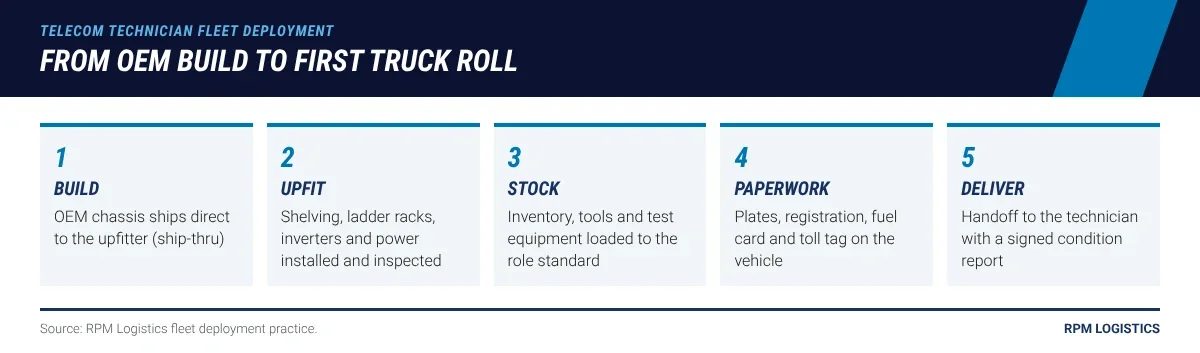
Delivery is stage five, not the finish line; a van that arrives without stock or plates still cannot run a single service call.
What is telecom technician fleet deployment?
Telecom technician fleet deployment covers every step between a new vehicle order and a technician's first service call. It includes OEM delivery, upfitting, inventory loading, registration and final delivery. The goal is a vehicle that is ready to work, not just a vehicle that has arrived.
The workforce behind these fleets is large and still hiring. The U.S. had 257,800 telecommunications technician jobs in 2025, with about 20,300 openings a year projected over the next decade (Bureau of Labor Statistics, 2026). Line installers and repairers held another 131,900 jobs, with employment projected to grow 10% by 2035 and about 10,900 openings a year (Bureau of Labor Statistics, 2026).
Most of those openings come from turnover and retirements, not only from growth. Each new technician needs a vehicle. Each departing technician leaves one that must be recovered, reset and reassigned.
Telecom fleets typically run a mix of:
- Cargo vans with shelving, ladder racks and inverters for installers.
- Pickups with service bodies for outside plant and field engineering.
- Bucket and aerial trucks for line work and pole access.
- Box trucks and splicing trucks for fiber crews and specialty work.
Why do technician vehicles sit idle after delivery?
Technician vehicles sit idle after delivery because the delivery date and the readiness date are treated as the same thing. A van can reach the depot on time and still wait days for parts bins, meters, a fuel card or a registration sticker.
The most common gaps are:
- Upfit backlog. Chassis arrive faster than the upfitter can build them out.
- Missing inventory. Parts, tools and test equipment are ordered separately from the vehicle.
- Paperwork lag. Plates, registration and fuel cards follow the vehicle by days or weeks.
- Wrong location. The vehicle lands at a central yard instead of the technician's market.
- No handoff owner. Fleet, operations and the transport provider each assume someone else checks readiness.
Every one of these gaps costs truck rolls. Our article on why delivered isn't the same as ready breaks down how those days add up across a fleet.
How should upfit and ship-thru fit into the plan?
Upfit and ship-thru should be planned as part of the transport route, not as a separate project. The fastest programs send chassis straight from the OEM to the upfitter, then from the upfitter to the technician's market, with no extra stops.
Ship-thru is the OEM arrangement where a new chassis ships directly to an approved upfitter before final delivery. It removes a dealer stop and a second transport leg. It also means the upfitter's schedule becomes the transport schedule.
To keep upfit from becoming the bottleneck:
- Share the build list early so the upfitter can stage shelving, racks and power kits before chassis arrive.
- Book outbound transport against the upfitter's completion dates, not the OEM ship date.
- Batch by region so completed units leave the upfitter in full loads.
- Inspect at the upfitter with a photo condition report before the vehicle moves.
Our guide to upfitting logistics and ship-thru transport covers the upfitter stage in more detail. Commercial fleet volume is significant: U.S. commercial fleet sales totaled 781,986 vehicles in 2025, down 4% from 2024 (Bobit Business Media, 2026).
What makes a technician vehicle ready for its first truck roll?
A technician vehicle is ready for its first truck roll when the technician can finish a job without a return trip. That means the vehicle, the stock and the paperwork are all complete at the same time.
A practical readiness checklist:
- Upfit complete and inspected, with shelving, racks and power working.
- Inventory loaded to the standard stock list for that technician's role.
- Tools and test equipment assigned and recorded.
- Plates and registration on the vehicle, not in the mail.
- Fuel card and toll tag issued and tied to the vehicle.
- Safety equipment such as cones, triangles and a first aid kit in place.
- Open recalls cleared by VIN through NHTSA's recall lookup.
- Condition report signed by the technician at handoff.
Registration deserves extra lead time when vehicles cross state lines. Our guide to fleet title and registration across state lines covers the common delays.
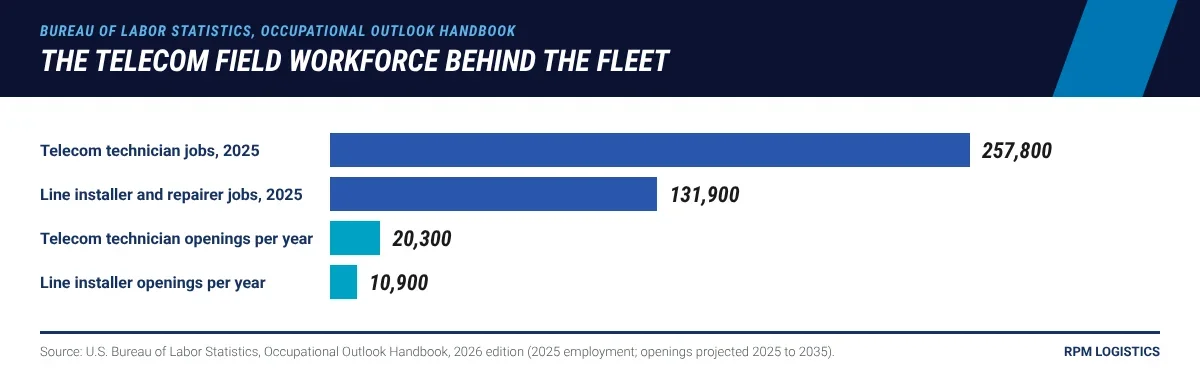
Roughly 31,000 combined openings a year means a steady stream of vehicle assignments, recoveries and resets, even in years when fleet size holds flat.
Do heavier technician trucks change the compliance picture?
Yes. A technician vehicle rated at 10,001 pounds or more is a commercial motor vehicle under federal rules when used in interstate commerce. That brings DOT requirements that a light cargo van does not.
Fleets that mix vans with bucket trucks or box trucks should check each unit against these thresholds:
- 10,001 pounds GVWR or more: commercial motor vehicle rules can apply, including driver medical certification and vehicle inspection requirements, under 49 CFR Part 390.
- 26,001 pounds GVWR or more: a single vehicle generally requires a commercial driver's license.
- Combinations: a truck towing a cable trailer or equipment can cross into a different CDL class.
This matters for deployment because the technician who receives the vehicle must be qualified to drive it. A bucket truck delivered to a technician without the right credentials will sit, no matter how fast it arrived. Our guide to commercial truck fleet logistics covers how moving trucks differs from moving cars.
Driveaway or haulaway for technician vehicles?
Driveaway and haulaway each fit different technician vehicle moves. The right choice depends on the vehicle type, the distance and whether the upfit can handle highway miles before delivery.
Situation | Usual method | Why |
|---|---|---|
Cargo vans, one market to the next | Driveaway | Fast and flexible for single units |
Many vans from one upfitter to one region | Haulaway | Full loads, fewer miles on new vehicles |
Bucket and aerial trucks | Driveaway by qualified drivers or specialized haul | Height, weight and CDL requirements |
Long-distance new units | Haulaway | Protects warranty miles and upfit equipment |
Many programs use both. Driveaway handles reassignments and short moves, while haulaway handles new-unit waves. Our comparison of driveaway vs. haulaway walks through the cost and protection trade-offs.
How do broadband build-outs change fleet planning?
Broadband build-outs change fleet planning because they create hiring and deployment waves in specific regions. When a provider wins a build program, it may need dozens of crews in a market that had few before.
Federal funding is one driver. The Broadband Equity, Access, and Deployment program, run by NTIA, was funded at $42.45 billion under the Infrastructure Investment and Jobs Act. As state projects move into construction, contractors and providers staff up market by market.
For fleet teams, a build-out wave looks like a small facility launch:
- Forecast crew starts by month and market with operations.
- Stage vehicles regionally ahead of start dates instead of shipping each to order.
- Coordinate upfit capacity so specialty trucks are ready in the same window.
- Plan the exit for when the build ends and crews move to the next market.
Our guide to fleet relocation for facility openings applies directly. For holding vehicles until crews start, see our framework for fleet vehicle storage between assignments.
What happens to a vehicle when a technician leaves?
When a technician leaves, the vehicle should be recovered, inventoried and reset before it goes to the next hire. Skipping any of those steps sends the next technician out with missing stock or unrecorded damage.
A clean recovery sequence looks like this:
- Schedule recovery for the technician's last day, with the vehicle's location confirmed.
- Count the stock and recover tools, meters and company devices.
- Record the condition with a photo report at pickup.
- Send it to make-ready for cleaning, repairs, service and restocking.
- Reassign or retire the vehicle based on its age, mileage and the next hire's market.
The same vehicle can serve three or four technicians over its life. Each turn is a chance to lose days or to lose track of inventory. Our playbook on fleet reassignment logistics covers turns between drivers, and our overview of the make-ready pipeline covers the shop stage.
Upfitted vehicles need extra attention at turnover. Shelving, racks and inverters should be inspected and repaired before reassignment, since a loose rack is a safety issue on the highway.
When a build ends, crews often move to the next market, and their vehicles go with them or return to a central pool. Planning that exit at the start avoids a scramble when contracts wind down.
Who owns each handoff in a technician deployment?
Each handoff in a technician deployment needs a named owner, because vehicles stall at the gaps between teams. A typical program involves the OEM, the upfitter, the transport provider, fleet management, operations and the technician.
- Fleet management owns the order, the build spec and the readiness standard.
- The upfitter owns build completion and the pre-transport inspection.
- The transport provider owns pickup, delivery and condition reports.
- Operations owns inventory, tools and the technician's start date.
- The technician owns the final inspection and sign-off.
A shared tracker that shows each vehicle's stage, owner and target date keeps everyone working from the same plan. It also shows at a glance which vehicles are stuck and why. Writing these owners down sounds basic, but it is where most programs fall short. Our article on the fleet handoff problem explains why accountability breaks between OEM, upfitter, transporter and driver.
Review the tracker weekly during a deployment wave. Vehicles that stay in one stage for more than a few days are the ones that will miss a technician's start date.
How RPM supports telecom and field service fleets
RPM Logistics moves technician vans, pickups and trucks for field service fleets across all 50 states and Canada. Programs use us for upfitter pickups, regional staging, reassignments between technicians and returns at end of cycle.
- Driveaway and haulaway matched to each vehicle and lane.
- 70+ storage locations in the U.S. and Canada for regional staging.
- Driver screening through motor vehicle record checks at onboarding, with continuous monitoring after that.
- Photo condition reports at pickup and delivery, so upfit damage is caught before handoff.
Carriers in the network recorded 3.5 accidents per million miles in 2026 year to date, measured as accident frequency (RPM Logistics, 2026). For program details, see our fleet vehicle logistics services.
Frequently asked questions
What is a truck roll in telecom?
A truck roll is a dispatch of a technician in a vehicle to a customer site or network location. Fleets track it because each roll costs time and money, and a vehicle that is not ready blocks it entirely.
What is ship-thru in fleet upfitting?
Ship-thru is an OEM arrangement that sends a new chassis directly to an approved upfitter before final delivery. It removes a dealer stop and a transport leg from the process.
Do bucket trucks need a CDL driver for delivery?
A single vehicle rated at 26,001 pounds GVWR or more generally requires a CDL. Lighter trucks rated at 10,001 pounds or more can still be commercial motor vehicles with their own DOT requirements.
Should technician vans be delivered by driveaway or haulaway?
Driveaway fits single vans and short moves. Haulaway fits waves of new vans from one upfitter to one region, or long distances where added miles would wear new equipment.
How many telecom technicians are there in the U.S.?
The Bureau of Labor Statistics counted 257,800 telecommunications technician jobs in 2025, with about 20,300 openings a year projected. Line installers and repairers held another 131,900 jobs.
What should a technician check at vehicle handoff?
Check the upfit, inventory, tools, plates, fuel card and safety equipment, then sign the condition report. Anything missing should be logged before the first service call.
Get technicians on the road faster
A technician without a ready vehicle is a crew short. RPM Logistics coordinates pickup, staging and delivery around your upfit and hiring schedule. Talk to our fleet team about your next technician deployment.