

Quick Answer
Buying an RV out of state means buying in one state and titling, registering and paying tax in the state where you live. The seller hands over the title, the bill of sale and the lien release. Your home DMV issues the plates. Plan how the RV gets home before you sign, because temporary tags and inspections set the clock.
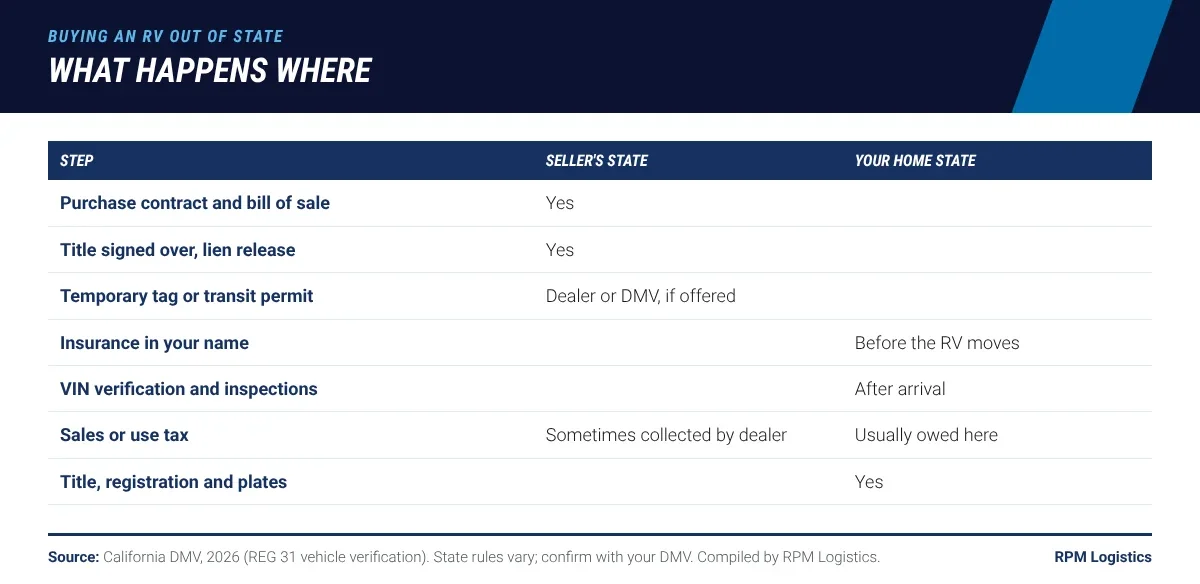
The sale happens where the RV is. Title, tax and plates happen where you live. Transport connects the two.
Why Buyers Look Out of State for an RV
An out-of-state RV purchase is any deal where the unit sits in a different state from the buyer's home address. It is common. Inventory is uneven, and a specific floor plan or chassis may only exist several states away.
The market has also shifted. RV makers shipped 342,220 units to dealers in 2025 (RV Industry Association, 2026). Through August 2026, shipments totaled 207,191, down 14.2% from the same period a year earlier (RV Industry Association, 2026). Fewer new units on local lots push more buyers to search wider.
Price is the other driver. Dealers in different regions price the same model differently, and private sellers in snowbird states often list units after a season. A better price can justify the extra paperwork. It only works if the paperwork and the trip home are planned up front.
What Happens in the Seller's State
The seller's state controls the sale itself. Your job there is to leave with clean ownership documents and a legal way to move the RV.
Buying from a dealer
Out-of-state dealers sell to nonresidents every week. Most will prepare the purchase contract, collect what they are required to collect and hand you the title paperwork or send it to your DMV. Ask three questions before you sign:
- Will the dealer collect sales tax? Some dealers collect your home state's tax. Others collect none and leave it to your DMV. A few may try to collect their own state's tax, which you may not owe.
- Who sends the title? If you finance, the lender usually holds the title and the dealer sends paperwork to the lender.
- What temporary permit can they issue? A temporary tag or transit permit lets the RV travel legally to your state. Its length and rules vary by state.
Buying from a private seller
A private sale puts more on you. Before money changes hands, get:
- The original title, signed by every owner listed on it.
- A bill of sale with the price, date, VIN and both signatures.
- A lien release if the title shows a lender, or a payoff arranged with that lender.
- The odometer reading for a motorhome, recorded on the title or a separate statement.
Match the VIN on the title to the VIN on the unit. On a motorhome, check both the chassis VIN and the coach label. On a travel trailer or fifth wheel, the VIN is usually on the frame near the hitch. A mismatch stops registration at home, so catch it before you pay.
Private sellers rarely issue temporary permits. That makes the move home its own decision, which we cover below.
What Happens in Your Home State
Your home state controls title, registration and tax. Each state runs its own process, but the steps rhyme.
Title and registration
You apply for a new title in your name and register the RV with your DMV. Most states ask for the out-of-state title, the bill of sale, proof of identity and residency, and the fee. Some states register towables by weight. Others use length or value. Expect the fee to differ from what you paid on your last car.
VIN verification
Many states require a physical VIN check on any vehicle titled out of state. California is a clear example. The California DMV requires a vehicle verification on form REG 31, completed by a peace officer, DMV employee or other authorized verifier, with the odometer recorded (California DMV, 2026). Other states use a police VIN check or an inspection station. The RV has to be physically present, so the verification happens after it arrives.
Sales or use tax
Tax usually follows registration. If the dealer did not collect your home state's tax, you pay use tax at your DMV. If you paid tax in the seller's state, many states credit it against what you owe at home. Rules differ, and a few states have no sales tax at all. Get the answer from your DMV or tax agency before you sign, not after.
Emissions and safety inspections
Some states inspect motorhomes for safety, emissions or both. Towables rarely need emissions checks but may need a safety inspection. Look up your state's rule by vehicle type. A motorhome can be treated differently from a pickup with the same engine.
How Temporary Tags and Transit Permits Work
A temporary tag is short-term permission to operate an unregistered vehicle. For an out-of-state RV, it covers the gap between the sale and your home registration.
Dealers in many states can issue a temporary tag that is valid for a set number of days. Some states also sell a one-trip or transit permit for private-party buyers. Rules that matter:
- The tag must be valid for the full trip, including weather delays.
- Insurance must be active before the RV moves, not after it arrives.
- A tag from the seller's state does not register the RV in your state. You still title and register at home.
If the tag is likely to expire before the RV gets home, or if there is no tag at all, professional transport takes the timing pressure off. A carrier or towaway driver moves the RV under its own operating authority. Ask your transport provider what documentation it needs to move an unregistered unit.
Getting the RV Home: Drive, Tow or Ship
There are three ways to bring an out-of-state RV home. Each fits a different buyer.
Drive or tow it yourself
This works when you have the time, the right tow vehicle and experience with the unit size. You pick up, drive home and handle any problems along the way. The risk is a breakdown on an unfamiliar unit, far from your own service shop.
Hire a professional towaway or driveaway driver
A professional driver can tow a travel trailer or fifth wheel with a properly equipped truck, or drive a motorhome under its own power. This is the most common professional option for RVs. RPM's guide to RV towaway versus driveaway explains how the two methods differ and when each one fits.
Ship it on a trailer
Smaller towables, campers and some park models can ride on a flatbed or step deck. Larger and taller units may need over-dimensional transport with permits and route planning. Trailer shipping adds no miles to the RV, which matters on a new unit or one with low engine hours.
For the full method breakdown, see how to ship an RV. For what drives the price, see RV shipping cost factors. Price depends on unit size, method, distance, route and timing, so ask for a quote on your specific unit.
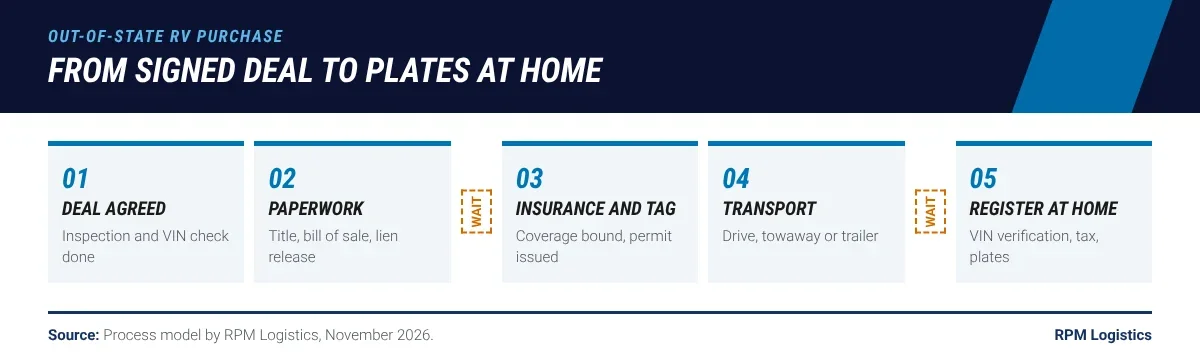
Book transport while the deal is still open. Waiting for the title before calling a carrier adds days to a temporary tag that is already running.
Inspect Before You Pay, Not After It Arrives
An RV bought from hundreds of miles away is hard to inspect in person. That is where most out-of-state buyers get hurt. A problem found in your driveway is your problem.
Options for checking an RV you cannot see:
- Hire an independent RV inspector near the seller. Ask for a written report with photos of the roof, seals, slides, frame and tires.
- Request a dealer walk-through on video with every system running, including the generator, slides, awnings, water heater and furnace.
- Check tire dates. RV tires often age out before they wear out. A unit on old tires may need new ones before a long tow.
- Search open recalls on both the chassis and the coach through NHTSA's recall lookup. Motorhomes can have recalls from the chassis maker and the coach builder.
RPM covers this step in more depth in its guide to pre-purchase inspection logistics. The idea is simple: inspect where the RV is, then move it once.
Insurance and Value Before the RV Moves
Insurance needs to start on the day you take ownership. Most insurers will bind coverage with the VIN and the purchase contract. Your policy should cover the RV during the trip home, whether you drive it or a professional moves it.
Know the unit's value before you buy coverage. J.D. Power RV values are a common reference for used RV pricing. A clear value helps you compare insurance quotes and judge the seller's price.
If you hire a transport provider, ask for its insurance certificate before pickup. Confirm the carrier's operating authority on the FMCSA company snapshot. A condition report at pickup and delivery records the RV's state at each end of the trip.
Five Mistakes Out-of-State RV Buyers Make
Most out-of-state RV problems trace back to a few avoidable choices. Each one costs time at the DMV or money on the road.
- Paying before the title is in hand. In a private sale, a missing signature or an unreleased lien can stall registration for weeks. Do not release funds until the title is signed and clear, or until the lender payoff is confirmed in writing.
- Assuming the dealer handled the tax. A contract with no tax line does not mean no tax is owed. Your DMV will ask, and the bill arrives at registration.
- Letting the temporary tag run out. Buyers often wait for paperwork before they plan the trip. The tag keeps counting while they wait.
- Skipping the inspection because the photos looked good. Roof leaks, delamination and soft floors rarely show in listing photos. An inspector on site sees what a camera misses.
- Booking transport without the unit's real dimensions. Height, length and weight decide the method and the route. A guess on height can mean a different trailer, a permit or a rebooked pickup.
None of these are rare. All of them are cheaper to prevent than to fix after the RV is parked in your driveway.
Out-of-State RV Purchase Checklist
- Confirm your home state's title, tax and inspection rules for your RV type.
- Arrange an independent inspection or video walk-through before you pay.
- Check the VIN on the unit against the title and run a recall search.
- Collect the signed title, bill of sale, lien release and odometer statement.
- Bind insurance on the day you take ownership.
- Secure a temporary tag or transit permit, or book professional transport.
- Book pickup with a named release contact and confirmed hours.
- Complete VIN verification and inspection once the RV is home.
- Title, register and pay any use tax at your DMV.
The same logic applies to cars. RPM's tips for buying a car from out of state cover the passenger-vehicle version, and its guide to changing registration when you move walks through the DMV side.
Buying From Canada or Shipping Across the Border
A cross-border RV purchase adds import rules on top of everything above. The RV has to meet U.S. import requirements, and the paperwork runs through customs before your DMV sees it. See RPM's guide to shipping an RV to or from Canada before you commit to a Canadian unit.
When to Call a Transport Provider
Call as soon as you have a deal in principle. A transport provider needs the unit type, length, height, weight, pickup and delivery locations, and the date the RV can be released. With that, it can confirm the method and the timing.
Early booking matters most in two cases. The first is a dealer purchase with a temporary tag that is already counting down. The second is a private sale where the seller wants the RV gone by a set date. RPM Logistics moves RVs in all 50 states and Canada. Its RV transport service covers towables and motorhomes for private buyers, dealers and manufacturers.
If you buy from a dealership, RPM's five things to know about shipping from a dealership also apply to RVs. Confirm the release contact, the pickup hours and who signs the condition report.
Frequently Asked Questions
Do I pay sales tax in the state where I buy the RV?
Usually you pay tax in the state where you register the RV. Some dealers collect your home state's tax at the sale. If you paid tax in the seller's state, many states give a credit. Confirm with your home DMV or tax agency before you sign.
Can I drive an RV home with no plates?
Not legally in most cases. You need a temporary tag or transit permit and active insurance. If the seller cannot issue a tag, professional transport moves the RV under the carrier's own authority.
Does my state need to inspect an out-of-state RV?
Many states require a VIN verification on vehicles titled out of state. California uses form REG 31. Some states also require safety or emissions inspections for motorhomes. The RV has to be present for these checks.
What paperwork do I need from a private RV seller?
Get the signed original title, a bill of sale with the price, date and VIN, a lien release if a lender is listed, and the odometer reading for a motorhome. Match the VIN on the unit to the title before you pay.
How do I get an RV home from another state?
You can drive or tow it yourself, hire a professional towaway or driveaway driver, or ship it on a trailer. The right choice depends on the unit size, your schedule and whether you want to add miles to the RV.
When should I book RV transport after buying out of state?
Book as soon as the deal is agreed. Early booking protects a temporary tag that is already running and meets a seller's deadline. The provider needs the unit's size, both locations and the release date.