

Quick Answer
The cost of a fleet vehicle transition is everything the vehicle costs while it sits between one driver and the next. Insurance, depreciation, registration and finance keep running every day. AAA puts ownership cost at $28.50 a day for a half-ton crew-cab pickup. A long gap can cost more than the transport move itself.
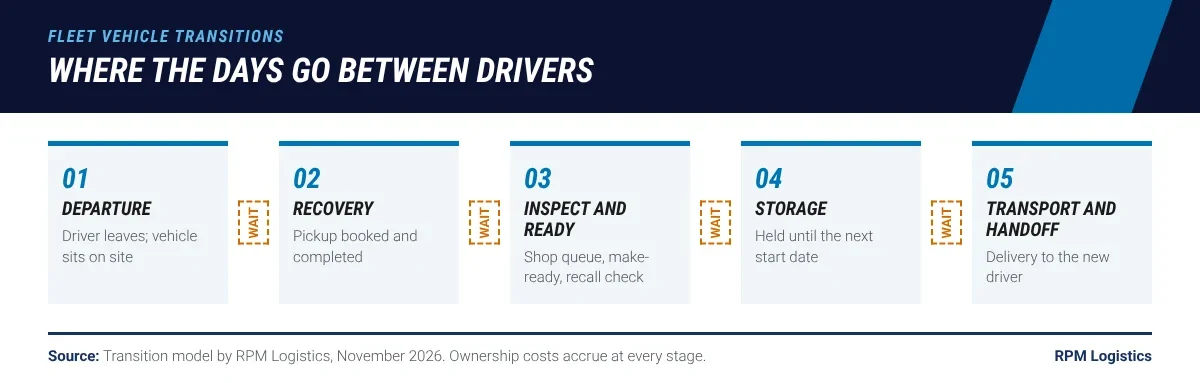
Most of the gap is waiting between stages, not work inside them. Those waits are where the days accumulate.
What the Gap Between Drivers Really Is
A fleet vehicle transition starts when a driver leaves a vehicle and ends when the next driver takes it. In between, the vehicle is recovered, inspected, made ready, stored and moved. Each stage might take a day. The waits between them often take far longer.
Fleets usually track the transport invoice for this period. Few track the cost of the days. That is the blind spot. The truck is not earning, but it is still costing.
What a Vehicle Costs Per Day When Nobody Drives It
A parked vehicle still carries its ownership costs. AAA defines these as full-coverage insurance, license, registration and taxes, depreciation and finance charges. None of them stop when the keys come back.
AAA's 2025 Your Driving Costs study puts daily ownership cost at:
- $28.50 per day for a half-ton crew-cab pickup (AAA, 2025).
- $20.91 per day for a midsize pickup (AAA, 2025).
- $17.81 per day for a medium sedan (AAA, 2025).
- $21.84 per day as the weighted average across vehicle types (AAA, 2025).
These are consumer averages, not fleet costs. Fleet pricing, lease terms and insurance programs differ. The point is the order of magnitude. Every idle day carries a real cost, and fleets should replace AAA's figures with their own.
Value also moves while a vehicle waits. Unadjusted wholesale used-vehicle prices fell 2.3% from September to October 2026 (Cox Automotive, November 2026). For a vehicle near the end of its cycle, a long hold can mean selling into a lower month.
The Costs Fleets Do Not See on the Invoice
Ownership cost is only the first layer. The gap also creates costs that land in other budgets:
- Rental or pool vehicles for a new hire whose assigned vehicle is not ready.
- Lost productivity when a new driver starts without a vehicle, or with the wrong one.
- Storage fees at a lot, shop or third-party yard.
- Extra moves when a vehicle goes to storage first and then to the driver, instead of direct.
- Admin time chasing status across the shop, the yard and the carrier.
Our article on the $500 transport decision that can create a $5,000 fleet problem shows how a small choice early in the process spreads into these costs.
Where the Days Get Lost
The gap rarely comes from one long delay. It comes from several short waits that nobody owns. These are the common ones.
Waiting for Recovery
The departing driver leaves, and the vehicle sits at a home or job site until someone schedules a pickup. If the recovery request goes through several people, days pass before a carrier is even booked.
Waiting for the Shop
Inspection and make-ready work runs to the shop's queue, not the fleet's calendar. Our guide to the fleet make-ready pipeline covers how that queue forms.
Waiting for the Next Driver
A ready vehicle often sits until the new hire's start date. If the start date moves, the vehicle waits again.
Waiting on Transport
If the delivery move is booked only after the vehicle is ready, the carrier's lead time adds days on top. Booking late is the most common avoidable wait.
Waiting for a Recall Fix
A gap is a good time to clear open recalls, but only if someone checks. About 28 million vehicles were affected by U.S. recalls in 2025 (Recall Masters, 2026). A check through NHTSA's recall lookup during inspection keeps a recall from delaying the handoff later.
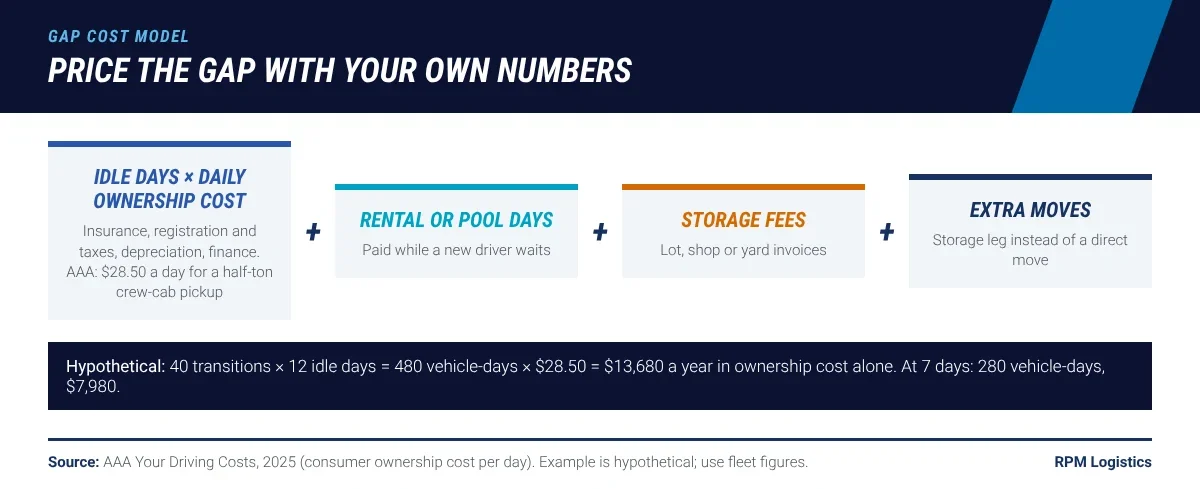
Every input comes from the fleet's own records. The model needs no outside benchmark to show where the money goes.
A Simple Model for the Cost of the Gap
Fleets can price their own gap with four inputs from their own records:
- Idle days from driver departure to the next driver's handoff.
- Daily ownership cost for that vehicle type, from lease, insurance and depreciation data.
- Rental or pool days paid while a new driver waits.
- Storage and extra move costs from invoices.
Gap cost = (idle days × daily ownership cost) + rental or pool cost + storage + extra moves.
Here is a hypothetical example, using AAA's half-ton pickup figure as a stand-in. A fleet handles 40 transitions a year. Each gap averages 12 idle days. That is 480 idle vehicle-days. At $28.50 a day, ownership cost alone is $13,680 a year, before any rental, storage or extra moves.
Cut the average gap to 7 days and idle vehicle-days fall to 280. Ownership cost drops to $7,980. The transport invoices did not change. Only the waiting did.
That kind of figure belongs in the transport budget. Our guide to budgeting 2027 fleet transport spend explains how to separate known costs from a reserve.
Signs the Gap Is Costing Too Much
Most fleets do not need a study to know their gap is too long. A few signals show up in daily operations:
- New hires start in rental or pool vehicles as a matter of routine.
- The same vehicles appear on storage invoices month after month.
- Delivery moves are booked only after a vehicle is marked ready.
- Nobody can say, without checking several systems, how many vehicles are between drivers today.
- Vehicles going to remarketing have sat for weeks after their last driver left.
If two or more of these are true, the gap is likely the cheapest place to recover cost in the fleet program. It needs no new vehicles and no new vendors, only tighter timing.
Which Days Transport Timing Controls
Transport cannot fix a shop backlog or a new hire's start date. It does control several of the waits:
- Recovery speed: a pickup booked the day a driver gives notice, not the day they leave.
- Booking ahead: the delivery move scheduled when the start date is set, not when the vehicle is ready.
- Direct moves: taking a vehicle straight from one driver to the next when its condition allows, skipping storage.
- Mode choice: a single vehicle on a tight timeline may move faster by driveaway than by waiting for a full truck. See driveaway vs haulaway.
- Clean handoffs: a delivered vehicle that is ready to drive on arrival. Our article on why delivered isn't ready covers what that takes.
The process steps for each move are covered in our guide to fleet reassignment logistics. Where to hold vehicles during a gap is covered in fleet vehicle storage between assignments.
Who Should Own the Gap
The gap lasts longest when nobody owns it. HR owns the departure. The shop owns make-ready. Fleet owns the vehicle. The carrier owns the move. Each one finishes its piece and waits for the next.
The fix is a single owner for the whole transition, with the idle-day count as the measure. Our article on the fleet handoff problem covers how to assign that ownership. Fleet managers can also find peer practices through NAFA Fleet Management Association.
RPM moves fleet vehicles between drivers, shops and storage across all 50 states and Canada through its fleet vehicle transport service. Recovery, storage and delivery can be planned as one transition rather than three separate moves.
Frequently Asked Questions
How much does it cost when a fleet vehicle sits unassigned?
It depends on the vehicle and the fleet. As a reference point, AAA's 2025 study puts ownership cost at $28.50 a day for a half-ton crew-cab pickup and $17.81 for a medium sedan. Fleets should use their own lease, insurance and depreciation figures.
What counts as ownership cost for an idle vehicle?
Insurance, license, registration and taxes, depreciation and finance charges. These run whether the vehicle is driven or parked. Fuel and maintenance are operating costs and mostly stop while it sits.
Why do fleet vehicle transitions take so long?
Usually because of waits between stages, not the stages themselves. Recovery, shop work, the next start date and transport booking each add days when nobody schedules them together.
How can a fleet shorten the gap between drivers?
Book recovery when notice is given, schedule delivery when the start date is set, move vehicles direct when condition allows and give one person ownership of the whole transition.
Should a fleet store vehicles between drivers or move them direct?
Direct moves skip storage fees and an extra transport leg. Storage makes sense when the vehicle needs work or the next driver is weeks away. The decision should weigh daily ownership cost against storage and move costs.
Is the transition gap the same as maintenance downtime?
No. Maintenance downtime is a vehicle out of service for repair. A transition gap is a working vehicle with no driver. Most published downtime figures cover the first.