

Quick Answer
Auto transport theft is the theft of vehicles while they are being shipped, most often through fraud rather than force. Thieves pose as carriers, double-broker loads, hijack load board accounts or show up early with forged paperwork. Finished vehicles are most exposed at release points: ports, plants, auctions and dealer lots.
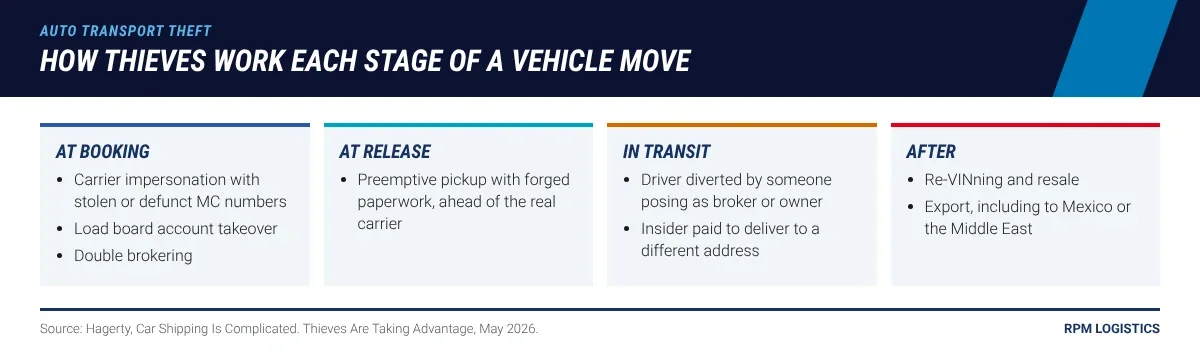
Most of these thefts are decided at booking and release, long before a truck reaches the highway, which is why paperwork checks stop more of them than locks do.
What is auto transport theft?
Auto transport theft is the loss of a vehicle during shipping to someone who has no right to it. It covers cars stolen from carriers, cars released to fake carriers, and cars diverted to the wrong address mid-trip. In most cases, nobody breaks a lock. The thief is handed the keys.
This is a form of strategic cargo theft, where fraud tricks shippers, brokers or carriers into giving a load to the wrong party. Strategic theft grew 1,500% between 2021 and mid-2025, according to the American Trucking Associations, as reported by Hagerty (2026).
The cars targeted are rarely cheap. Hagerty reported that the average vehicle stolen in these schemes is worth more than $200,000. U.S. losses run up to $35 million a year (Hagerty, 2026). Luxury SUVs, exotics and new high-line inventory are common targets.
For the wider cargo theft picture, see our cargo theft statistics for 2026.
Why are finished vehicles a target in transit?
Finished vehicles are a target in transit because they are valuable, easy to move and handed off many times. A new car can pass from a plant to a rail yard, a carrier, a dealer and a buyer within days. Every handoff is a chance for fraud.
Several features make vehicles attractive to thieves:
- They drive themselves away. A stolen car needs no forklift or trailer once it is released.
- They hold value. High-line vehicles resell quickly in the U.S. or overseas.
- They can be re-identified. A stolen car can be given a cloned VIN and sold as legitimate.
- The market is fragmented. Many loads move through brokers and online load boards to carriers the shipper never meets.
The scale of that market adds risk. Central Dispatch, one of the largest vehicle load boards, handled more than 17 million vehicles in 2025, according to Hagerty (2026). Most of those moves go smoothly. The size of the pool is what makes it worth a fraudster's time.
Ordinary vehicle theft is moving the other way. NICB data show U.S. vehicle thefts fell 23% in 2025 to 659,880. Transport fraud is growing even as street theft declines, which points to where criminals are shifting.
How do thieves steal vehicles from the transport chain?
Thieves steal vehicles from the transport chain mostly by exploiting trust between shippers, brokers and carriers. Hagerty's reporting describes the main methods, which map to the stages of a move.
At booking
- Carrier impersonation. Scammers bid on loads using stolen, purchased or defunct MC numbers.
- Account takeover. Phishing gives thieves control of a real company's load board account.
- Double brokering. A fraudulent company accepts the load, then re-brokers it to a real carrier that is later sent elsewhere.
Our explainer on what double brokering is covers the law and liability behind that scheme.
At release
- Preemptive pickups. Thieves arrive at a dealer or auction ahead of the real carrier, with forged paperwork.
This is a fictitious pickup, the most direct way to steal a vehicle from a lot. Our guide to stopping a fictitious pickup at the gate lays out the verification steps.
In transit
- Diversion. Someone posing as the broker or owner calls the driver and changes the delivery address.
- Insider conspiracy. A hired carrier is paid to deliver to a different address than the shipper gave.
After the theft
- Re-VINning and resale. The car gets a cloned identity and is sold to an unsuspecting buyer.
- Export. Hagerty reports stolen vehicles may be shipped to Mexico or the Middle East.
Re-identification is why a stolen car can vanish so completely. Our guide to what VIN cloning is explains how cloned cars slip back into the market.
Where in a finished vehicle's journey is the risk highest?
The risk is highest at release points, where custody changes and a vehicle can leave with whoever has the right paperwork. These include ports, rail ramps, plant lots, auctions and dealer lots.
Release point | Typical risk | Key control |
|---|---|---|
Port or rail ramp | Forged release paperwork, wrong carrier on site | Release only to the carrier named on the order, with ID checked |
Plant or upfitter lot | Early pickup before the real carrier arrives | Advance notice of driver, truck and trailer details |
Auction | Gate pass used by an unverified carrier | Match gate pass to the dispatched carrier and driver |
Dealer lot | Impersonation of a known transport company | Call back on a known number before release |
Delivery | Address changed in transit | Written confirmation of any change from a known contact |
For dealers holding high-value stock, our guide to supercar dealer inventory transport covers release discipline for six- and seven-figure units.
How can shippers verify a carrier before releasing a vehicle?
Shippers can verify a carrier by checking its authority, its contact details and its driver before any vehicle leaves the lot. The check takes minutes and stops most fraud schemes at the start.
- Check authority. Look up the carrier's USDOT and MC numbers in FMCSA's SAFER system and confirm the authority is active.
- Use known contacts. Call the carrier on a number from FMCSA records or a prior relationship, not one from the email or load post.
- Watch for recent changes. A new phone number, email domain or address on an older MC number is a warning sign.
- Get driver details in advance. Ask for the driver's name, truck and trailer numbers before pickup.
- Match at the gate. Check ID, truck and trailer against those details before releasing keys.
- Confirm the VIN. Record the VIN at pickup and match it again at delivery.
Carrier registration details can also be confirmed through FMCSA registration. For a full verification playbook against brokered fraud, see our guide on how to prevent double brokering.
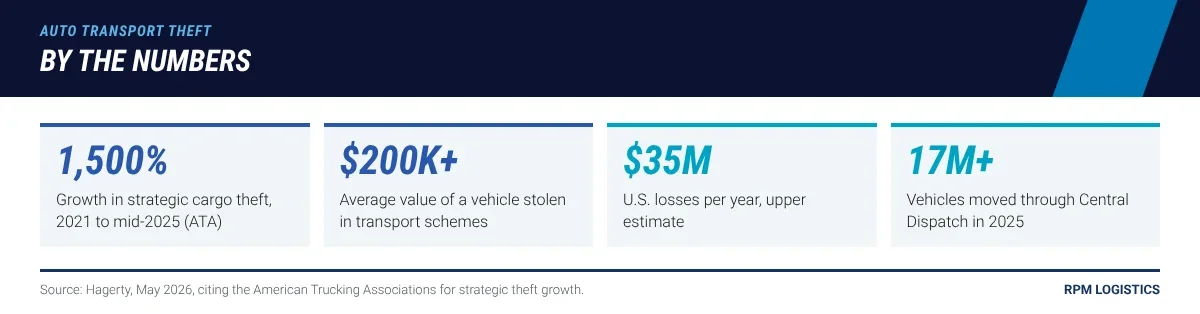
The loss total is small against the volume moved, but each theft is a six-figure vehicle, which is why targeting is so selective.
What red flags show up in a fraudulent booking?
Fraudulent bookings often show warning signs before any vehicle moves. Training staff to spot them is one of the cheapest defenses a shipper or broker has.
- A rate well below the market for the lane, offered to win the load quickly.
- Contact details that do not match FMCSA records, such as a new email domain or mobile number.
- Pressure to release early, before the scheduled pickup window.
- Last-minute driver or truck changes with no clear reason.
- Requests to change the delivery address by text or phone, mid-trip.
- Paperwork with small errors, such as a misspelled company name or mismatched MC number.
One red flag is not proof of fraud. Two or more on the same load are a reason to stop and verify before releasing a vehicle. Our overview of freight fraud in 2026 covers how these schemes have changed.
How can dealers and auctions reduce their exposure?
Dealers and auctions reduce exposure by treating vehicle release as a controlled step, with the same check every time. Most thefts at release succeed because one person, under time pressure, skips the check once.
Practical controls include:
- Written release rules that name who may approve a release.
- Advance carrier notice, so the gate knows which driver and truck to expect.
- ID and truck checks against that notice, logged for every release.
- Call-backs on known numbers when anything does not match.
- Key control, so keys are released only after the checks pass.
- Photo records of the driver, truck and vehicle at release.
These steps add minutes per vehicle. They also create a record that helps police and insurers if something still goes wrong. For auction-specific practice, see our guide to auction vehicle transport.
What should you do if a vehicle disappears in transit?
If a vehicle disappears in transit, act within hours, not days. Stolen vehicles can be re-identified or exported quickly, and early reports give police and recovery teams the best chance.
- Contact the carrier and broker on known numbers and ask for the driver's location.
- Report the theft to local police with the VIN, plate, description and pickup details.
- Notify your insurer and the vehicle's owner or lienholder.
- Preserve records, including emails, load posts, rate confirmations and gate logs.
- Alert release points so the same scheme cannot be used on other vehicles.
Speed matters because thieves often run the same scheme on several loads. Sharing details with your network can stop the next theft.
Keep a simple incident log template ready before you need it. Fields for VIN, carrier, broker, driver, pickup time, last contact and police report number save time when every hour counts.
How do insurance and liability work when a car is stolen in transit?
Insurance and liability for a car stolen in transit depend on who had custody and what each party's policy covers. A carrier's cargo insurance may cover theft while the vehicle is in its care. Fraud cases are harder, because the vehicle may have been handed to a party that was never a legitimate carrier.
Questions to settle before a move, not after:
- Cargo coverage limits per vehicle and per load, compared with the vehicle's value.
- Exclusions for fraud, false pretenses or release to an unauthorized party.
- The owner's own policy, which may cover theft in some cases.
- Who verified the carrier, since a release to the wrong party can shift liability.
Collector and high-value owners should review coverage with their agent. Our guide to high-value freight security matches controls to cargo value tiers, and our cargo theft prevention playbook covers program-level defenses.
Does enclosed transport reduce theft risk?
Enclosed transport reduces some theft risk, but it does not stop fraud. A closed trailer keeps a vehicle out of sight at truck stops and in traffic, so opportunistic theft is less likely. It does nothing if the vehicle was released to the wrong carrier in the first place. Treat enclosed equipment as one layer, alongside carrier verification, release controls and VIN checks at both ends.
How RPM approaches vehicle transport security
RPM Logistics moves vehicles for OEMs, dealers, remarketers, fleets and collectors across all 50 states and Canada. A network of more than 15,000 active carriers handles those moves.
Every move includes photo condition reports at pickup and delivery. Shippers can ask for driver, truck and trailer details ahead of pickup to run the gate checks above. For high-value moves, enclosed transport keeps vehicles out of public view. Learn more on our enclosed transport page.
Frequently asked questions
How do cars get stolen during auto transport?
Most are stolen through fraud. Common methods include carrier impersonation, double brokering, load board account takeovers, early pickups with forged paperwork and diversion of the driver mid-trip.
What kinds of vehicles are stolen from transport most often?
High-value vehicles such as luxury SUVs, exotics and new high-line inventory. Hagerty reported the average vehicle stolen in these schemes is worth more than $200,000.
How can I tell if a car carrier is legitimate?
Look up its USDOT and MC numbers in FMCSA's SAFER system and call it on a known number. Get driver, truck and trailer details before pickup, then match them at the gate.
What is a fictitious pickup?
A fictitious pickup is when a thief poses as the assigned carrier and collects a load with forged or stolen paperwork. The thief often arrives before the real carrier.
Is auto transport theft increasing?
Strategic cargo theft, which includes vehicle transport fraud, grew 1,500% between 2021 and mid-2025, according to the American Trucking Associations as reported by Hagerty.
What should I do if my car is stolen during shipping?
Contact the carrier and broker on known numbers, report the theft to police with the VIN, notify your insurer and preserve all booking records. Act within hours.