

Quick Answer
Finished vehicle theft at fixed nodes is the theft of new vehicles, or parts from them, while they sit at ports, rail ramps and storage compounds. Exposure grows with dwell time. The strongest controls are tight key custody, daily VIN reconciliation, short dwell and a verified release at the gate. Fences alone have not stopped organized crews.
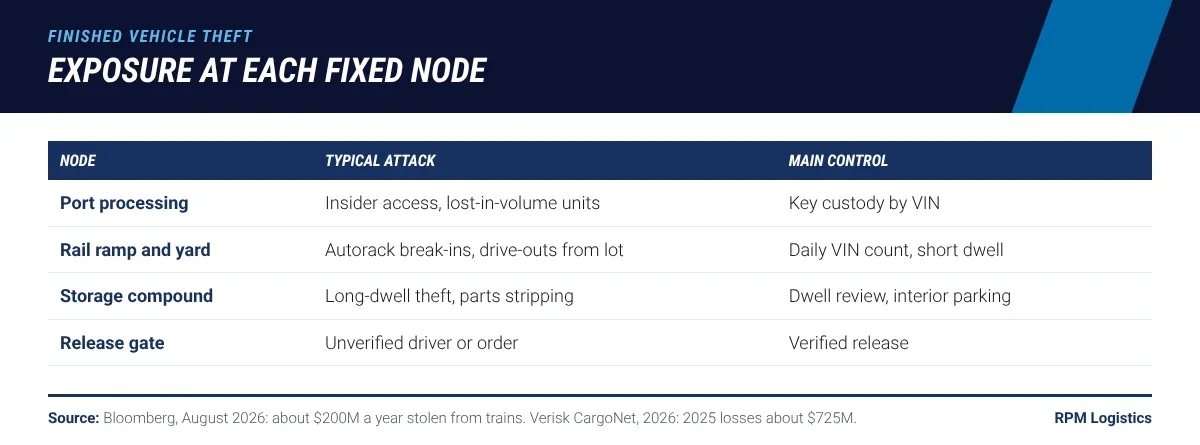
Each node has its own attack pattern. The common thread is time: the longer a vehicle sits, the longer it is a target.
Why Fixed Nodes Are the Target
A new vehicle spends most of its trip to the dealer standing still. It waits at the port after discharge, at a rail ramp after the train arrives and at a compound before final-mile delivery. Every one of those stops concentrates hundreds or thousands of high-value units in one place.
That concentration is what draws organized theft. The value per unit is high. The new-vehicle average transaction price hit a record $51,109 in October 2026 (Cox Automotive, November 2026). Full-size pickups averaged $67,912 (Cox Automotive, November 2026). A lot holding 500 units can carry well over $25 million in inventory.
This article covers physical theft and break-ins at those fixed nodes. Fraud during the handoff, such as fake carriers and spoofed pickups, is a separate problem. RPM covers it in its guide to auto transport theft.
How Big the Problem Is
Hard numbers on finished vehicle theft are scattered. No single source tracks every node. The figures that do exist point the same way:
- Theft from trains costs about $200 million a year across all freight (Bloomberg, August 2026).
- U.S. cargo theft losses reached about $725 million in 2025, with an average theft value of $273,990 (Verisk CargoNet, 2026).
- The median value of vehicles stolen in transit was about $80,000, and three in four were model year 2024 or newer (Super Dispatch data reported by Forbes).
The FBI has publicly described crews breaking into autoracks that carry new vehicles. Breaking into a carrier facility or rail car with intent to steal is a federal crime under 18 U.S.C. § 2117, with a penalty of up to 10 years. RPM tracks the wider trend in its cargo theft statistics for 2026.
Where Theft Happens and How
Ports
Port processing areas hold vehicles after discharge and before inland moves. The risk is a mix of insider access and volume. Thousands of keys, many workers and fast turnover make it easy to lose track of one unit. See RPM's overview of port-to-dealer finished vehicle logistics for how vehicles flow through these sites.
Rail ramps and rail yards
Rail yards are large, hard to patrol and often next to public roads. Theft here takes two forms. Crews break into autoracks on stopped trains, or they enter the ramp lot and drive units out. In Philadelphia, three new Hyundais were taken from a CSX yard in 2022 (Fox 29, 2022). In Shreveport, local station KTBS reported five new vehicles stolen from a fenced yard topped with razor wire.
Storage compounds
Compounds hold vehicles for days or weeks while they wait for trucks, dealer capacity or processing. Long dwell is the main risk. A unit that sits for three weeks is exposed for three weeks. RPM explains compound workflows in its guide to vehicle compound management.
Parts and break-ins
Not every theft takes the whole vehicle. Crews strip wheels, tires, catalytic converters and electronics from units in yards. A stripped vehicle still costs the OEM a repair, a delay and a delivery to a waiting customer.
Why Fences Are Not Enough
Perimeter fencing slows casual theft. It does not stop a crew that has studied the site. The Shreveport case shows the gap. A fence with razor wire still lost five vehicles.
Organized crews look for the weakest control, not the strongest. Common weak points:
- Keys left in vehicles or stored on open boards.
- Gates that release vehicles on a phone call or a name.
- Inventory counts done weekly instead of daily.
- Units parked near the fence line or out of camera view.
- Night shifts with fewer staff and more ground to cover.
Fixing these takes process more than hardware. That is good news for shippers. Process changes cost less than a new fence and they work at every site.
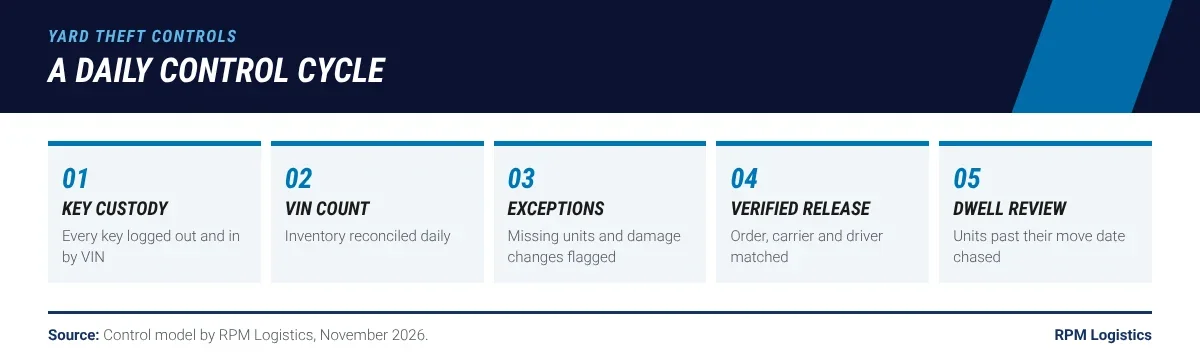
A daily cycle catches a missing unit in hours, not at the next weekly count.
Dwell Time Is the Exposure Multiplier
Dwell time is the number of days a vehicle sits at a node before it moves on. It is the one theft factor a shipper can plan around. Fences, lighting and guards stay the same from day to day. Dwell changes with every booking decision.
Think of exposure as unit-days. A compound holding 400 vehicles for an average of 4 days carries 1,600 unit-days of exposure each cycle. Stretch the average to 12 days and the same volume carries 4,800. Nothing about the site changed. The risk tripled because the vehicles waited longer.
Long dwell usually has plain causes. Outbound trucks are booked late. A dealer cannot accept delivery. A unit waits on a repair or a hold that nobody is chasing. Each cause has an owner, and each one can be tracked. Yards that report dwell by VIN, not just by average, find the units that have been forgotten.
What to Do When a Unit Goes Missing
Speed matters more than anything else in the first hours. A stolen new vehicle can be moved, stripped or re-VINned quickly. A clear response plan helps:
- Confirm the count. Recheck the row, the overflow area and any recent moves before you call it a theft.
- Check the key log. Find who last had the key and when.
- Review the gate record. Match every release in the window to an order and a verified driver.
- Report fast. Notify the vehicle owner, file a police report with the VIN and alert the carrier network.
- Fix the gap. Treat each loss as a test of the controls and close whatever failed.
Controls That Shrink Dwell-Time Theft Exposure
- Key custody by VIN. Store keys in a locked system, log every key out and back in, and tie each key to a VIN and a person.
- Daily VIN reconciliation. Count every unit against the expected inventory each day. A missing VIN found the same day is easier to recover.
- Verified release at the gate. Release vehicles only against a confirmed order, a verified carrier and a matching driver.
- Short, planned dwell. Book outbound trucks before units arrive so they move on, not sit.
- Interior parking for high-risk units. Park the most stolen models and highest-value trims away from fences and gates.
- Exception reporting. Flag any unit that misses its planned move date or shows a damage change between counts.
Gate verification deserves its own focus. RPM's guide to fictitious pickup gate verification walks through what a release check should confirm.
VIN Records as a Recovery Tool
A clean VIN record helps after a theft as well as before. Federal rules require some vehicle lines to carry the VIN on major parts. The Federal Motor Vehicle Theft Prevention Standard in 49 CFR Part 541 sets those marking rules. Marked parts are harder to resell and easier to trace.
Stolen vehicles are also used in VIN cloning, where a thief puts a legitimate VIN on a stolen unit. Yards can catch mismatches early by decoding each VIN at intake with NHTSA's VIN decoder and comparing the result to the unit's make, model and year.
What Shippers Can Ask of Transport Partners
OEMs and fleet owners do not run every node, but they choose who moves vehicles out of them. Questions worth asking a transport partner:
- How do you verify a release before a driver leaves the gate?
- How do you document condition at pickup and delivery?
- How fast do you report a missing unit or a damage exception?
- How do you schedule pickups to keep dwell short?
RPM Logistics moves finished vehicles from ports, rail ramps and compounds in all 50 states and Canada. Its OEM vehicle logistics service covers outbound moves from these nodes. For wider freight security practices, see RPM's guides to cargo theft prevention and high-value freight security, and its overview of what counts as high-value freight.
Frequently Asked Questions
Where are new vehicles most often stolen before delivery?
Theft concentrates where vehicles wait: port processing areas, rail ramps and yards, and storage compounds. Long dwell, large inventories and many keys make these sites attractive to organized crews.
Do fences stop vehicle theft at rail yards?
Fences slow casual theft but do not stop organized crews. Station KTBS reported five new vehicles stolen from a fenced Shreveport yard topped with razor wire. Key control, daily counts and verified releases close the gaps fences leave.
What is the best control for finished vehicle theft at a compound?
Short dwell is the strongest single control, because exposure grows with every day a unit sits. Pair it with key custody by VIN, daily VIN reconciliation and a verified release at the gate.
Is breaking into a rail car a federal crime?
Yes. Breaking into a carrier facility or rail car with intent to steal falls under 18 U.S.C. § 2117. The penalty is up to 10 years in prison.
How does VIN reconciliation help prevent theft?
A daily VIN count shows a missing unit within a day. That speeds recovery and exposes control gaps quickly. Decoding VINs at intake also helps catch cloned or mismatched VINs.